Get Full Government Meeting Transcripts, Videos, & Alerts Forever!
Get email alerts on the Direct Admissions Expansion topic
No spam. Unsubscribe anytime.
Committee considers bill to expand Direct Admissions statewide by 2029; OHE and students describe benefits and implementation needs
Summary
Senate File 14-74 would expand Minnesota’s Direct Admissions program so every public high school participates by 2029. Supporters described increases in FAFSA completion, college enrollment and student confidence; state Office of Higher Education staff outlined technical, administrative and staffing needs and a fiscal note is pending.
Senate File 14-74, proposing statewide expansion of Minnesota’s Direct Admissions program by the 2029 school year, drew broad support from students, higher‑education advocates and the Office of Higher Education during a committee hearing. Committee members agreed to lay the bill over pending a fiscal note and further review.
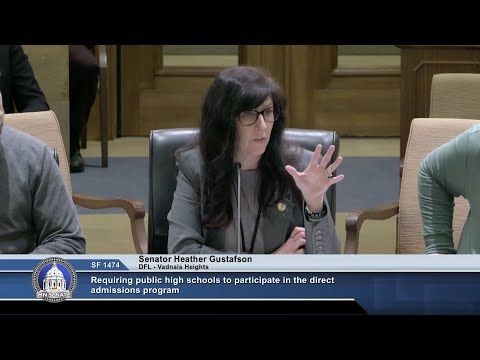
Direct Admissions proactively notifies high school juniors of postsecondary institutions where their current cumulative GPA meets automatic admission criteria; it also waives application fees for participating schools. Senator Gustafson, the bill’s sponsor, described the program as “an innovative college access program” that has increased FAFSA completion and college enrollment in participating schools and said the bill would help retain Minnesota students and bolster the state workforce.
Student witnesses said the program reduced stress and removed financial and informational barriers. “Knowing I was already college material freed me to focus on figuring out which school was best for me,” said Talia Treblehorn, a student at Minnesota State University, Moorhead, who testified she benefited from Direct Admissions in 2023. Karina Valada, a University of Minnesota student and mother who testified by video, described being a first‑generation student who would have benefited from such a program earlier.
Advocates and program leaders described measurable outcomes and the program’s broader supports. Matt Shaver, senior policy director at MED Allies, said Direct Admissions has produced higher FAFSA completion and enrollment rates where it’s implemented and argued that guaranteeing the program statewide will equalize access. Mike Dean of Northstar Prosperity urged an accelerated timeline but said the program helps retain local talent and bolster the workforce.
Implementation questions and staffing needs
Office of Higher Education (OHE) staff described the program components beyond the mailed letter: school events where students receive letters, parent information sessions, counselor professional development and outreach materials that explain FAFSA and financial aid. Wendy Robinson, Assistant Commissioner at OHE, noted the program includes technical and administrative back‑office work OHE performs, and cautioned that scaling should avoid overburdening high school counselors.
Aaron Salcek (listed in the record as Aaron Salzek/Salasic), Direct Admissions coordinator at OHE, outlined four scaling challenges: administration, communications, technology and fidelity of implementation. He told the committee that high school work to implement the program averages between about 40 and 80 hours in the first year (and substantially less in subsequent years), and that key technical tasks include transcript processes and data‑sharing agreements governed by student‑privacy rules.
OHE staff said they expect to scale to 100 additional high schools next year and that technology vendor variation across districts is a practical barrier: one vendor group that serves about 30 schools remained unconnected in the current cohort. The agency said it is working with the Minnesota Department of Education and technology partners to mitigate that issue.
Cost and staffing
Committee members pressed staff on costs. Robinson said OHE currently operates the program with a small team (about 1.5 full‑time equivalent staff dedicated to Direct Admissions) and that a fiscal note under development would request additional staff to support statewide scale. Robinson said an additional 1.5 FTE was under consideration to reach a sustainable staffing level for full statewide participation.
Senators voiced concern about imposing workload mandates on local districts before OHE and schools are able to scale implementation; several members asked for a local impact analysis or more detailed fiscal notes. The committee said it would hold the bill over to allow for those analyses.
What the bill would do
- Require participation of public high schools so every Minnesota senior receives Direct Admissions notification by 2029. - Waive application fees for participating institutions and provide a structured set of communications and supports to students and families.
Next steps
The committee laid the bill over and requested a fiscal note and additional implementation details from the Office of Higher Education. Members and witnesses emphasized balancing urgency to expand access with care to avoid imposing unfunded mandates on schools.
Ending note
Supporters framed the bill as a student‑centered access policy with measurable outcomes in FAFSA and enrollment; OHE staff and some lawmakers urged patience to scale equitably, pointing to data‑sharing, counselor workload and technology integration as points that require planned resources.