Get Full Government Meeting Transcripts, Videos, & Alerts Forever!
Get email alerts on the Hf500 Funding Amendment topic
No spam. Unsubscribe anytime.
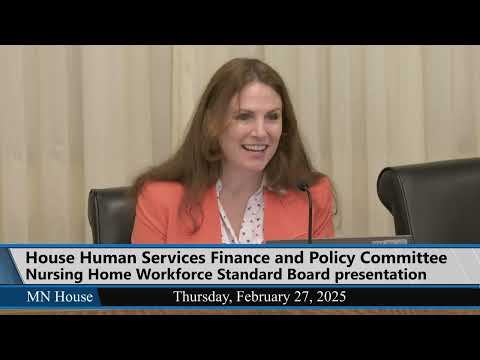
House committee adopts amendment requiring legislative funding for nursing-home mandates; HF500 re-referred to labor committee
Summary
The committee adopted a DE2 amendment to House File 500 that requires the Legislature to estimate and fully fund each nursing home’s cost before workforce standards could take effect, and re‑referred the bill to the Labor and Economic Development Committee by a 9‑7 roll call.
The Minnesota House Human Services Finance and Policy Committee on March 3 adopted an amendment (DE2) to House File 500 that bars nursing-home workforce standards from taking effect unless the Legislature first estimates each facility’s cost and fully pays that expense.
Representative Zalesnikar, the bill author and a retired nursing-home administrator who testified she has worked as a CNA and as an administrator, described House File 500 as an “insurance policy” to ensure legislative oversight and funding for mandates that providers say would otherwise threaten facility viability. The committee adopted the DE2 amendment by voice vote and later re‑referred House File 500, as amended, to the Committee on Labor and Economic Development, Finance and Policy after a roll-call motion, 9 ayes to 7 nays.
Representative Schumacher had earlier laid over House File 1419, a separate bill that would fund the workforce-board mandates and add annual updates to elderly-waiver rates; testimony at the March 3 hearing included supporters of that approach and proponents of HF500’s funding requirement.
Provider groups and operators who testified in support of HF500 as amended warned the Legislature that the nursing‑home workforce standards board’s two finalized rules — holiday pay and the proposed minimum wage standards — impose substantial upfront costs on facilities that operate on thin margins. Paxton Wiffler, chief operating officer at Monarch Healthcare, told the committee his organization estimated the holiday-pay mandate would cost its facilities about $1 million this year and said broad estimates place total statewide impacts in the hundreds of millions. Leaders from Care Providers Minnesota, LeadingAge Minnesota, Good Samaritan and Pioneer Care urged legislative funding for board mandates and annual elderly-waiver updates; several witnesses provided written estimates of facility-level impacts in the committee packet.
Representatives of labor and nursing-home staff opposed HF500. SEIU Minnesota State Council executive director Brian Elliott — one of the lead advocates for creation of the Nursing Home Workforce Standards Board — told the committee the standards board is a long-standing model in other states and gives workers and employers a forum to solve workforce problems. Elliott said the DE2 amendment is a step forward but that the bill as amended still fails to protect workers in facilities that have invested in wages and benefits. Multiple front-line workers testified they had seen improved staffing, morale and recruitment after board rules such as holiday pay and training requirements were adopted, and urged the committee to reject efforts to pause or eliminate standards.
Representative Zalesnikar and provider witnesses argued HF500 as amended preserves legislative control over spending and prevents mandates from taking effect without a funding plan. Opponents said withholding standards until appropriations are approved would punish facilities that have already invested in wages and benefits and could slow progress on addressing staffing shortages.
After public testimony and member remarks, the committee conducted a roll call. The clerk recorded the following final tally for the motion to re‑refer HF500, as amended: 9 ayes and 7 nays. The committee chair announced HF500, as amended, was re‑referred to the Committee on Labor and Economic Development, Finance and Policy. Committee members also laid over House File 1419 for possible inclusion in future omnibus language; that bill was presented by Representative Schumacher earlier in the hearing and proponents said it would fund the board mandates and institute annual elderly‑waiver rate updates.
Why this matters: HF500 as amended would block board standards from taking effect unless the Legislature funds each facility’s estimated costs. The decision shifts the timing and locus of budget responsibility to the Legislature and sets up a policy and budget discussion about how Minnesota will reconcile worker protections and wage mandates with provider fiscal viability.
Sources and evidence: testimony and remarks at the March 3, 2025 House Human Services Finance and Policy Committee hearing, including the bill presentation by Representative Zalesnikar and testimony from provider, union and worker representatives.