Get Full Government Meeting Transcripts, Videos, & Alerts Forever!
Get email alerts on the Nursing Home Workforce Standards topic
No spam. Unsubscribe anytime.
Nursing Home Workforce Standards Board outlines wage, holiday rules and waiver process to Minnesota House committee
Summary
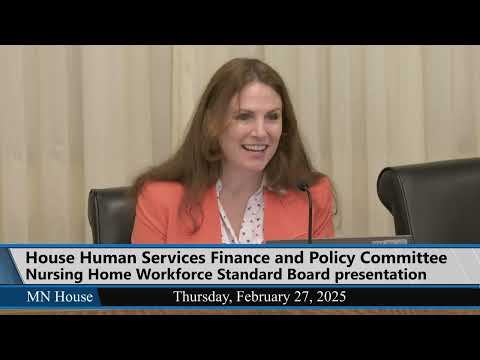
Leah Solo, executive director of the Nursing Home Workforce Standards Board, told the House Human Services Finance and Policy Committee the board adopted initial wage standards timed for 2026 (pending appropriation and federal approval) and holiday-pay and posting rules that took effect Jan. 1, 2025.
Leah Solo, executive director of the Nursing Home Workforce Standards Board, told the Minnesota House Human Services Finance and Policy Committee on March 3 that the board completed extensive public engagement and data analysis and has adopted two sets of rules: initial wage standards (earliest effective Jan. 1, 2026, pending legislative appropriation and federal approval) and holiday pay, posting and certified worker-organization rules that took effect Jan. 1, 2025.
The board was created by the 2023 Legislature and began meeting in August 2023. Solo told the committee the nine-member board (three commissioner or commissioner-designee seats and six governor-appointed members, split evenly between employer and worker representatives) held roughly 25 full-board meetings and about 48 work-group meetings during its first 16 months and staged five public forums and three online questionnaires to solicit input.
The board’s statute directs it to research market conditions and adopt minimum nursing-home employment standards that “meet or exceed existing industry conditions for a majority of nursing home workers,” a threshold Solo described to the committee as a “majority benchmark.” The board used Department of Human Services (DHS) data and other agency datasets to model how various minimum-wage options would affect the workforce and whether proposed standards met that majority benchmark.
DHS budget director Alyce Bailey told the committee the agency used the statutory methodology to compare the board’s holiday-pay standard to the current rate forecast. Bailey said DHS’s forecasted average rate growth is about 4.78% per year and that, using the required statutory calculations, the estimated cost of the holiday-pay standard is roughly a 0.655% increase — an amount DHS treated as within the value-based reimbursement (VBR) forecast and therefore not requiring an additional appropriation in the short term. Bailey cautioned, however, that changes to wage-related costs typically show up in rates with an 18-to-24-month lag because of how cost reporting and rate adjustments are processed.
Solo described the two rule sets the board approved on May 9, 2024. The first set — the initial wage standards — includes multi-step increases with a first step on Jan. 1, 2026, and a second step on Jan. 1, 2027, and sets separate rates for groups such as certified nursing assistants (CNAs), trained medical assistants (TMAs) and licensed practical nurses (LPNs) as well as a general minimum for other roles (dietary, housekeeping, laundry). Solo said those standards meet the majority benchmark the statute requires but emphasized they cannot take legal effect without legislative appropriation and federal approval where required.
The second set of rules — effective Jan. 1, 2025 — requires time-and-a-half holiday pay for 11 state holidays and includes posting requirements and rules governing certified worker organizations (entities that train workers on rights under the Nursing Home Workforce Standards Board Act). Solo listed the holidays covered by the rule as: New Year’s Day, Martin Luther King Jr. Day, Presidents’ Day, Memorial Day, Juneteenth, Independence Day, Labor Day, Indigenous Peoples’ Day, Thanksgiving, Veterans Day and Christmas.
Solo also briefed the committee on a waiver and variance process the board established for temporary relief if a facility would face closure or receivership from complying with a standard. She said the board set a deadline to accept such requests and that, as of two days before the March 3 hearing, “we haven't had any applications for a waiver variance from the standards.”
Committee members pressed the board and DHS on scope and fiscal assumptions. Representative Noor asked who counts as a nursing home worker; Solo read the statutory definition at Minnesota Statutes §181.211, which includes direct-care staff, non–direct-care staff and contractors who provide services in a nursing home, and explicitly excludes administrative staff, medical directors, physicians and staff employed by supplemental nursing services agencies. Noor and others asked whether subcontractors and IT workers, when working inside a nursing home, might fall under the definition; Solo replied contractors can be included, depending on the circumstances.
Members also asked whether the board consulted nursing-home administrators directly. Solo said the board’s outreach included five public forums (two virtual and three in person — Brooklyn Park, Duluth and Redwood Falls), roughly 224 forum attendees, three online questionnaires with about 200 responses, and employer and worker representatives on the board who brought supplemental data and employer surveys to work groups.
DHS staff described how the statutory cost-comparison process interacts with the VBR system. Bailey told the committee the VBR methodology is based on facility cost reports; because rate changes follow reporting, wage increases implemented Jan. 1 would typically be reflected in rates about 18 to 24 months later. For the holiday-pay rule DHS estimated a small percentage increase compared with forecasted rate growth and therefore did not request a separate appropriation for that component. For the minimum-wage standard, Bailey said the November forecast and the governor’s budget recognized that additional appropriation would be needed to implement the full minimum-wage mandate.
Board members, legislators and stakeholders raised questions about geographic representation on the board, how the board handled rural–metro wage differences, and whether the board’s expedited rule-making was appropriately transparent. Solo said the board considered geographic splits but opted for a single state-level standard to promote equity across Greater Minnesota and the Twin Cities, and described the board’s hybrid meeting practice that keeps at least one member physically at the Department of Labor and Industry offices as required by open-meeting law.
Why this matters: the board’s standards would alter wages and benefits across Minnesota’s long-term-care workforce and interact directly with the state’s reimbursement system and budget process. The committee’s questions focused on timing (when costs will show up in rates), scope (who counts as a nursing home worker), and the need for legislative appropriations to make wage rules effective.
The board materials, including a 14-page memo describing wage options and the majority-benchmark analysis, are posted on the board’s website, Solo said. The committee did not take formal action on the board’s rules during the hearing; its proceedings included the presentation by Solo and follow-up questions from members.
Sources and evidence: presentation and answers to committee questions by Leah Solo, Executive Director, Nursing Home Workforce Standards Board; testimony from Alyce Bailey, Budget Director, Department of Human Services; public comments summarized by Solo during the March 3, 2025 committee hearing.