Get Full Government Meeting Transcripts, Videos, & Alerts Forever!
Get email alerts on the Data Centers Tax Exemption topic
No spam. Unsubscribe anytime.
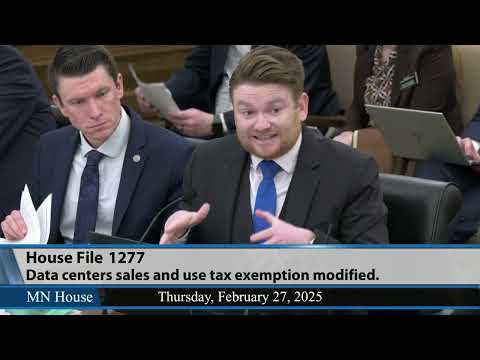
Committee hears competing claims over HF1277’s shift of data‑center tax rebate to point‑of‑sale exemption
Summary
The Minnesota House Taxes Committee heard testimony on House File 1277, a proposal to create a new “large‑scale data center” category and convert portions of the state’s refund‑based sales‑tax rebate for data‑center equipment, software and electricity into an upfront point‑of‑sale exemption for qualifying projects.
The Minnesota House Taxes Committee heard testimony on House File 1277, a bill that would create a new “large‑scale data center” category and convert portions of the state’s current sales‑tax rebate for data‑center equipment, software and electricity into an upfront point‑of‑sale exemption for qualifying projects.
Supporters told the committee the change would make Minnesota more competitive for large capital investments and free up private capital, while opponents warned the change would obscure program costs, increase pressure on the state’s energy and water systems, and shift the fiscal burden onto Minnesota taxpayers.
House Research staff described the bill as expanding the existing sales‑and‑use tax exemption for qualifying data‑center equipment, software and electricity to cover a new class of “large scale data centers.” The bill would create specifications and a certification process administered by the Department of Employment and Economic Development for projects to qualify. It also specifies that a current exemption expiration date of July 1, 2042 applies to existing qualifying and qualified refurbished data centers but not to the new large‑scale category proposed by HF1277.
Proponents’ case
Barbara Comstock, representing NetChoice, told the committee states that adopted long‑term certainty for data centers attracted major investment and local tax revenues, citing Virginia as an example. Comstock said, “this is nearly a $100,000,000,000 market, bigger than manufacturing, telecom, or any other industry,” and argued that Minnesota should offer similar long‑term certainty to capture large projects.
Bart McClellan, general counsel for NetChoice, said the change is one of timing rather than substance and argued Minnesota already grants many up‑front exemptions to other capital‑intensive industries. He warned against “discriminating against a particular industry,” which he called “a poor public‑policy decision.”
Labor and utility representatives also supported the bill. Andy Campbell of the Minnesota Pipe Trades Association and Joel Johnson of the IBEW State Council said large data‑center construction produces sustained hours for union trades during buildouts and some ongoing maintenance jobs afterward. Zack Martin of Minnesota Power told the committee the bill’s $250 million investment threshold for the new category targets “large scale” projects and said the measure would help Minnesota compete with neighboring states that have amended tax treatment for data centers.
Opponents’ concerns
Environmental groups, labor coalitions and advocacy organizations opposed HF1277 or its conversion of the current rebate into an upfront exemption. Aaron Lehi of the Minnesota Center for Environmental Advocacy said, “HF1277 makes the problem of accountability for supersized mega data centers worse by converting the current rebate into a point of sale exemption,” and urged clearer Minnesota standards on energy, water and material impacts.
Ivanna Stark of Clean Water Action said data centers consume “huge quantities of water” and use chemicals in cooling and maintenance that raise local risks; she added, “Giving billionaires more tax breaks when average Americans are struggling to buy basic necessities isn’t the answer.” Patty O’Keefe of Vote Solar said the bill removes a transparency safeguard and warned the exemption has already grown dramatically in recent years.
Several witnesses focused on transparency and fiscal tracking. Minnesota Association of Professional Employees’ Tanner Fritzinger and coalition representatives urged retaining the refund model because refunds require documentation and allow the Department of Revenue and the legislature to see the program’s annual cost. Fritzinger noted that the program’s estimated cost has risen substantially from initial estimates in 2011.
Policy details discussed
- The bill would create a large‑scale data‑center category with qualifying thresholds (testimony described a construction/software investment threshold of at least $250,000,000 in a 60‑month period and a minimum footprint referenced in committee discussion). - Under current law qualifying data centers may seek refunds after paying sales tax up front; HF1277 would allow certain large projects to avoid paying the tax at purchase (point‑of‑sale exemption). Committee staff and witnesses discussed that refund‑based claims provide an audit trail for the Department of Revenue, while an exemption reduces direct documentation of annual program costs. - Department of Employment and Economic Development (DEED) certification for qualifying projects was described as part of the proposed oversight process.
Economic and fiscal testimony
Proponents pointed to job creation during construction and some ongoing maintenance positions after buildout; they cited examples of capital investment and local tax receipts from other states. NetChoice testimony cited Virginia data on capital investment and local revenue and said changes to timing of tax treatment were necessary to attract hyperscale projects.
Opponents and budget advocates warned that the exemption’s cost has risen far above early estimates and would likely grow with more projects, creating tradeoffs with schools, health care and other services. Witnesses cited estimates presented in testimony ranging from tens of millions to hundreds of millions of dollars in annual cost under current law and argued the bill would remove an important line of sight into program size and fiscal impact.
Environmental and utility concerns
Multiple testifiers urged the committee to consider impacts on electricity demand, the state grid, and groundwater. Several witnesses said Minnesota should condition incentives on demonstrable energy sourcing, water‑use plans, and local permitting safeguards rather than convert to a less transparent mechanism.
Committee action
The committee heard extended oral testimony from proponents and opponents and asked clarifying questions. No vote was recorded on HF1277 at the hearing. The chair indicated the bill would be laid over for possible inclusion on a future agenda.
The committee hearing assembled evidence from business, labor, environmental and fiscal advocates; it did not adopt formal legislative changes at this meeting and left key decisions—timing of tax treatment, oversight mechanisms, and environmental conditions—for further consideration.