Get Full Government Meeting Transcripts, Videos, & Alerts Forever!
Get email alerts on the Renewable Waste Management topic
No spam. Unsubscribe anytime.
House committee advances bill to limit wind and solar waste, adopts technical amendments
Summary
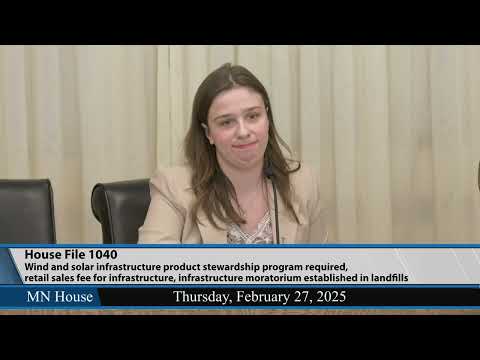
The House Energy and Finance Policy Committee on March 3 advanced House File 1040, a bill requiring producers and sellers to account for end-of-life management of wind and solar equipment and banning disposal of some components in landfills.
The House Energy and Finance Policy Committee on March 3 advanced House File 1040, a bill requiring producers and sellers to account for end-of-life management of wind and solar equipment and banning disposal of some components in landfills. Representative Scott, the bill author, moved the measure to the Environment and Natural Resources Committee after the committee approved technical oral amendments.
Representative Scott said she first introduced a version of the bill in 2014 and described local cleanup costs from earlier renewable-energy waste problems. "I didn't want that happening in other people's communities," she said, citing a local cleanup that she said cost taxpayers more than $20 million and pointing to large piles of retired wind blades visible near Interstate 35 in Iowa.
The bill sets up a product-stewardship framework patterned on existing programs such as paint stewardship. Under language discussed in committee, the measure would allow producers to submit stewardship plans for approval by the Minnesota Pollution Control Agency (MPCA); after commissioner approval, vendors would begin collecting an assessment added to the sale price to finance recycling or other end-of-life management. Representative Scott described an explicit landfill moratorium in the bill's final pages: "the moratorium on disposing of wind and solar infrastructure into landfills or mixed municipal solid waste," she said.
Kurt Koudelka, assistant commissioner at the Minnesota Pollution Control Agency, told the committee the MPCA supports product stewardship goals and recently completed a legislatively commissioned report on solar end-of-life management. "We support the recommendations in the report," he said, and offered to engage stakeholders further on implementing the report's proposals.
Industry and environmental stakeholders agreed on the goal of keeping panels and blades out of landfills but differed on whether a broad extended producer responsibility (EPR) model is the right near-term tool. Madeline Siriello, deputy director for siting and permitting policy at the American Clean Power Association, said the bill "pursues an inefficient and unnecessary policy model" and warned a one-size-fits-all fee could drive up project costs and, ultimately, customer bills.
EDF Renewables and other developers said they already arrange for recycling and prefer using existing permitting and decommissioning mechanisms. Adam Sokolsky of EDF Renewables described the bill as establishing an "inefficient quasi-governmental body" that would collect fees decades before many installations retire. He and other industry witnesses pointed to market solutions and ongoing technological and vendor developments for turbine-blade and panel recycling.
Conservation Minnesota and the Minnesota Solar Energy Industries Association (MNSEA) supported some bill components while urging a phased approach. James Lehner of Conservation Minnesota and David Moberg of MNSEA said they back a landfill ban and recommended adopting elements of the MPCA working group's report, including lowering the decommissioning threshold for mandatory recycling from the current utility-level standard to 1 megawatt DC and creating a central management organization for small installations.
Recyclers described current capabilities and growth in capacity. Nicholas Kane of Solar Cycle said glass is the largest material by weight in a typical crystalline silicon module and described efforts to recover and reuse glass and aluminum, while noting the industry is still scaling to meet peak, lumpy retirements decades from now. Committee members asked about existing capacity and proximity of recycling facilities; testifiers said capacity is growing and vendors in nearby states, including an Iowa recycler, are operating at scale.
Committee action and next steps: the committee approved technical oral amendments to renumber subdivisions and other drafting fixes and then approved Representative Scott's motion to refer House File 1040 to the Environment and Natural Resources Committee. The minutes of the committee's Feb. 25 meeting were approved earlier in the session. Committee members repeatedly urged Representative Scott to work with the MPCA and interested legislators to incorporate the working-group recommendations as the bill moves forward.
Why it matters: Minnesota legislators and stakeholders face a decision about how to manage future retirements of large-volume renewable infrastructure. Witnesses agreed officials should prevent panels and blades from entering landfills but differed on when and how to impose producer fees, with developers warning about costs and potential market effects and advocacy groups urging bans and lowered thresholds to spur local recycling markets.
The bill as amended will go next to the Environment and Natural Resources Committee for consideration of policy details and possible further amendments.