Get Full Government Meeting Transcripts, Videos, & Alerts Forever!
Get email alerts on the Campaign Finance topic
No spam. Unsubscribe anytime.
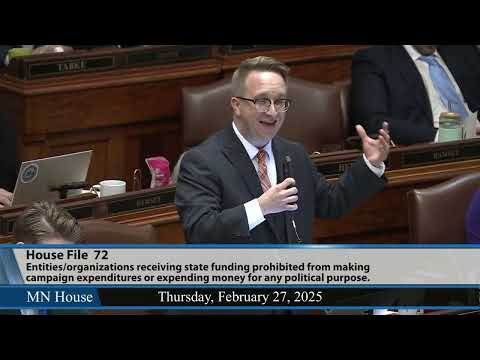
Minn. House passes bill barring state-funded entities from certain election spending
Summary
The Minnesota House passed House File 72, as amended, restricting organizations that receive state funding from making certain election-related expenditures; the measure passed 130–3 on third reading.
House File 72, a bill that would restrict entities that receive state funding from making certain expenditures related to elections, passed the Minnesota House on third reading as amended, 130–3.
The measure, offered by Representative Engin, would bar organizations that receive direct state appropriations or other state financial benefits from engaging in certain elections-related spending. "This is a dark money loophole," Representative Engin said, arguing the bill would "return political influence back to the Minnesota voters" by preventing state-funded entities from using those resources for election activity.
The bill’s author told members the bill addresses what she described as an "inherent and systemic conflict of interest" when nonprofit organizations that receive state aid can also spend on election-related activity. Engin said that in 2023 roughly $1.1 billion in state appropriations went to earmarked nonprofit organizations and that some of those entities have "statutory eligibility to donate directly to political groups."
Supporters and some members of both parties described the bill as a step toward limiting undisclosed or "dark" spending. Representative Greenman said the measure would give voters "the right to know who is spending" on independent expenditures, while Representative Coulter said public dollars "by any other name are still public dollars" and described the bill as a beginning of a broader conversation about large-scale political spending.
Several members urged clarification of terms. Representative Freiburg noted the bill "resides in chapter 211B, which does not define the term organization or the term entity or the term state funding," and told colleagues the bill "includes nonprofits, but it's not exclusive to nonprofits," which, she said, means it also could cover corporations. Freiburg and others discussed whether tax expenditures, grants or other forms of state financial benefit would be captured.
Repairs and clarifying amendments were offered during debate. Representative Engin offered an amendment that she said preserved a transparency element about separating private fundraising from state funds; that amendment was adopted. Two other proposed amendments discussed in committee were withdrawn by their sponsors after members said the bill’s language already achieved the intended scope.
Representative Engin also cited an example from the nonprofit sector when discussing the bill, mentioning that Second Harvest Heartland had posted a job listing for a voter engagement position and naming the organization’s CEO, Allison O’Toole, as context for her concern about nonprofits engaging in voter contact while receiving state funds. Engin framed the proposal as addressing conflicts regardless of political direction.
After debate, the clerk called the roll for third reading. The roll was closed with the result recorded as 130 ayes and 3 nays; the clerk announced that "the bill is passed as amended and its title is agreed to." Known recorded remote votes in the transcript include Gander and Hicks voting "aye." The final passage was recorded as an approval of House File 72 "as amended."