Get Full Government Meeting Transcripts, Videos, & Alerts Forever!
Get email alerts on the Dhs Dct Asset Preservation topic
No spam. Unsubscribe anytime.
DHS seeks $11.43M for state care facilities, $15M for St. Peter sewer; early-childhood facility grants detailed
Summary
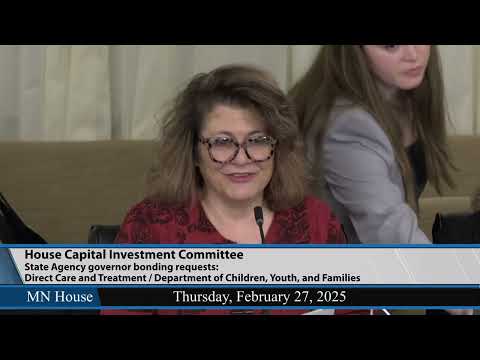
Nancy Freeman, chief operating officer for Direct Care and Treatment at the Minnesota Department of Human Services, told the House Capital Investment Committee on Feb. 27 that DCT needs $11,430,000 in bonding to keep state-owned, secure treatment facilities functional and safe.
Nancy Freeman, chief operating officer for Direct Care and Treatment (DCT) at the Minnesota Department of Human Services, told the House Capital Investment Committee on Feb. 27 that DCT needs $11,430,000 in bonding to keep state-owned, secure treatment facilities functional and safe.
Freeman said DCT operates specialized psychiatric hospitals, inpatient substance-abuse treatment facilities, group homes and vocational sites across “over 200 sites statewide,” and that agency-owned facilities total about 3,000,000 square feet. The division’s replacement value exceeded $1 billion and recent facility-condition assessments put deferred maintenance at “over $180,000,000,” Freeman said.
Nut graf: DCT said its facilities are both highly secure and intended to be therapeutic. The agency prioritized projects that include energy and operating savings and described a rolling need for about $30,000,000 per year to address critical preservation items in its 10-year plan.
St. Peter sewer request: Freeman told the committee the lower St. Peter campus drinking-water, sanitary and storm systems were built in the 1950s, have “far exceeded their useful life,” and an engineering analysis completed in 2018 recommended wholesale replacement. The governor’s request includes $15,000,000 to replace water main, sanitary sewer and storm infrastructure. The campus serves roughly 1,100 people (patients, clients and staff). Freeman said prior funding in 2023 included $1,050,000 for design and that the agency is ready to bid construction if funded.
Early childhood facilities grants: Shana Morse, legislative director for the Department of Children, Youth and Families, summarized the governor’s proposal for early-childhood facility grants. Morse said statute at Minn. Stat. § 142A.46 defines program parameters, that eligible facilities must be owned by the state or a political subdivision, and that statute and program rules cap most projects at $500,000 (with up to $2,000,000 for buildings housing multiple programs). Morse said the governor would lower the local match from 50% to 25% and that awards are issued through a competitive request-for-proposals process. The presentation said between 1992 and 2014 roughly $23 million supported 75 projects statewide and that a 2023 appropriation was $900,000.
Committee questions and context: Members asked about competitiveness, oversight and fraud risk in childcare grant programs; Morse and other DHS staff said earlier statute and program rules set eligibility and that grants for early-childhood facilities are limited to public owners or political subdivisions (which can partner with Head Start or licensed child-care programs). Committee member concerns about past fraud in childcare assistance were noted; DHS said the facility grants are structured under existing statute and that teams are working to reduce application barriers.
Ending: DHS said its asset-preservation projects also yield energy and operating savings, and that the St. Peter infrastructure replacement is intended to ensure 24/7 campus operation.