Get Full Government Meeting Transcripts, Videos, & Alerts Forever!
Get email alerts on the Data Centers Backup Generation topic
No spam. Unsubscribe anytime.
Committee advances bill to streamline local approvals for data-center backup generation amid debate over air, water and tax impacts
Summary
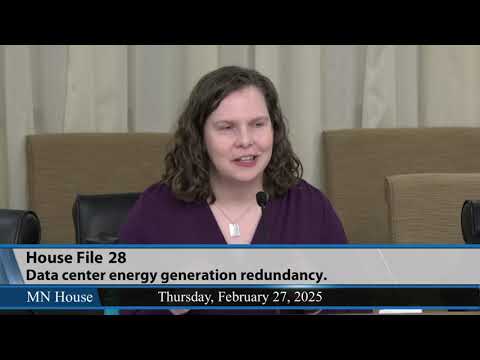
The Environment and Natural Resources Finance and Policy Committee on March 5 advanced House File 28, a measure clarifying how local alternative urban area‑wide reviews (AUARs) interact with state permitting and narrowing state review of large emergency backup generation at proposed data‑center sites.
The Environment and Natural Resources Finance and Policy Committee on March 5 advanced House File 28, a bill that would let local governments move forward with development covered by an alternative urban area‑wide review (AUAR) even while some state agency reviews continue, and would narrow state review of large emergency backup generation proposed at data‑center sites.
The committee adopted an A4 amendment, described by Catherine Neuschler, executive director of the Environmental Quality Board, as clarification “that the projects that are covered under an AUAR, and they're reviewed when that review is complete. That review is complete. And then the governmental permits and approvals can move ahead for those projects that are covered.” The amendment passed on a voice vote.
Why it matters: supporters say the bill gives towns and cities certainty when a local AUAR has already examined cumulative impacts, allowing construction and permitting for covered residential, commercial, warehousing and light industrial uses to proceed without repeating previous reviews. Opponents say the measure would short‑circuit state oversight of large combustion backup systems, increase pollution risks, and lock in fossil‑fuel solutions instead of newer storage or renewable options.
Supporters included local officials and business groups. Mark Kolbinger, mayor of Becker, described his city’s transition after the Sherco power plant retirement and urged support, saying House File 28 “supports local zoning control for those communities that have gone through the rigorous alternative urban area wide review process.” Becker city administrator Greg Leroux told the committee an AUAR is “a rigorous statutory environmental review planning tool” and argued the bill prevents duplicative reviews.
Labor and utility‑development voices also supported the bill. Joel Johnson of the IBEW State Council said siting data centers in Minnesota would produce construction and permanent jobs, and Joe Parkers of Native Sun urged the committee to allow a range of backup options, including battery storage, rather than limit policy to diesel generators.
Opposition focused on public‑health, environmental and fiscal concerns. Sarah Wolf of Minnesota Interfaith Power & Light and Patty O'Keefe of Vote Solar warned that diesel backup generators produce nitrogen oxides and particulate matter that disproportionately affect nearby communities. Peter Wagenis of Sierra Club North Star chapter and Ivana Stark of Clean Water Action said the state’s data‑center tax incentives and large water and energy demands have produced fiscal and environmental costs; Wagenis cited a figure from advocates that the state program has cost “over $350,000,000.” Sarah Meradian of CURE told the committee Amazon had asked the Public Utilities Commission to exempt proposed backup generation from certificate‑of‑need review and said the bill appeared to “end run” that process.
Committee discussion touched on distinctions between AUARs and project‑level environmental reviews. Neuschler and other witnesses said AUARs are limited to certain local development types and that projects triggering other mandatory review categories — for example, large water appropriations or power‑plant sized generation — still require separate agency review. Neuschler summarized: “AUARs also can only be conducted by local governments… anything else, any industrial facility that triggers any of the other mandatory categories for environmental review… needs to go through whatever other processes are relevant.”
Several members raised water‑use and public‑health questions for specific data‑center proposals in Becker, and Representative Lee Fisher moved to lay the bill on the table until water‑use details were provided; that procedural motion failed 6–7. Chair Heintzeman then moved to re‑refer the bill to the general register; the motion passed on a roll call, 7–6, sending House File 28 forward with the A4 amendment in place.
Actions and procedural record: Chair Heintzeman made the motion to move House File 28 in committee and also moved the A4 amendment; the A4 amendment was adopted by voice vote. A motion to lay the bill on the table failed on a roll call (6 yes, 7 no). A subsequent roll‑call motion to re‑refer House File 28 to the general register carried 7 yes, 6 no. The committee’s discussion and vote record are reflected in the minutes.
Next steps: with the A4 amendment adopted and the committee referring the bill to the general register, the bill proceeds in the House process. Committee members who requested further technical information said they expect additional conversations about water‑use permits, certificate‑of‑need authority, and whether battery storage or other alternatives should be explicitly enabled.
Votes at a glance: A4 amendment — adopted (voice vote). Lay on the table — failed (6 yes / 7 no). Re‑refer to general register — passed (7 yes / 6 no).