Get Full Government Meeting Transcripts, Videos, & Alerts Forever!
Get email alerts on the Subcommittee Votes Summary topic
No spam. Unsubscribe anytime.
Health and Government Operations subcommittee advances multiple bills in June voting session
Summary
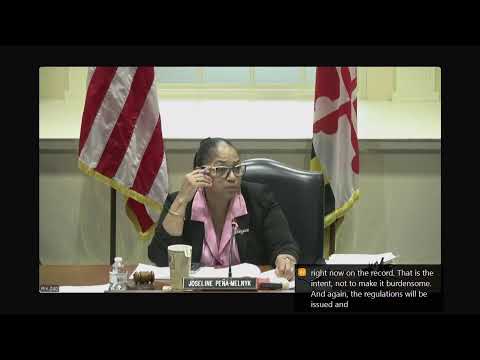
The Maryland House Health and Government Operations Subcommittee met in June for a voting session, approving a slate of bills (many with amendments) and moving others with recommendations to the full committee. Several bills were amended to create work groups, change reporting requirements or clarify procurement and licensing rules.
The Health and Government Operations Subcommittee convened in June for a voting session that cleared a broad set of bills — many “favorable with amendments” — and moved them to the full committee for further consideration.
Subcommittee members opened the meeting with a set of withdrawn bills and then took up individual items, voting largely by voice “aye” with few recorded objections. Several bills were narrowed in scope by amendments adopted in subcommittee, while others were converted to study or work‑group directives.
Votes at a glance (selection from the June session):
- House Bill 56 — local food procurement for school systems: Favorable with amendment; passed in subcommittee and recommended to the full committee. - House Bill 268 — hospital financial assistance and medical debt collection: Favorable with amendment; the subcommittee adopted amendments and the bill passed; several members declined to be listed as sponsors. - House Bill 334 — universal newborn nurse home‑visiting services: Amended to strike the program and instead create a work group to study existing programs and report by Dec. 31, 2025; passed as amended. - House Bill 406 — State Board of Examiners appointment and quorum provisions: Narrowed by amendment; passed as amended. - House Bill 420 — emergency use epinephrine terminology update: Favorable as secondary committee; passed with amendment to replace “auto‑injectable epinephrine” terminology where appropriate. - House Bill 507 — state contract prohibited provisions: Favorable; passed. - House Bill 508 — procurement preference for Blind Industries and Services of Maryland: Favorable; passed. - House Bill 514 — State Board of Chiropractic Examiners revisions: Favorable with amendment; passed. - House Bill 729 — opioid restitution fund authorized uses and overdose response training: Favorable with amendment; passed with an added amendment addressing socioeconomic disparities. - House Bill 820 — health insurance utilization review and AI use: Favorable with amendment (clarifying nondiscrimination); passed. - House Bill 848 — adverse decisions reporting and carrier examination authority: Favorable with amendment; passed. - House Bill 936 — cancellation and nonrenewal notice for small employer plans: Favorable with amendment; passed. - House Bill 939 — continuing care providers, alternate subscriber membership: Favorable with amendment; passed. - House Bill 939 (alternate bill number in packet) — Maryland Commission for Women collaborative on over‑the‑counter birth control coverage: Passed with amendment to authorize consultations with professional associations. - House Bill 1100 — public health equity data dashboard: Favorable with amendment (quarterly updates as data allow; “substance use” clarified from “abuse”); passed. - House Bill 1380 — minimum perinatal care standards for hospitals and birthing centers: Favorable with amendment; passed with several members recorded as not wanting to be listed on the bill.
Several bills were carried forward with clarifying amendments that narrowed scope, required additional coordination (for example between the Department of Health and state procurement or maternal‑health entities), or replaced programmatic mandates with work groups charged to study options and report back. A number of items passed unanimously in voice vote; where members were asked whether they wanted their names listed on bills, a handful declined to be listed as sponsors (the transcript records those declinations for specific bills).
The subcommittee paused after the voting session and planned to reconvene for bill hearings in the afternoon.