Get Full Government Meeting Transcripts, Videos, & Alerts Forever!
Get email alerts on the Committee Votes Roundup topic
No spam. Unsubscribe anytime.
Economic Matters Committee advances a package of consumer, licensing and housing bills
Summary
The committee moved favorably on a series of House bills covering THC product enforcement, consumer contract timelines, accountancy emeritus status, self‑storage rules, real estate continuing education, mortgage assumption in divorce and limits on medical debt in credit reports; several bills were withdrawn by sponsors.
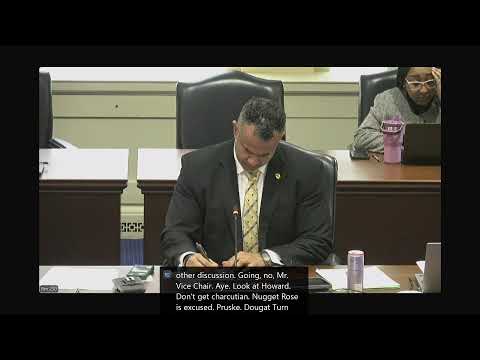
The Economic Matters Committee voted on a slate of House bills during a voting session that covered consumer protections, professional licensing changes and housing-related consumer rules.
Committee members first considered House Bill 12, a departmental bill that would strengthen enforcement against certain THC-containing products by authorizing the Alcohol, Tobacco and Cannabis Commission (ATCC) to seize, destroy or confiscate products that violate statutory or regulatory requirements and by permitting ATCC field enforcement to issue citations for specified THC violations. The committee moved the bill favorable after brief remarks and a roll call.
The committee also moved favorably a range of largely noncontroversial or technical bills, including House Bill 427 (allowing the State Board of Public Accountancy to place eligible licensees on emeritus status), House Bill 431 (prohibiting certain consumer contracts from shortening statutory timeframes for legal actions and removing criminal penalties in section 13‑411), and several bills related to self‑storage facility regulation and notice requirements (House Bills 968 and 979). The committee approved changes to continuing education requirements for real estate brokers and salespersons under House Bill 972 and advanced House Bill 1018, which would create a right to assume a mortgage in divorce proceedings. House Bill 1020, which would limit consumer reporting agencies from including some medical-debt information in consumer reports and bar using included medical-debt information for creditworthiness determinations, was moved as amended after discussion about the bill's definition of medical debt and how elective or cosmetic procedures are treated.
Many of the bills were accompanied by one-line summaries or staff clarifications during the session. On House Bill 1020, discussion focused on the bill's definition of medical debt and an amendment that narrows the definition to debt owed to an entity whose primary business is providing medical services, products or devices; committee members and staff noted that that change was intended to exclude ordinary credit-card charges that are not issued specifically for payment of health care services. On House Bill 1018, committee counsel explained enforcement authority and penalties, saying that “the commission may issue a cease and desist order, suspend or revoke the license of the violator, and or issue a penalty order against the person for up to $10,000 for a first violation and $25,000 for every subsequent.” That explanation was given in the course of discussing enforcement mechanics tied to licensing authority listed in the bill packet.
Several witnesses and interest groups were recorded in the committee file as having opposed or supported specific bills. The transcript records that two private citizens and the Maryland Cannabis Equity Collective opposed House Bill 12. The bankers association and the Maryland/DC creditors bar were listed as opposing House Bill 431 before its criminal penalties were removed. The Maryland REALTORS submitted support with an amendment on at least one housing-related bill, and the creditors bar provided language that was incorporated into an amendment for House Bill 1020. Committee members repeatedly described some items as technical or noncontroversial; sponsors withdrew unfavorable motions on a set of additional bills (House Bills 904, 1220, 12808, 1340, 1413, 14308 and 1458) by consent.
Votes at a glance (committee action and notable discussion): - House Bill 12: departmental THC enforcement bill — moved favorable after discussion; recorded public opposition from two private citizens and the Maryland Cannabis Equity Collective. - House Bill 427: State Board of Public Accountancy may grant emeritus status — moved favorable (no amendments). - House Bill 431: prohibits consumer contracts from shortening statutory legal timelines; sponsor amendment removed criminal penalties (section cited as 13‑411 in discussion) — moved as amended; opposition from Bankers Association and Maryland/DC Creditors Bar noted. - House Bill 968: excludes self‑storage facilities from the definition of storage warehouse — moved favorable. - House Bill 972: changes continuing education requirements for real estate licenses — moved favorable; lenders/realtors signaled support. - House Bill 979: requires notice to occupants before lien sale at self‑service storage facilities — moved favorable. - House Bill 1018: creates a right to assume a mortgage in divorce under certain circumstances — moved favorable after discussion about enforcement and penalty authority. - House Bill 1020: limits reporting of certain medical debt in consumer reports and prohibits use of medical-debt information for credit determinations — moved as amended; committee discussed definitions (elective vs. medically necessary procedures) and credit‑card treatment; amendment narrowed medical-debt definition to parties whose primary business is providing medical services, products or devices. - Withdrawn by sponsor (consent): House Bills 904, 1220, 12808, 1340, 1413, 14308, 1458.
Where the transcript records substantive committee discussion, this article summarizes that discussion rather than paraphrasing witness testimony. Several members asked detailed questions on definitions and retroactivity, particularly on House Bills 1018 and 1020. The session concluded with the committee accepting sponsor withdrawals and reminders about upcoming events.
The transcript does not include full, consistently formatted roll-call tallies for every vote; where the record states that “all present voted aye” or similar, that language is reported above rather than a numerical count.