Get Full Government Meeting Transcripts, Videos, & Alerts Forever!
Get email alerts on the Emergency Preparedness Registry topic
No spam. Unsubscribe anytime.
State registry for residents with access or functional needs explained to North Kingstown SELAC
Summary
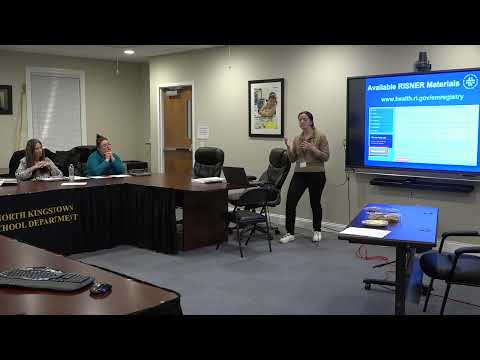
Mary Herman of the Rhode Island Department of Health briefed the North Kingstown Special Education Local Advisory Committee on the Rhode Island Special Needs Emergency Registry, known as RISNER, during the committee's meeting (date not specified).
Mary Herman of the Rhode Island Department of Health briefed the North Kingstown Special Education Local Advisory Committee on the Rhode Island Special Needs Emergency Registry, known as RISNER, during the committee's meeting (date not specified).
The registry is a free, voluntary statewide database managed by the Rhode Island Department of Health and used by emergency managers and first responders to identify residents with access or functional needs. "It's a free and voluntary statewide registry" Herman said, adding that municipalities identify a small number of users — typically police, fire, EMS or emergency management staff — who can access only their municipality's enrollments.
Committee members pressed for details about how the tool is used and what it can do. Dr. Rachel Santa, the district's director of student services, asked, "Who has access to it? Like, by ZIP code?" Herman replied that access is tightly controlled and limited to authorized municipal users and RISNER managers at the Department of Health, and that users can pull only the list for their ZIP code.
Herman described several RISNER features. If an enrolled person's phone number is used to call 911, the dispatcher's system will display the registrant's top three health conditions so responders can individualize their response. The registry also supports preparedness and response tasks — for example, mapping affected enrollments during localized flooding — and has been used by some municipalities for door-to-door wellness checks after outages. Herman cited a 2019 example in Newport where officials used the registry to check on residents after a citywide gas outage.
Enrollment is open to Rhode Island residents of any age who have chronic conditions, mobility or sensory needs, or other access or functional needs. Individuals may self-enroll or be registered by a caregiver with the enrolled person's consent. Herman noted that enrollment does not guarantee assistance: "Enrollment in RISNER does not guarantee assistance," she said. The registry is intended to be an information tool for local responders to use when allocating available resources.
The presenter reviewed how to enroll: by paper form (mailed to the Department of Health), by phone (ask for a RISNER manager) or online via the Department of Health website. Required fields for submission are name, date of birth, street address, phone number and a signed consent; additional medical or living-situation details are optional. Herman said the registry is HIPAA-compliant, uses encrypted devices and dual passwords, and provides access by ZIP code. Materials and forms are available in English, Spanish and Portuguese.
Committee members raised limits and implementation questions. A parent asked whether listing a medically vulnerable household would create priority snow-removal or public-works routing; Herman said the registry does not automatically cross-reference municipal public-works systems and that any such local practice would be a municipality-level decision. A question about whether a school nurse calling from a school phone would trigger the 911 dispatcher display received the answer that the display is tied to the phone number listed in the registry: if the school phone number is registered, that number would populate for the dispatcher.
Herman left contact information and paper brochures for committee members and said RISNER staff offer presentations and a "personal preparedness 101" session for communities.
Less urgent details: Herman said the registry has routine data cleaning and validation against vital records, a biennial mailing to encourage updates, and the option for enrollees to request removal at any time.
Clarifying details and local next steps were discussed but no formal action or municipal policy changes were taken at the meeting.