Get Full Government Meeting Transcripts, Videos, & Alerts Forever!
Get email alerts on the Signs topic
No spam. Unsubscribe anytime.
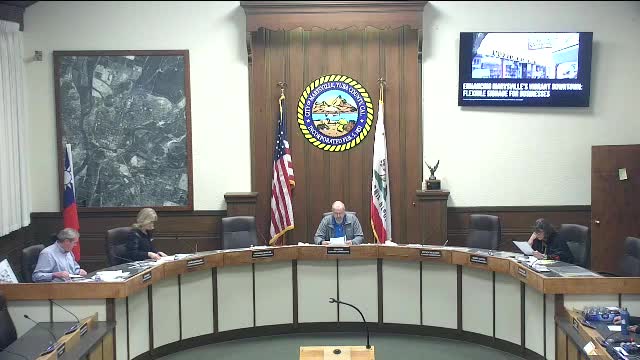
Planning Commission recommends council approve sign-ordinance changes to allow limited flexibility for murals and historic roof signs
Summary
The Marysville Planning Commission voted to recommend City Council approve an amendment to the sign ordinance to add case-by-case exceptions, clarify mural rules, and allow limited exceptions for historically themed roof-mounted signs.
The Marysville Planning Commission voted to recommend that the City Council approve an amendment to the city sign ordinance that would add case-by-case flexibility to existing sign exceptions, update rules for murals and allow limited exceptions for historically themed roof-mounted signs.
Planning staff said the proposed ordinance would modify the sign-exception section of the Marysville Municipal Code to permit moving allocated square footage among sign types on a parcel so long as total permitted area based on lot frontage is not exceeded. "It's a relatively simple ordinance" that would "allow flexibility" while keeping review by the Architectural Review Board or Planning Commission, staff said.
The proposal would also update the mural provision to be more content neutral. Staff noted the current code prevents murals that reference a business’s product or service (for example, scissors for a hair salon) and said that restriction risks running afoul of content-neutral sign law. "Signs and sign law in the U.S. has to be fairly content neutral," staff said, and the amendment would allow murals that reference the business while keeping overall square-footage limits.
After the staff report, Commissioner Brammer asked staff to add a specific exception to allow historically themed roof-mounted signs on a case-by-case basis; staff and the commission agreed to include that change in their recommendation to council. Staff said the change would allow a historically significant roof-mounted sign that might otherwise be prohibited unless grandfathered.
Commissioners discussed wording changes to the proposed ordinance, including replacing several instances of "may" with "shall" in sections that describe which body reviews exceptions so the code more clearly requires review and consideration by the Architectural Review Board or Planning Commission. Commissioners also asked staff to consider adding a formal definition of what qualifies as a "historic" sign so applicants and reviewers have a common standard.
Chair Deal opened the public hearing and asked for public comment; seeing none, the commission moved to a recommendation vote. A motion recommending City Council approve the ordinance as revised was made and seconded. The chair called for the vote and said, "All those in favor? Aye." The motion passed. The commission will send the recommended changes to City Council for final action.
Key provisions noted by staff and commissioners: - Exceptions to the sign ordinance would remain subject to Architectural Review Board or Planning Commission approval and must be in harmony with the surrounding area. - The amendment would permit reallocating permitted square footage across sign types on the same parcel so long as the parcel stays under the maximum allowed signage determined by lot frontage. - The mural provision would be revised to be content neutral so murals may include business-related imagery within the total permitted signage. - The commission directed staff to add or clarify definitions (including what constitutes a historic sign) and to refine permissive/mandatory language in sections describing review and approval.
The Planning Commission's recommendation will be forwarded to the City Council for its consideration; the ordinance is not yet adopted and will take effect only if council approves the amendment.