Get Full Government Meeting Transcripts, Videos, & Alerts Forever!
Get email alerts on the Behavioral Health Mobile Crisis topic
No spam. Unsubscribe anytime.
Marin’s county‑operated mobile crisis team faces staffing challenges and an estimated $2 million annual funding gap under state changes
Summary
Behavioral Health and Recovery Services staff told the Board the county operates a 24/7 mobile crisis response with about 15 FTEs, but that changes in state funding and Medi‑Cal program reforms have left an estimated roughly $2 million ongoing gap to sustain mandated services.
Michelle Funes, division director for Behavioral Health and Recovery Services, briefed the Board on Feb. 26 about the county’s mobile crisis program and the fiscal and operational pressures resulting from state reforms.
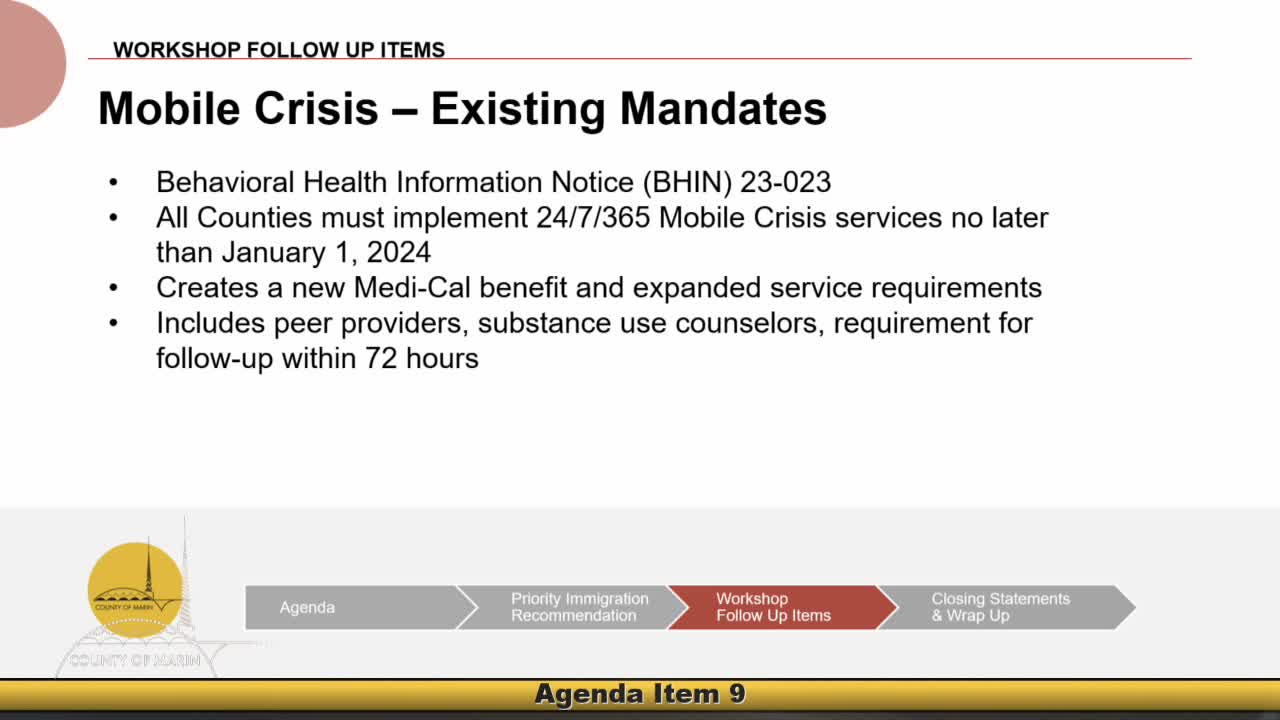
Funes said the county implemented a 24/7 mobile crisis service by Jan. 1, 2024, and currently staffs the team at roughly 15 full‑time equivalent employees (a mix of full‑ and part‑time). She said the program is connected to the county’s crisis stabilization unit and other continuum services and described operational metrics: nearly 3,500 calls in 2024, the majority arriving during daytime hours; an average internal time to dispatch of about 20 minutes; and an average call‑to‑scene interval variable by geography (the record referenced response time averages). Funes noted about 12% of field calls result in an involuntary hold and about 17.8% of calls involved some interaction with law enforcement (calls could involve law enforcement presence at various points, including referral or scene clearance).
Funes told the board that passage of Prop 1 and Behavioral Health Services Act reforms have created a funding gap and that the county faces approximately a $2,000,000 annual shortfall for the mandated level of service. She said staffing recruitment remains a longstanding challenge and that the county will pursue Medi‑Cal billing, grant opportunities and private insurance to offset costs. County staff described complementary “Safe Team” programs staffed by community providers (e.g., San Rafael’s SAFE team operated by Petaluma People Services) that handle lower‑acuity responses during high‑volume hours; Novato and Marin City are pursuing similar pilots.
Supervisors asked about the cost to spin up additional teams, coverage areas and whether cities would consider sharing costs for guaranteed response times. Funes said those details depend on team size, staffing mixes and geographic coverage and recommended further off‑line work to scope costs. The board did not adopt a funding action on Feb. 26. Funes and county executives said they expect to incorporate ongoing funding needs into budget planning ahead of May hearings.