Get Full Government Meeting Transcripts, Videos, & Alerts Forever!
Get email alerts on the Transportation topic
No spam. Unsubscribe anytime.
Comal County authorizes TCEQ owner form for Smithson Valley Road bridge project over Edwards Aquifer recharge zone
Summary
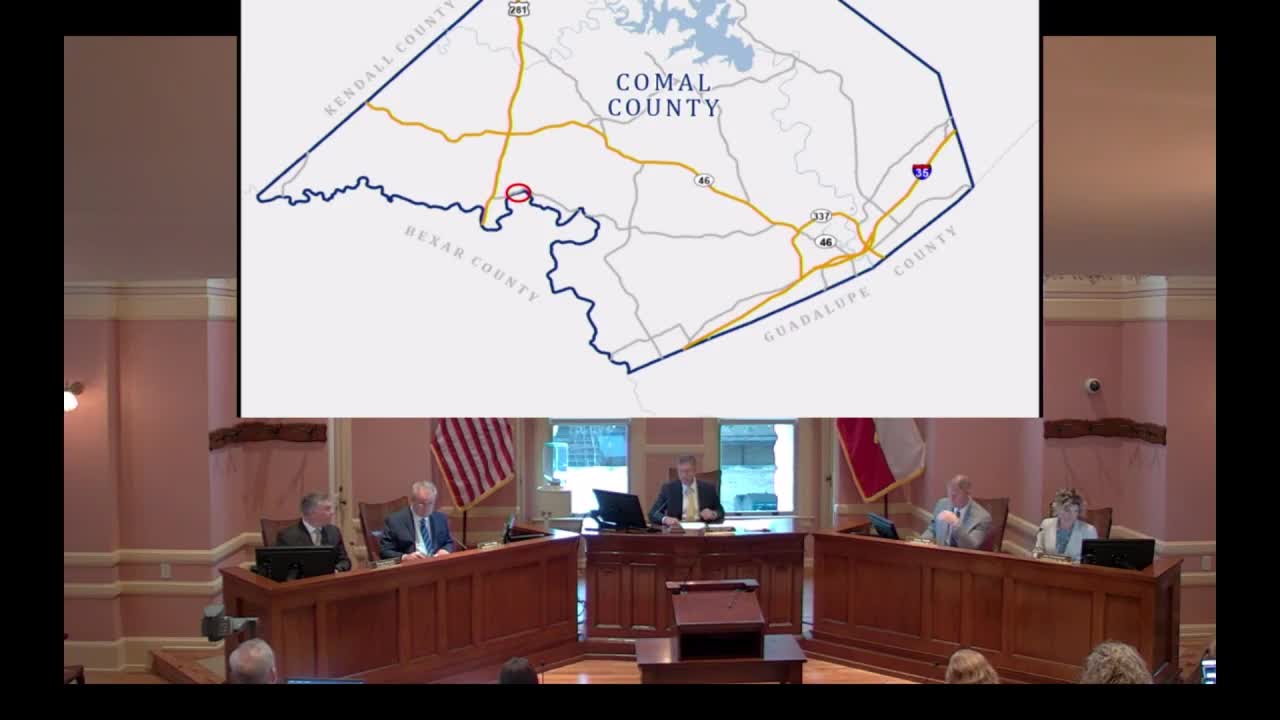
Comal County approved a Texas Commission on Environmental Quality owner authorization form so Bexar County can submit required water pollution abatement documentation and move the Smithson Valley Road bridge (low-water crossing) project to construction in 2025.
Comal County Commissioners Court voted to authorize the Texas Commission on Environmental Quality (TCEQ) owner authorization form for the Smithson Valley Road bridge project, enabling a partner county engineer to submit required applications so construction can proceed in 2025.
County engineers said the project, conducted in partnership with Bexar County, will relocate the low-water crossing north and tie into Farm-to-Market Road 1863. The speaker said the county recently acquired necessary land and that, because the site lies over the Edwards Aquifer Recharge Zone, a water pollution abatement plan is required.
The staff presentation said the action would specifically authorize Reggie Fountain, an engineer with Bexar County, to submit the TCEQ application and continue permitting so construction can begin in 2025.
“...it is located over the Edwards [Aquifer] Recharge Zone. So, it does require water pollution abatement plan,” the county presenter said.
Commissioners approved the TCEQ owner authorization by motion and voice vote. No budget transfer was required at the time of approval; the presentation described the item as permitting and authorization needed to proceed with construction and regulatory compliance.
The county indicated the project is part of a multi-year effort with partner jurisdictions to replace or relocate low-water crossings for safety and connectivity.