Get Full Government Meeting Transcripts, Videos, & Alerts Forever!
Get email alerts on the Public Services topic
No spam. Unsubscribe anytime.
Public Services proposals include automated trash truck to realign routes, WinReady changes and parking-authority maintenance
Summary
Public Services proposed acquiring a third automated refuse truck to advance automated routes and personnel reductions, planned WinReady route adjustments to move demand to on‑demand service, and parking-authority maintenance funded by parking revenues.
Public Services staff presented multiple department budgets and capital requests including refuse, streets, fleet, facilities and transit.
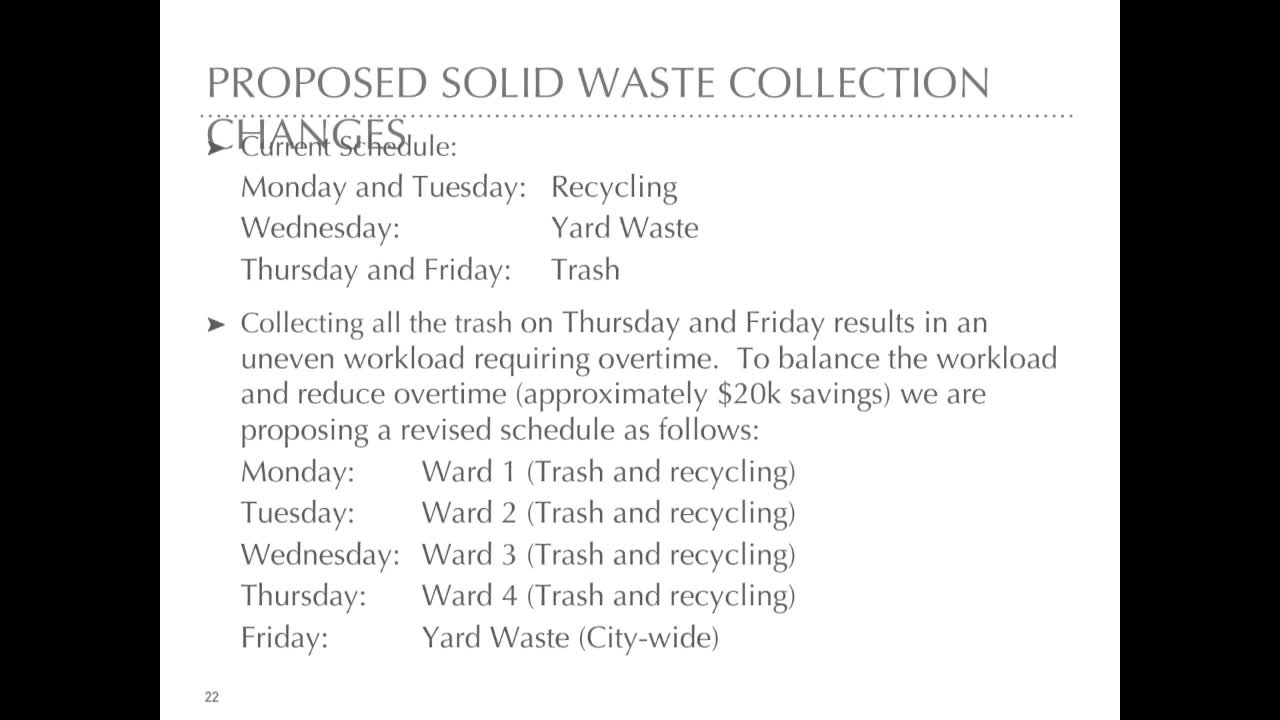
Refuse: staff described the transition to automated refuse collection that began three years ago and proposed replacing a refuse truck and adding a third automated truck. Staff said acquiring a third automated truck is the “tipping point” that allows the department to guarantee two automated trucks in service daily and thereby reduce one solid-waste collector position (and eliminate another in FY2027 when a new truck is delivered). The truck cost presented in the materials was $510,000; staff said the trucks are long-lived assets if well maintained.
Transit: staff detailed a net budget decrease for transit of roughly $251,000 driven by route adjustments and by shifting resources to WinReady, the city’s on-demand service. Staff said the fixed “loop route” will be removed because ridership has declined as riders migrated to WinReady; the change will reassign vehicles to WinReady and is intended to reduce wait times. Staff said WinReady and paratransit remain ADA-capable: paratransit is the appropriate service for riders with significant mobility needs and receives substantial federal funding.
Parking and facilities: the Parking Authority presented a budget funded by parking revenues and said a large chunk of projected maintenance and repair costs for the parking garage will be covered by parking receipts; the authority seeks to add a maintenance technician funded from parking revenue, not the general fund.
Why it matters: the refuse truck purchase would be a capital investment with recurring personnel implications (fewer collector positions over time). Transit changes shift service model from some fixed routes to on-demand service, with implications for bus-stop infrastructure and maintenance obligations. Parking Authority repairs will be funded from parking revenues and staff said the lines are self-supporting.
Committee guidance: staff said they could include the solid-waste truck in Option 2 at the committee’s direction; several committee members signaled support for placing the truck in Option 2 rather than only in the highest option.