Get Full Government Meeting Transcripts, Videos, & Alerts Forever!
Get email alerts on the Calaim Ecm Community Supports topic
No spam. Unsubscribe anytime.
Low utilization, local provider concerns cloud CalAIM ECM and community supports; advocates call for higher rates and standardization
Summary
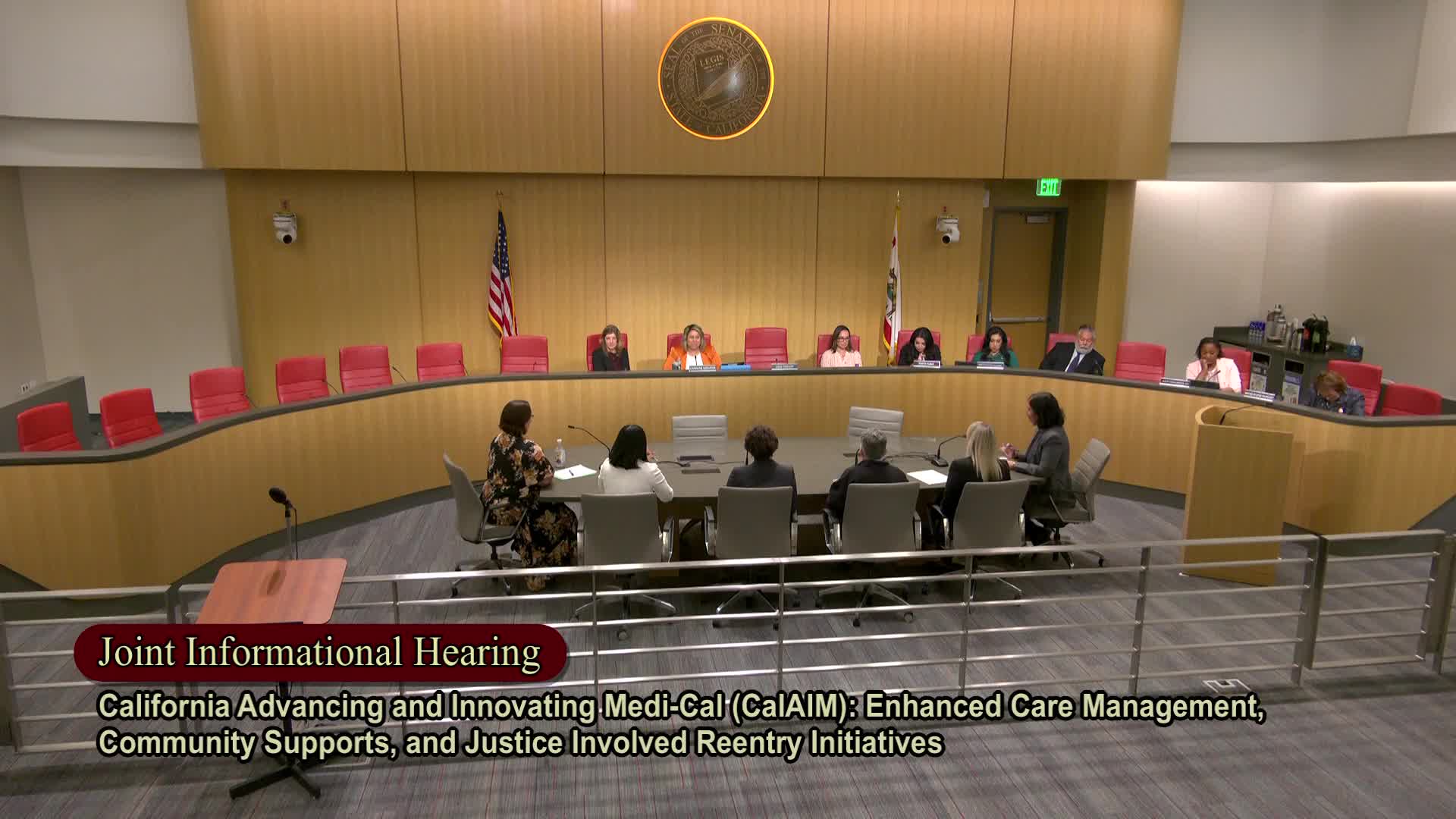
Three years after CalAIM launched enhanced care management (ECM) and optional community supports, presenters at a Senate hearing said utilization remains far below need, community-based providers face billing and contracting barriers, and assisted‑living and housing supports require clearer statewide operations and faster plan access.
Lawmakers and stakeholders told a joint Senate Health and Public Safety hearing that CalAIM’s enhanced care management (ECM) and community supports — services designed to coordinate care and address social drivers of health — remain unevenly accessed three years after initial implementation, and they urged the state to standardize contracting, raise reimbursement and prioritize locally embedded community‑based organizations (CBOs).
The hearing framed ECM as a high‑touch care management benefit for Medi‑Cal members with complex needs and community supports as a set of optional services (14 named services in DHCS guidance) plans can offer to address housing, nutrition and other social needs. Linda Wei of the Western Center on Law & Poverty told senators that, while utilization has increased, "less than 1% of Medi‑Cal members have received ECM or community supports since implementation in 2022," and advocates report quality and access problems including long approval timelines and narrow plan eligibility policies.
Why this matters: ECM and community supports retool Medi‑Cal to fund services aimed at preventing hospitalization and institutional care by addressing housing, nutrition, transportation and other barriers. If implemented broadly and equitably, they could reduce costly acute care. Panelists, however, said administrative and rate barriers prevent community providers from scaling up.
Provider testimony emphasized local capacity. Catherine Couch, CEO of Ceres Community Project, said the North Bay nonprofit had delivered about 168,000 medically tailored meals to roughly 1,000 Medi‑Cal members across four counties, but she warned that an Eviset analysis shows about 70% of total CalAIM funding going to for‑profit organizations and 14% going to entities outside California — trends Couch said risk disinvesting local safety‑net providers.
"Community providers are more likely to identify and reach members who can most benefit from these services," Couch said, arguing that locally embedded providers are better positioned to deliver culturally competent, sustained services and to absorb outreach and trust‑building work that plans and national vendors do not.
Advocates for older adults, including Hagar Dickman of Justice in Aging and representatives from LeadingAge California, urged steps to expand assisted‑living community supports and to use CalAIM to reduce the Assisted Living Waiver wait list (about 7,700 people currently on the ALW list for 15 counties). Dickman recommended making community supports mandatory for plans and using DHCS authority to fast‑track placements for people already on the waiver wait list.
CBO leaders and hub operators argued that technical assistance and predictable payment are essential. Full Circle Health Network described a hub model that provides contracting, reporting and claims infrastructure so small CBOs can participate without developing full billing operations. Full Circle and other witnesses recommended clearer, uniform contracting and forms across plans, expanded capacity‑building grants, and prospective payments or higher rates tied to the true cost of services.
State and plan responses: DHCS officials said they are working to standardize referral forms and issued service‑definition updates; DHCS reported progress on presumptive authorizations for certain high‑need populations and said it is building a portal to give managed‑care plans visibility into the Assisted Living Waiver wait list, with a target to have a portal by Q2 (department estimate). DHCS also said it is collecting more granular utilization and demographic data and will perform outcome monitoring and evaluation required by federal authorities for community supports.
Managed‑care plans described local efforts to build community networks. CalOptima Health said it created an ECM ‘‘academy’’ and has awarded capacity‑building grants (CalOptima reported 170 grants totaling about $44 million) to help local providers become ECM/CS contractors. Kaiser Permanente described a network lead entity approach meant to combine clinical integration with local CBO partnerships.
Data and utilization snapshots offered at the hearing illustrated uneven uptake: Justice in Aging noted medically tailored meals served about 25,000 members in a recent 12‑month DHCS reporting period, while a nursing‑home‑diversion community support to assisted living served 765 members in the same reporting window. DHCS officials said that while the state initially estimated 3–5% of the Medi‑Cal population would be eligible for and use ECM, current enrollment is roughly 2% and continues to rise as additional populations and counties phase in.
Recommendations and next steps emerging from the hearing included making community supports mandatory for managed‑care plans (or at least strengthening network adequacy rules and contracting priorities for local CBOs), increasing reimbursement rates to cover administrative costs and staffing, standardizing referral and authorization forms, expanding hub models and investing additional PATH‑style technical assistance and capacity grants.
The department said it will continue to monitor utilization, disaggregate results by language, race/ethnicity and population of focus, and pursue federal approvals where appropriate to make some supports a state‑approved Medicaid benefit. Senators asked DHCS and plans to provide follow‑up on portal timelines, utilization broken down by county and demographic group, and concrete plans to improve CBO contracting and payment timeliness.
No votes or formal legislative actions were taken during the hearing; lawmakers signaled continued oversight and possible follow‑up legislation to tighten contracting, accountability and sustained funding mechanisms for ECM and community supports.