
Senate hearing spotlights CalAIM reentry rollout; counties, providers cite funding, billing and coordination gaps
Get AI-powered insights, summaries, and transcripts
Sign Up Free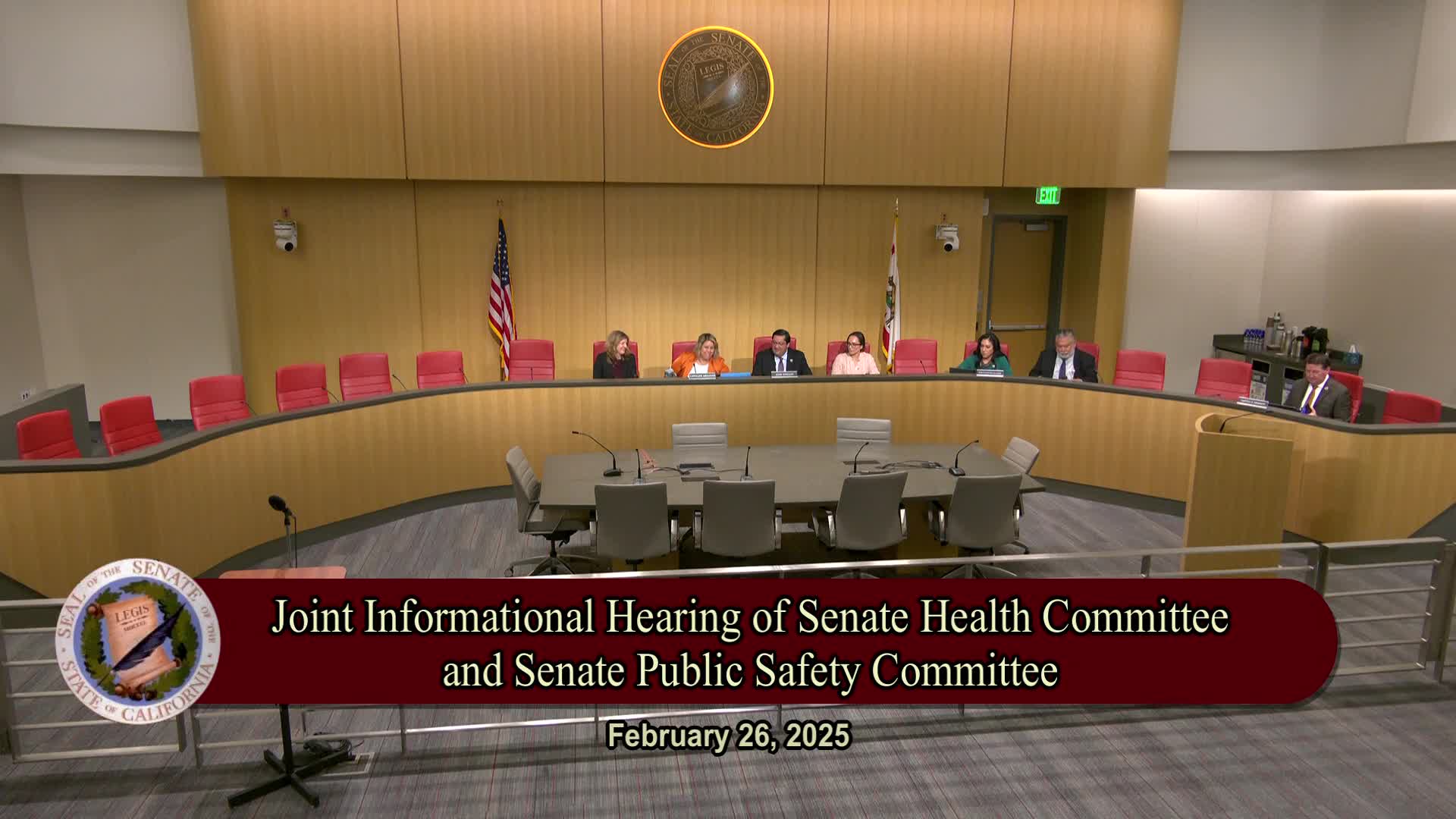
Summary
Senate committees heard updates March 2025 on the CalAIM Justice-Involved Reentry Initiative, where county health officials, probation leaders, CDCR and community providers described early benefits — medications and appointments in hand at release — but warned that one‑time startup funds, low billing rates and data‑sharing and coordination gaps threaten long‑term sustainability.
Senate committees on Health and Public Safety heard updates and concerns about the CalAIM Justice-Involved Reentry Initiative at a March hearing, where state and county health officers, corrections officials and community providers described both early implementation successes and outstanding operational challenges.
The hearing opened with Senator Menjivar, chair of the Senate Health Committee, framing CalAIM as a statewide effort begun in 2022 to expand Medi-Cal services that address social drivers of health. Panelists then described how the initiative is intended to provide prerelease and 90-day in‑reach services to incarcerated people so they leave custody with medications, appointments and connections to community supports.
Why this matters: The initiative shifts new federal Medicaid funding to correctional settings and county reentry services and aims to reduce hospital and criminal justice costs by improving continuity of care after release. Panelists emphasized that initial federal and state investments created the infrastructure to bill Medicaid for prerelease care, but they warned the program’s long‑term success depends on reimbursement rates, staffing and better operational coordination.
HealthRight 360 chief executive Vidka Eisen told the committees that the program’s complexity — dozens of managed‑care plans serving beneficiaries who return to 58 counties from more than 30 state prisons and dozens of camps — argues for regional "hub" entities to coordinate warm handoffs, standardize contracting and reduce administrative burden on local providers. "By establishing regional hubs ... you can ensure some kind of standardized delivery," Eisen said.
Yuba County Public Health Officer Dr. Phuong Lu described Yuba as one of the earliest counties to go live and reported the county has served more than 500 incarcerated people with prerelease medical, behavioral‑health and reentry care coordination since it began enrollment on Oct. 1, 2024. She said the county gets beneficiaries medications in hand at release and helped arrange primary care and social‑services connections, but she warned the initiative relies on one‑time PATH infrastructure funding and low fee‑for‑service rates for several reentry billing bundles.
"If our in‑reach provider cannot sustain the staffing model due to the low fee‑for‑service rates, then this jeopardizes their involvement in the long term," Dr. Lu told the committees. She also flagged delayed transitions from fee‑for‑service to managed care after release — in some cases taking more than 30 days — which can block access to managed‑care transportation, community supports and other plan services.
Sonoma County Chief Probation Officer Vanessa Fuchs urged stronger mandates for coordination between probation and managed‑care plans, and targeted training for probation staff. "Probation staff require specific targeted training to understand CalAIM services, referral processes and managed care requirements," Fuchs said, adding that data‑sharing limits under HIPAA and 42 CFR Part 2 create operational roadblocks for multidisciplinary reentry teams.
Lisa Hines, who described herself as project executive for the CDCR CalAIM implementation, said corrections began billing in early February 2025 and submitted 1,538 pharmacy claims with an expected reimbursement of about $77,000 as a first step. CDCR’s rollout is phased: CDCR reported its initial prerelease billing (phase 1) began 02/03/2025, phase 2 — billing for case management services — was scheduled to begin 04/01/2025, and phase 3 — clinical services billing (laboratory, radiology, consultation) — was planned for July 2025.
Department of Health Care Services (DHCS) leadership, including Director Michelle Baass and Deputy Director Autumn Boylan, told the committees DHCS sees the PATH funds as one‑time start‑up investments (the panel cited an initial PATH allocation of roughly $561,000,000) that created billing and IT infrastructure allowing correctional facilities and counties to draw federal Medicaid funds. DHCS acknowledged that fee‑for‑service reimbursement may not fully cover long‑term programmatic and staffing costs and said it is pursuing administrative claiming avenues and federal discussions that could produce ongoing support.
DHCS said it has implemented system improvements to assign individuals to managed‑care plans while they remain in custody to reduce post‑release enrollment gaps, and it allows community‑based providers to bill fee‑for‑service for up to 30 days post‑release to bridge delays to managed care enrollment. DHCS also pointed to CalAIM reentry data‑sharing guidance issued under AB 133 and a public reentry toolkit intended to help correct confusion around HIPAA and 42 CFR Part 2 releases for substance‑use records.
Panelists repeatedly raised workforce and sustainability concerns: probation agencies lack billing capacity, many community providers say negotiated rates are too low to maintain staff, and sheriffs have asked counties to fund deputies whose sole role is to protect external providers delivering in‑custody services. Transportation gaps were highlighted for rural counties that lack nonemergency transport networks if managed‑care benefits are not yet in place at the time of release.
Discussion points and directions from the hearing included: consideration of regional hub pilots (a recurring recommendation from county and CBO witnesses), clearer statewide reporting and enrollment guidance for correctional facilities and probation departments, additional technical assistance and training for probation and jail staff, and strengthened data‑sharing flows to ensure continuity of care across county lines.
The committees heard repeated calls to make short‑term PATH investments translate into sustainable billing and administrative frameworks, with DHCS agreeing to continue discussions with counties, CDCR and federal partners as the phased rollout proceeds. DHCS told senators it expects all counties to be phased in by Oct. 1, 2026.
The hearing did not produce formal votes or new statutory action; senators and witnesses emphasized next steps would include further legislative oversight, technical fixes and continued stakeholder engagement.
Looking ahead: The committees requested additional data on enrollment timelines, claims experience and outcomes as counties and CDCR complete later phases of billing and warm handoffs. Several senators signaled interest in potential legislation to secure ongoing funding or to clarify contracting and data‑sharing obligations after the PATH funds end.