Get Full Government Meeting Transcripts, Videos, & Alerts Forever!
Get email alerts on the Sustainable Aviation Fuel topic
No spam. Unsubscribe anytime.
Senate taxes panel advances bill extending Minnesota sustainable aviation fuel tax credit
Summary
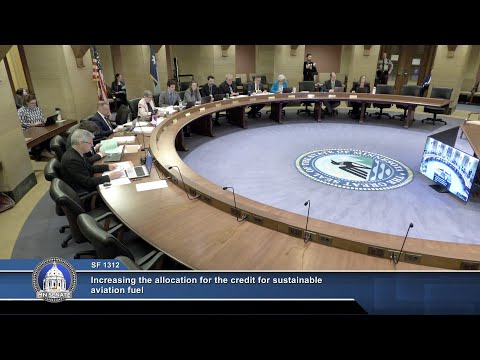
The Minnesota Senate Taxes Committee on Feb. 20 recommended passage of Senate File 1312, a bill extending and expanding the state's sustainable aviation fuel (SAF) tax credit and updating statutory definitions to allow new feedstocks such as captured gaseous carbon oxides.
The Minnesota Senate Taxes Committee on Feb. 20 recommended passage of Senate File 1312, a bill that would extend and expand the state's sustainable aviation fuel (SAF) tax credit and update statutory definitions for eligible feedstocks.
The committee, chaired by Senator Jennifer Rest, voted by voice to move the bill to the Senate floor after adopting an author's A2 amendment and after Senator Ron Dibble offered and then withdrew an A3 amendment for further work. Senator Gary Putnam moved the motion to recommend passage; the motion prevailed by voice vote.
The bill would extend the existing $1.50-per-gallon refundable SAF tax credit first enacted in 2023 and, as described to the committee, would push expiration of the program to 2035 and increase annual allocations in the program language. The text presented to the committee also adds new eligible feedstocks and clarifies the statutory definition of biomass to allow "gaseous carbon oxides" (captured CO2) as a feedstock pathway for SAF production.
"Sustainable aviation fuel can potentially reduce jet emissions by 50%," said Senator Mark Kupak, a co-author, explaining why Minnesota should maintain and expand the tax credit. Co-author Senator Joe Jasinski described a range of feedstocks and the state's capacity to produce SAF from crops, forestry residues and other materials found in Minnesota.
State officials and industry representatives urged support. Paul Marquardt, commissioner of the Minnesota Department of Revenue, said the governor supports the bill and cited a pending private investment: "DG Fuels announced in late October that they're looking at building a $5,000,000,000 manufacturing facility in Moorhead that will produce 650 jobs, and produce 93,000,000 gallons of SAF, which would be about 50% of all the aviation fuel used out the Minneapolis Saint Paul International Airport."
Tom Peterson, commissioner of the Minnesota Department of Agriculture, told the committee Minnesota has feedstocks and institutional strengths to compete with other states and reiterated interest in ensuring the state's farms and industries benefit from SAF development. Jeff Davidman of Delta Airlines said SAF is essential to the airline industry's decarbonization plan and that "60% of how we're gonna get to that 90% is with sustainable aviation fuel." He said Minnesota has an "end customer" in airlines and cited Minnesota's first SAF flight and a privately funded blending facility as evidence of progress.
Multiple agriculture, forestry, labor and business groups also testified in support. The Minnesota SAF Hub, represented by CEO Peter Frosh, described a public-private effort to scale SAF and presented preliminary modeling that three SAF biorefineries in Minnesota could create tens of thousands of construction and operation jobs and reduce global carbon emissions. The Metropolitan Airports Commission's chair Rick King said widespread SAF availability would be a recruiting point for air service at MSP airport.
Senator Dibble's A3 amendment, which he offered for discussion but did not press for a vote, proposed adding winter oilseeds (notably camelina and pennycress) as an expressly eligible feedstock and sought guardrails to prevent land-use changes and to exclude imported used cooking oil and other foreign feedstocks that would not benefit Minnesota's economy. Several agricultural witnesses supported the policy goals in principle but raised technical concerns about specific language in the amendment, particularly a cropping-history requirement that some farm groups said could disadvantage new or beginning farmers.
Committee discussion also highlighted permitting as a parallel issue: members and witnesses pressed for faster permitting pathways to keep Minnesota competitive nationally and internationally. Several speakers and senators said permitting reform bills are under separate consideration and will be coordinated with SAF policy work.
Formal actions taken in the committee included adoption of the A2 author's amendment (offered by Senator John Klein) and the committee's recommendation that SF 1312, as amended, be passed and sent to the Senate floor. The A3 amendment was offered by Senator Dibble for discussion and subsequently withdrawn without a vote.
The bill language discussed includes program funding allocations and effective-date language described to the committee: the amendment text presented to the committee specified annual allocations and carry-forward authority; committee witnesses and authors described figures in the bill text as $7,400,000 per year for certain early years and an additional $2,100,000 per year for later fiscal years through the extended sunset. The bill text also stated the law would apply retroactively for taxable years beginning after Dec. 31, 2023, for SAF sold after June 30, 2024 and before the extended sunset date.
The Taxes Committee chair said the measure and related permitting reforms could be folded into the omnibus tax bill if the committee is favorable. With the committee's recommendation, SF 1312 moves next to the full Senate for further consideration.
Votes at a glance: the committee adopted the A2 author's amendment by voice vote and later recommended the bill as amended be passed and sent to the floor; both were decided by voice vote with no roll-call recorded in the hearing transcript.
Sources: Committee hearing transcript, Feb. 20, 2025 (testimony from Paul Marquardt, Tom Peterson, Jeff Davidman, Peter Frosh, Rick King, Nick Jordan, Joe Smentek, Amanda Bilek, Ann Schwagel, Rick Horton, Tom Bicklitz, Darren Broden, Hunter Peterson, Carolyn Berninger, Brian Werner).