Get Full Government Meeting Transcripts, Videos, & Alerts Forever!
Get email alerts on the Care Act topic
No spam. Unsubscribe anytime.
Judicial Council reports statewide implementation of CARE Act courts; petitions rising
Summary
The Judicial Council said all courts implemented Community Assistance, Recovery, and Empowerment (CARE) Act proceedings statewide by December 2024 and expects more than 2,000 petitions annually based on early filing trends.
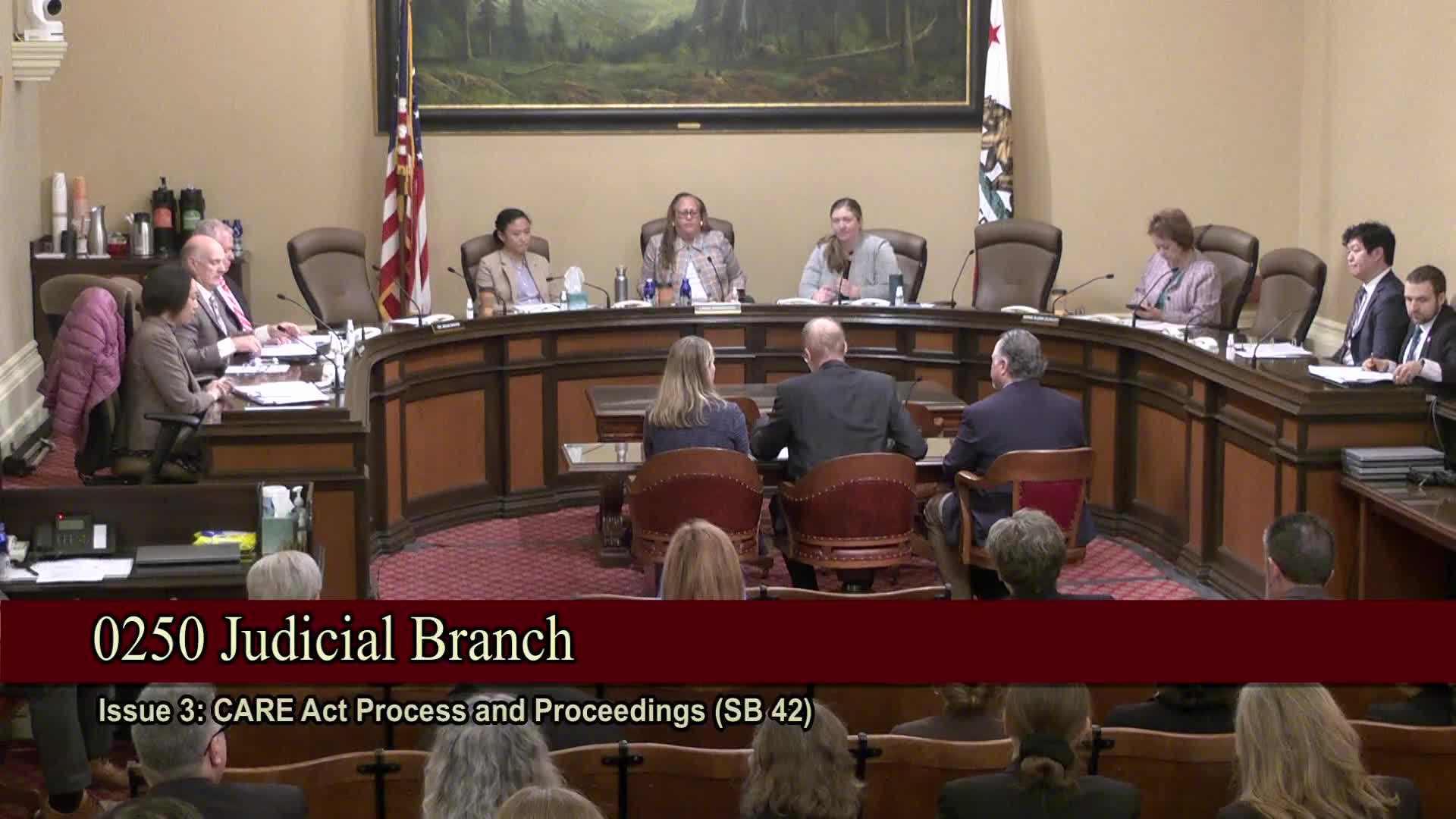
The Judicial Council told the Senate budget subcommittee that implementation of CARE Act (Community Assistance, Recovery, and Empowerment Act) proceedings is complete statewide and that early filing trends suggest growing use of the new civil pathway.
Don Will, deputy director for the Center for Families, Children and the Courts, said the first seven pilot courts began CARE Act operations in October 2023 and Los Angeles in December 2023. The council reported full statewide implementation by December 1, 2024. Will said the council has recorded roughly 1,258 CARE Act petitions since the program began and 21 hearings tied to those petitions in the early implementer courts; January 2025 filings in early courts rose 11% over December 2024, which the council said annualizes to more than 2,000 petitions per year if trends continue.
Why it matters: CARE Act proceedings allow certain people to seek assistance for adults with severe mental illness through a civil court process; implementation affects courts, behavioral‑health partners, and family members seeking interventions or services.
Judicial Council support work: The council described convenings, rule and form changes, on‑demand trainings, a forthcoming bench guide, and local experimentation such as a Los Angeles hotline connecting self‑represented litigants to behavioral‑health representatives and Riverside accepting CARE filings through e‑submit.
Questions and outstanding issues: Committee members asked how CARE interacts with assisted outpatient treatment and conservatorship pathways; the Judicial Council said its bench guide and resources will explain the alternatives and help courts and families find the appropriate pathway. Senators also asked whether those who are unhoused are being referred to CARE programs; council staff said some unhoused individuals are involved in CARE proceedings but affirmed that the pathway depends on case facts and local partner services.
Ending: The Judicial Council agreed to continue providing implementation updates and resources to the committee; no funding vote occurred at the hearing.