Get Full Government Meeting Transcripts, Videos, & Alerts Forever!
Get email alerts on the Federal Funds Medicaid topic
No spam. Unsubscribe anytime.
Minnesota officials warn federal budget moves could cut Medicaid funding, freeze dozens of grants
Summary
State budget officials told a Minnesota Senate committee that federal actions and proposed congressional cuts could disrupt nearly $23 billion in federal awards to the state and could reduce federal Medicaid funding by more than $1 billion a year, forcing difficult state budget choices.
State budget officials told a Minnesota Senate committee on Feb. 27, 2025, that federal actions and proposed congressional changes could disrupt nearly $23 billion in federal awards administered by the state and reduce federal Medicaid funding by more than $1 billion a year, creating large budget pressure for Minnesota.
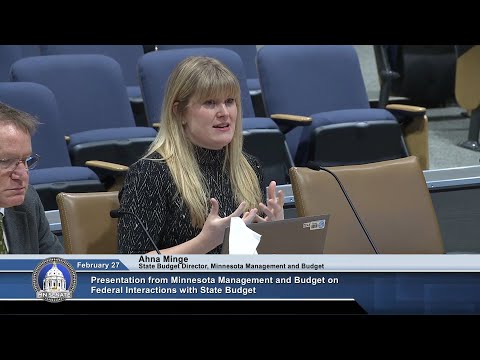
Anna Mingi, state budget director with Minnesota Management and Budget, told the Senate Finance Committee — joined by members of health and human services panels — that state agencies administer almost 700 federal awards representing “almost $23,000,000,000” in state fiscal year 2025 and that just over a third of the state’s total spending comes from federal funds. She said 56% of those federal awards — just under $13 billion — support state entitlement spending, primarily health and human services programs and education.
The magnitude matters because many of those dollars are matched entitlement payments: “Medicaid is, by and large, the largest federal funding stream flowing to the state of Minnesota, representing more than half of our total federal funding, or almost $12,000,000,000 this year,” Mingi said. She and Dave Greenman, chief financial officer for the Department of Human Services, warned that several federal developments could sharply reduce that support.
Mingi described recent disruptions to access for some federal awards after an Office of Management and Budget memo temporarily limited statewide access to grant disbursements. That memo was later rescinded, she said, but the state has experienced interruptions. As of the evening of Feb. 25, Mingi said, there were 12 state awards the state could not access; six were at the Department of Commerce, four at the Department of Natural Resources and two at the Department of Agriculture. She said 10 of those 12 originated in the Infrastructure Investment and Jobs Act and the Inflation Reduction Act.
Greenman outlined potential impacts from the House budget resolution, which he described as seeking large spending reductions over a multi‑year period. He said congressional proposals being discussed could include per‑capita caps, block grants, elimination of the enhanced match for the Medicaid expansion population and reinstatement of work requirements. Those changes, depending on their design, “could have a pretty significant impact on Minnesota because Minnesota pays more per person per month than most other states,” Greenman said.
Greenman and Mingi both provided preliminary state estimates for one change often mentioned in congressional discussions: the loss of the enhanced federal match for the expansion adult population. They estimated that returning the expansion population to the regular federal match rate would cost Minnesota roughly $1.2 billion to $1.3 billion a year — about $2.5 billion in a biennium — unless federal or state policy changed eligibility, benefits or provider payments.
Committee members pressed for more detail. Senators asked how many of the 12 disrupted awards had been resolved; Mingi said status was fluid and that some awards had access restored and later shut off again. Members also requested a committee‑wide list of the disrupted awards with dollar amounts; Mingi agreed to provide it.
MMB described active steps it is taking: working “very closely with state agencies to identify any disruptions,” analyzing incoming federal guidance and executive orders, and trying to determine which Minnesotans and programs would be affected if federal actions continue or if Congress enacts deeper cuts. Mingi told the committee the office is monitoring guidance and that many federal executive orders and directives to study programs have not yet produced specific implementation language.
Committee members from both parties described the stakes in direct terms: Medicaid serves roughly 1.2 million Minnesotans per month (MMB figure for SFY2025), pays for half of long‑term care services in the state and provides about $20 billion a year in payments to providers, Greenman said. Other large federal streams MMB cited include SNAP (about $1.6 billion in FY2025), school nutrition programs (about $430 million), Title I (about $190 million), the Child Care and Development Block Grant (about $553 million) and transportation funding (about $3 billion). MMB also noted Minnesota Care receives roughly $590 million in federal support in 2025 under the Basic Health Program rules.
Senators repeatedly emphasized uncertainty. Mingi warned the February revenue forecast would not incorporate any hypothetical congressional cuts; if Congress and the president finalize changes that reduce federal Medicaid support, the state forecast and lawmakers would have to respond within the biennial budget process. Several senators asked agencies to analyze local impacts — for example, on counties, rural hospitals and capital projects tied to federal grants — and asked MMB and DHS to provide portfolio‑level information to the committee.
Where the committee left the topic: MMB and DHS will continue to monitor federal action, provide the committee with a list of disrupted awards and their dollar amounts, and update lawmakers as federal guidance and legislative proposals evolve. Senators told the panel they intend to use the incoming state forecast and agency data to evaluate policy choices if federal funds are reduced.
The hearing contained no formal votes or final legislative actions; it was a briefing and preparatory discussion for the upcoming state budget forecast and the 2025 session.