Get Full Government Meeting Transcripts, Videos, & Alerts Forever!
Get email alerts on the Permitting Ombudsman Deed topic
No spam. Unsubscribe anytime.
Committee advances bill to create DEED ombudsman for business permitting after debate on funding and public access
Summary
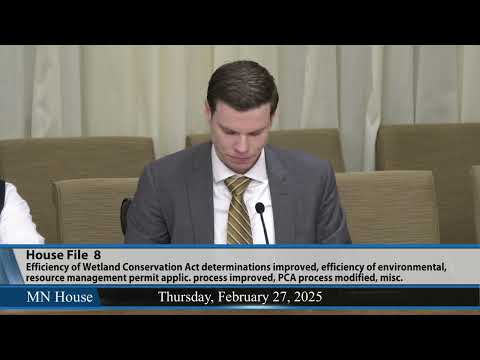
The House Workforce, Labor and Economic Development Committee voted Thursday to pass House File 8 as amended, sending the bill to the Committee on Ways and Means. The bill creates a permitting ombudsman position at the Minnesota Department of Employment and Economic Development (DEED) intended to help businesses navigate state environmental permitting.
The House Workforce, Labor and Economic Development Committee voted Thursday to pass House File 8 as amended, sending the bill to the Committee on Ways and Means. The bill creates a permitting ombudsman position at the Minnesota Department of Employment and Economic Development (DEED) intended to help businesses navigate state environmental permitting.
The amendment approved by the committee adds an appropriation intended to fund two ombudsman positions. Representative Josh Heintzeman, the bill author, said the office is meant to “protect Minnesota’s air, land, and water” by helping regulated parties understand and comply with state environmental requirements while also making permitting more navigable for businesses.
Supporters from the business and trades community told the committee permitting delays and uncertainty discourage investment. Andrew Morley, government relations representative for the Minnesota Chamber of Commerce, said Minnesota “ranks number 40 in the nation for overall GDP growth” and that long permit timelines—he cited air permitting as taking “up to six times longer than comparable states”—keep projects from moving forward. John Pollard, legislative and political director for the International Union of Operating Engineers Local 49, said the bill “doesn’t weaken any environmental standards” and called the ombudsman a “perfect example” of improving predictability.
The Minnesota Pollution Control Agency (MPCA) and environmental groups raised concerns about where the ombudsman would be housed, data access, independence and public participation. Tom Johnson, government relations director for MPCA, said the agency supports the concept but cautioned that placing the ombudsman at DEED “does create several challenges,” including handling confidential or protected nonpublic data and a tension between making the ombudsman both independent and sufficiently expert to assist on complex agency processes.
Environmental groups warned the bill could reduce public participation and undercut agency enforcement. Catherine Hoffman, chief executive officer of the Minnesota Center for Environmental Advocacy, said more public reporting would be helpful but argued HF 8, as introduced, “misses the point” because she believes permitting problems stem from weak enforcement and agencies’ inability to say no when proposals do not meet standards. Steve Morse, executive director of the Minnesota Environmental Partnership, said the ombudsman concept “makes a lot of sense” but characterized the bill overall as “fundamentally flawed” and singled out limits on public participation and a lack of structured tribal consultation.
DEED officials told the committee the agency’s fiscal note estimated four full‑time equivalents (FTEs) would be required to carry out the bill’s duties as written. Devin Baldry, government relations director at DEED, said the amendment’s appropriation would pay for “about one and a half to two FTEs,” and that with the lower appropriation some duties might require contracting or would not be fully staffed. Representative Lee Pinto and other members pressed for clarity on the fiscal mismatch; Heintzeman said the amendment reflects a compromise the author was prepared to take to Ways and Means for further adjustments.
Committee members also debated whether DEED’s proposed ombudsman would duplicate existing resources, such as Minnesota Business First Stop, a cross‑agency program that provides assistance on licensing, permitting and regulatory matters. Andrew Morley said the proposed office would be “complementary, and not duplicative,” describing it as a separate, siloed resource focused on businesses already in the permitting process rather than an initial intake resource.
After extended member questioning, the committee approved the author’s amendment by voice vote and later passed the amended bill to Ways and Means by voice vote. Two procedural motions raised during the hearing—a motion to re‑refer the bill to the Environment and Natural Resources Finance and Policy Committee and a separate motion to lay the bill on the table—failed on recorded votes (both outcomes recorded as failing 7–6). The committee’s final action advanced House File 8 as amended to Ways and Means.
The committee hearing record shows divergent views among business groups, state agency staff and environmental advocates on whether the DEED placement, funded level and statutory language strike the right balance between streamlining permitting and preserving public participation and enforcement authority. Lawmakers on the committee said the bill can be further adjusted in Ways and Means and in subsequent hearings.
— Votes at a glance — • Amendment to HF 8 (author appropriation for two ombudsman positions): passed (voice vote). • Motion to re‑refer HF 8 to Environment and Natural Resources Finance and Policy Committee: failed (recorded vote 7–6). • Motion to lay HF 8 on the table: failed (recorded vote 7–6). • Final: Pass and re‑refer HF 8, as amended, to Committee on Ways and Means: passed (voice vote).