Get Full Government Meeting Transcripts, Videos, & Alerts Forever!
Get email alerts on the Health Insurance Mandates topic
No spam. Unsubscribe anytime.
Commerce, Health Department and insurers outline Minnesota process for reviewing health insurance mandates and warn of premium pressure
Summary
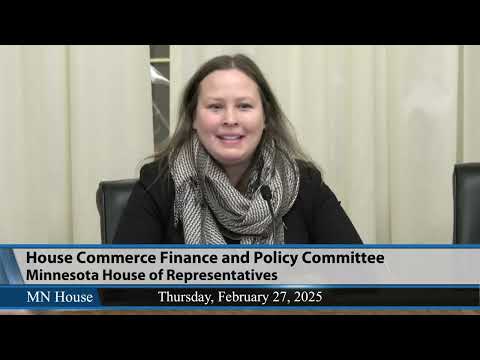
The Minnesota House Commerce, Finance and Policy Committee heard Feb. 27 how state agencies review proposed health insurance mandates, how the state calculates any required federal defrayal payments, and how those and other factors can affect premiums and market participation.
The Minnesota House Commerce, Finance and Policy Committee heard presentations Feb. 27 from the Department of Commerce and the Department of Health on how the state evaluates health insurance benefit mandates, including how it measures costs that may be borne by the state and by health plan enrollees.
Ashley Sedalan, health policy director in the insurance division at the Minnesota Department of Commerce, told the committee that Commerce conducts mandate evaluations in partnership with a contractor and with technical input from the Department of Health and Minnesota Management and Budget. “We work with a vendor, American Institutes for Research on those evaluations,” she said, describing a process that can include a feasibility review, literature review, a claims analysis using the Minnesota All Payer Claims Database (APCD), a public comment period and a calculation of any federal “defrayal” payments the state must make.
The committee was briefed on two separate cost concepts. Sedalan said defrayal (payments from the state to carriers under federal Affordable Care Act rules) is a direct state payment when a new mandate expands the federally defined essential health benefit (EHB) benchmark. By contrast, she said, per‑member‑per‑month (PMPM) estimates describe projected impacts on premiums paid by enrollees and employers and are not direct state outlays. Sedalan noted some mandates are judged to require full defrayal, others partial, and some none at all. She said Minnesota has completed 34 mandate evaluations since 2021; 11 were determined to require defrayal (five full, six partial), and four bills that required defrayal have passed since the current review process began in 2021.
Pamela Mink, director of health services research at the Minnesota Department of Health, explained the role of the Minnesota APCD in the evaluations. “We have complete years up through 2023 for commercial claims,” she said, and the APCD provides deidentified, adjudicated claim amounts, enrollment, limited demographics and geographic information that MDH uses to estimate prevalence, utilization and plan‑paid amounts for services or drugs referenced in proposed mandates. Mink and Sedalan also flagged common challenges: limited claims data for very new therapies (for example, recently approved gene therapies), bills with broad or vague language that force analytic assumptions, and matters that cannot be measured in claims (for example, over‑the‑counter purchases).
Stephan Gildermeister, state health economist at MDH, placed the mandate work in market context, noting the state regulates some but not all coverage. “About 52% of the population have coverage that roughly falls under the jurisdiction of the Minnesota legislature,” he said, and explained that Medicare and many self‑insured employer plans are governed by federal rules and generally fall outside the state mandate rules.
Officials gave specific program and timing details the committee asked about. Sedalan said the mandate evaluation vendor and agencies must typically deliver evaluations within 180 days of a legislator’s request; she said a chiropractic evaluation is due to the legislature around March 31. Sedalan also described defrayal payment timing: the state reimburses carriers after plan‑year close based on actual carrier claims submissions. She said one mandate already subject to defrayal, coverage for PANS/PANDAS, has generated just under $140,000 in state defrayal payments to date and that four additional mandates that became effective Jan. 1, 2025, will be subject to defrayal reimbursements starting in spring 2026.
Witnesses representing carriers and employers told lawmakers that mandates are only one driver of premium increases but that they contribute to affordability pressures, plan exits from the fully insured market and employer moves to self‑insurance. Barbara Cox of HealthPartners testified that carriers raised rates in 2025 and that, in her view, added mandates can push consumers into higher‑deductible plans or out of coverage. “Affordability is access,” she said. Matt Shaffer of Medica warned that mandates that cover expensive drugs are particularly difficult to forecast and could change over time: “whenever you give the pharmaceutical industry or anyone who has the ability to mark up an already expensive drug more bargaining power, they're going to use it.” Bentley Grama of the Minnesota Chamber of Commerce described survey results showing many small‑ and midsize employers consider dropping or reducing coverage if cost pressures continue.
Committee members asked whether the state’s mandate review could feed the federal process for changing the essential health benefit benchmark or whether law changes could align the processes; Commerce staff said they would examine the question and provide follow‑up. Members also sought data on how the composition of markets has changed over time; MDH said it could provide historical APCD and market‑share information to the committee.
The committee took one formal administrative action at the start of the hearing: Representative Elkins moved to approve the Feb. 25 minutes; the motion prevailed and the minutes were adopted by voice vote.
The presentations and discussion left lawmakers with concrete follow‑up items: Commerce said it will consider whether the state mandate review can better support an EHB benchmarking request to the Centers for Medicare & Medicaid Services; MDH and Commerce agreed to provide additional bill‑by‑bill detail about whether evaluated mandates represented entirely new coverage versus codifications of coverage that already existed; and MDH committed to share recent APCD trend analyses and prior spending‑trend reports on request.
As members emphasized during the hearing, differences remain about how to balance expanded coverage for specific services against premium impacts. Officials stressed analytic limits and data caveats; stakeholders stressed both the clinical or access need behind many proposed mandates and the affordability consequences of cumulative changes to plan benefits.