Get Full Government Meeting Transcripts, Videos, & Alerts Forever!
Get email alerts on the Redistricting topic
No spam. Unsubscribe anytime.
House committee refers constitutional amendment to create redistricting commission after independent-commission amendment fails
Summary
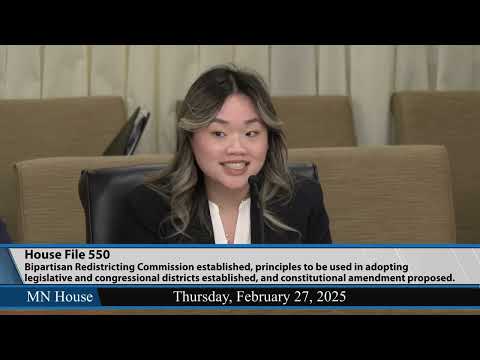
The Minnesota House State Government Finance and Policy Committee voted 7–6 on Feb. 27, 2025 to refer House File 550 — a proposed constitutional amendment to establish a redistricting commission — to the Judiciary Finance and Policy Committee after rejecting an amendment to create a larger independent commission.
The Minnesota House State Government Finance and Policy Committee on Feb. 27, 2025 voted to refer House File 550, a proposed constitutional amendment to establish a joint redistricting commission, to the Judiciary Finance and Policy Committee.
The underlying bill, described by author Representative Torkelson as a constitutional amendment needed to prepare for the next redistricting cycle, would create a bipartisan commission to draw legislative and congressional boundaries. "This is the right time to put it on the ballot," Representative Torkelson said, adding that Minnesota is likely to lose one congressional seat next cycle and that a commission could handle the complex work more effectively.
Supporters including the Minnesota Chamber of Commerce urged the committee to adopt a commission model. Brian Cook, director of taxes, fiscal policy and elections for the Minnesota Chamber of Commerce, told the panel the chamber supports a commission because it would provide "a more effective, reliable, and transparent system" and could be cost-competitive with the current legislative-plus-litigation track. Cook cited prior litigation-related costs: plaintiffs' attorney awards of about $345,000 after the 2010 cycle and an appropriation of about $490,000 after the 2020 cycle.
Opponents and some advocacy groups warned the committee that the bill as drafted would embed partisan dynamics rather than remove them. Tom Wheason, identifying himself as a resident of Monomedi, said the bill contains a "major conflict of interest" because it would allow partisan actors to influence appointments; he urged the committee to vote no. Mei Yang of the Minnesota Council of Foundations and Anastasia Belladonna, executive director of Common Cause Minnesota, said the proposal lacked sufficient protections for community participation, transparency and exclusion criteria for partisan actors.
Representative Freiburg offered the DE2 amendment to replace the bipartisan commission with a larger, more independent commission. Freiburg described her proposal as a 15-member structure with explicit independent seats and broader exclusions for lobbyists and party insiders. The committee voted the DE2 amendment down on a roll call, 7 no to 6 yes. The clerk recorded the following votes on DE2: Chair Nash — no; Vice Chair Davis — no; Representative Anderson — no; Representative Bonner — yes; Representative Clardy — yes; Representative Freiburg — yes; Representative Howard — yes; Representative Jones — yes; Representative Joy — no; Representative Kosnick — no; Representative Kraft — yes; Representative Quam — no; Representative Sexton — no. With DE2 defeated, Representative Cleburne moved to table the bill; that motion did not prevail. The committee then voted to refer the underlying House File 550 to the Judiciary Finance and Policy Committee on a roll call that passed 7–6 (ayes: Chair Nash; Vice Chair Davis; Representative Anderson; Representative Joy; Representative Kosnick; Representative Quam; Representative Sexton — nays: Representative Bonner; Representative Clardy; Representative Freiburg; Representative Howard; Representative Jones; Representative Kraft).
The referral sends the constitutional amendment proposal to the next committee for further consideration and drafting adjustments, including the specifics of appointments, exclusions, and tie-breaking or incentive mechanisms to encourage commission agreement.
Representative Torkelson and multiple testifiers said they plan further work with other caucuses to refine safeguards and incentives; several advocacy groups signaled readiness to continue negotiations.
The bill will next be considered in the Judiciary Finance and Policy Committee.