Get Full Government Meeting Transcripts, Videos, & Alerts Forever!
Get email alerts on the Enforcement And Prevention topic
No spam. Unsubscribe anytime.
District attorney describes enforcement against Kensington drug and shooting groups; civil-asset funds used for local prevention
Summary
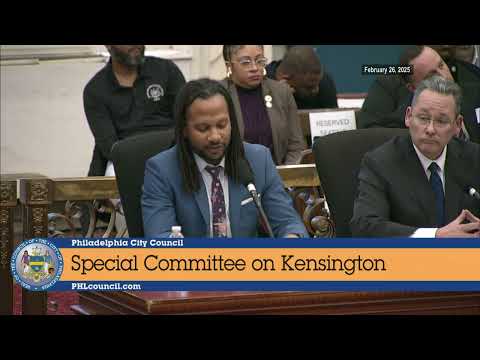
District Attorney Larry Krasner told the committee his office has been prosecuting major drug and shooting groups affecting Kensington and has directed civil asset forfeiture funds toward local community organizations; he urged combining enforcement with prevention and evidence-driven diversion.
District Attorney Larry Krasner told the special committee on Kensington that vigorous enforcement against violent and commercial drug networks must proceed alongside expanded diversion and prevention work, and that his office is investing civil asset forfeiture funds in local community groups to bolster prevention.
Krasner described recent felony-level cases his office is pursuing and the ongoing work of a gun violence task force. He said the office has charged defendants in high-profile shootings and uncovered cases where firearms were illegally transferred on Kensington streets; he highlighted one case involving 18 firearms purchased legally then moved into illegal transfers. Krasner also read a list of shooting crews his office and partners have taken down or greatly weakened over recent years, saying both enforcement and prevention are required to protect residents.
"There is a difference between the disease of addiction and people who hurt people," Krasner told the committee, stressing that prosecution remains essential for violent actors while diversion is targeted to people whose primary issue is substance use disorder.
Krasner said his office has used civil asset forfeiture funds to make grants to community organizations to support prevention and neighborhood services. He reported that over seven years the office had invested "almost $4,000,000" from forfeiture proceeds in local groups and cited examples including small local nonprofits and programs offering arts, sports and reentry services. Krasner framed the spending as focused on small organizations that need upfront funding, rather than large-dollar reimbursements.
Kimberly Essek, supervisor of the DA's Economic Crimes Division, described a vertical-prosecution retail-theft task force that she said now covers more than 1,500 transcripts and 500 offenders for targeted prosecution and follow-up. Essek said the unit works closely with police and merchants to gather repeated-offender data and to secure warrants where offenders are repeatedly present even when police could not respond to the initial calls. She also described an alerting system used by merchants and police so stores can warn one another and officers about prolific offenders.
Assistant DA Paul Riddell, who runs the Dangerous Drug Offenders Unit, said his team often works embedded with federal partners and the DEA to pursue larger supply-chain investigations that have led to multi-jurisdictional indictments and seizures. He described a multi-million-dollar federal case that traced narcotics and cash to a cartel-affiliated supply chain.
Committee members pressed officials about prosecution priorities and community protections; Krasner and his deputies said enforcement, prevention grants and data sharing with city agencies are complementary components of a strategy to reduce shootings, supply and the harms that degrade residents' quality of life in Kensington.
Ending note: Krasner said his office is willing to share its data and analytics resources with city partners for evaluation of programs and to improve evidence-based decisions on diversion and enforcement.