Get Full Government Meeting Transcripts, Videos, & Alerts Forever!
Get email alerts on the Diversion Programs topic
No spam. Unsubscribe anytime.
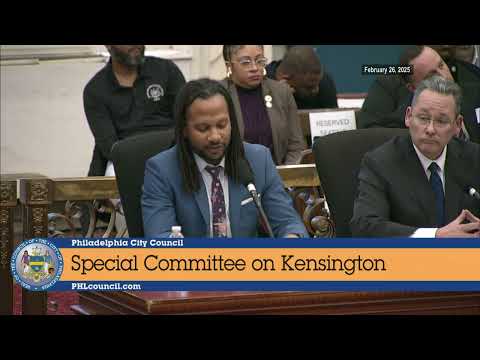
Philadelphia officials cite early wins from PAD, pilot Kensington wellness court and map expansion needs
Summary
City officials briefed the council special committee on Kensington on the city's diversion "continuum," reporting early positive indicators from Police Assisted Diversion (PAD) and the new Neighborhood Wellness Court pilot while identifying gaps in housing, withdrawal management and interagency data that must be fixed for larger scale success.
Philadelphia City officials told a special City Council committee that the city's expanding diversion programs'including Police Assisted Diversion (PAD) and a one-week-a-week Neighborhood Wellness Court pilot in Kensington'are showing early promise but will require faster access to treatment, better handoffs and more housing to meet demand.
Chief Public Safety Director Adam Gere told the committee the administration has mapped diversion programs "within the sequential intercept model framework" and described diversion as an approach that "has a potential to improve the lives of individuals suffering from substance use disorders, the quality of life of a neighborhood, and the overall safety of our city." Gere said the administration is focusing on both upstream "deflection" efforts (non-911 crisis response and co-response teams) and post-arrest diversion that provides off-ramps away from prosecution.
Gere described the Kensington Wellness Support Center at B and Lehigh as already open extended hours and on track to operate 24/7 in April, and said the pilot Neighborhood Wellness Court launched last month. The pilot pairs same-day screening and a judicial hearing for summary offenses with medical screening inside the support center, on-site legal advocacy and immediate case management. If the judge approves diversion, participants may receive a certified recovery specialist transport directly to treatment. Gere said diversion lengths in the pilot range from about 30 days up to a 90-day maximum.
Deputy Commissioner Francis Healy of the Philadelphia Police Department, who oversees behavioral health unit operations that include PAD, traced PAD'Philadelphia's pre-booking diversion model'to LEAD-style programs and said PAD began citywide expansion this year after a multi-year pilot and implementation period. Healy said PAD is split between arrest-deferral referrals and social referrals (people who ask officers for help on the street), and noted officers are screening out ineligible cases for reasons such as outstanding warrants, uncooperative behavior or prior PAD participation. Healy said the department has experienced more than 2,000 PAD interactions and that PAD officers are doing intensive social-service work'including obtaining identification documents and reconnecting clients with family members as part of placement and benefits applications.
Officials offered early program data and caveats. Gere and Healy described roughly 2,000 arrests referred to PAD in 2024 and reported a low formal rejection rate; Gere said only 67 of nearly 2,000 referrals in 2024 were rejected as ineligible because the person had already gone through PAD twice. Kurt August, executive director of the Office of Criminal Justice, said some PAD data shows hundreds of arrests were diverted to services and that partners report high percentages of inpatient placement for those who accept services (figures described during testimony included an example year in which 82 percent of PAD'accepted arrests received inpatient placement and 157 received outpatient placement, with others receiving social services or emergency mental health transport).
Committee members and witnesses identified three recurring operational challenges the city must solve to scale diversion: (1) withdrawal and medical stabilization'participants may leave treatment if withdrawal management is delayed or inadequate; (2) bench warrants and out-of-county warrants can block diversion eligibility and require cross-jurisdiction coordination; and (3) post-referral case management and tracking are limited, especially for PAD referrals upstream of court-based diversion, reducing the ability to measure medium-term outcomes.
Gere and Healy described steps already taken: weekly multi-agency debriefs for the pilot, on-site leadership presence on Wellness Court days, 12 operational changes made after early pilot review (including expanded staff and streamlined intake), and active efforts to clear local bench warrants so participants are eligible for diversion. Healy acknowledged more work is needed on out-of-county warrant processes and said the department has initiated outreach to neighboring counties.
Officials and council members repeatedly framed diversion as part of a broader public-safety and public-health strategy rather than a standalone solution. Gere said the administration will "go towards what works" and adjust programs as evidence about outcomes emerges. Several council members pressed officials for a clearer operational "road map" of how PAD, Neighborhood Wellness Court and DA diversion (AMP and others) fit together and asked for specific, timely data about placements, program completions and recidivism.
The hearing produced no formal vote; officials asked the committee to sustain multi-agency collaboration and to consider dedicated funding for staffing and for housing and withdrawal-management capacity as the pilot scales.
Ending note: Council members said they want more frequent, operational reporting as the pilot moves into warmer months when referral volumes typically rise, and asked the administration to return with a clearer timeline and cost estimate for expanding the Neighborhood Wellness Court schedule.