Get Full Government Meeting Transcripts, Videos, & Alerts Forever!
Get email alerts on the School Budget topic
No spam. Unsubscribe anytime.
Queen Anne's County school board reviews budget options and plans to ask commissioners for full funding amid underfunded Blueprint requirements
Summary
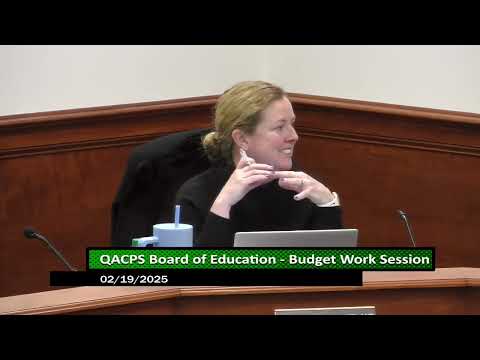
The Queen Anne's County Board of Education on Feb. 19 reviewed several draft budget scenarios and signaled its intent to ask county commissioners for full funding to avoid renewed staff furloughs and other cuts while preparing contingency plans if state or county support falls short.
The Queen Anne's County Board of Education on Feb. 19 reviewed several draft budget scenarios and signaled its intent to ask county commissioners for full funding to avoid renewed staff furloughs and other cuts while preparing contingency plans if the state or county support falls short.
Superintendent Dr. Kibler presented four budget options: a flat allocation (no additional county or state funds), a model built around a $5,000,000 placeholder from the commissioners, and an expanded “full ask” that would cover the district's stated needs and remove the temporary furloughs imposed last year. Kibler told the board the district previously projected a $7,500,000 ask to the commissioners and described the full package as the administration's recommendation for what the system needs to “keep whole and moving into next year.”
Why it matters: the session centered on how to respond to the so-called Blueprint requirements enacted at the state level and on whether local and state funding will cover rising personnel and insurance costs. The board heard repeated warnings that a shortfall would force difficult personnel decisions and service reductions.
The superintendent said staffing accounts for roughly 85% of the district's budget; the remaining 15% covers largely fixed operating costs such as transportation, utilities and communications. Dr. Kibler told the board that addressing last year's temporary furloughs would require additional funding and at one point noted the district needs to “come up with $22,000,000,” a figure discussed during the session in the context of closing multi-year funding gaps and restoring staffing levels.
The board discussed how last year's shortfall — described in the meeting as roughly $12.7 million — led to four furlough days and position freezes after the district used its available fund balance to reduce the number of furlough days. Board members and staff ran several scenarios showing that a mid-range shortfall between the $6.2 million the commissioners provided this year and the larger “full ask” could translate to elimination of roughly 30 positions, using a working estimate of about $100,000 per position.
State funding and the "Blueprint": board members and staff spent substantial time on the state Blueprint law and its fiscal impacts. Dr. Kibler told the board that the Blueprint is law and that implementation obligations are in place even where state funding has not matched those requirements. "The blueprint is actually a law. So if we don't implement the things in the blueprint, then we're breaking the law," Dr. Kibler said during the session, adding that the district views the Blueprint as an "underfunded mandate" in practice because reimbursement levels and foundation calculations do not fully cover the new obligations.
Commissioner support and prior county contributions: the superintendent and board noted county commissioners have provided supplemental funding in recent cycles. The meeting record shows commissioners provided about $6.2 million in supplemental funding in the current year, described in the presentation as a combination of maintenance-of-effort and other one-time amounts. Board members said commissioners have been supportive and at least some board members indicated they intend to ask commissioners for the full funding package discussed in the work session.
Contingency planning: several board members urged the administration to prepare concrete contingency plans for the likely shortfall scenarios. The administration said work is already underway to identify which positions could be frozen or eliminated, and to calculate retirements and voluntary resignations that would reduce net impacts. Staff stressed that some cuts — particularly to special education and core student services — would be a last resort.
Special education and transportation costs: the meeting included extended discussion about rising special education transportation needs. Staff reported about 35 additional special education transportation requests this school year, driving increased bus usage and costs; the district added two buses this year and said the fleet was stretched to capacity. Board members discussed regional approaches and noted Eastern Shore partners (through an ESMEC consortium) are working with the Maryland State Department of Education and Kennedy Krieger to explore creating a regional facility to reduce cross-county transportation in future years.
Other budget details raised during the session: the presentation highlighted line-item increases (for AP exam subsidies, utilities, laptop lease payments, and substitutes) and one-time accounting moves (a roughly $414,996 credit moved back into the operating budget). The administration said the budget increases presented were increases to existing line items rather than the full amounts for those lines.
Board direction and next steps: several board members said they favor asking the commissioners for the full funding package rather than a smaller placeholder. Board members also requested additional detail from the administration on active employee lists, roles and responsibilities for central-office positions, and a clearer mapping of which central-office employees work in schools full time. The board scheduled a follow-up budget work session and indicated representatives would meet with the county commissioners to convey the board's direction in advance of budget votes.
Votes and formal actions: the meeting record shows routine procedural motions (to open the session, approve the agenda and adjourn) were moved, seconded and passed; no ordinance or appropriation vote occurred at the Feb. 19 work session.
The board plans to continue budget work next week and expects to meet separately with county officials to present its request and the contingency analysis it developed during this session.