Get Full Government Meeting Transcripts, Videos, & Alerts Forever!
Get email alerts on the Utilities Water Regulation topic
No spam. Unsubscribe anytime.
Committee hears substitute to regulate private surface-water utilities; PSC warns of staffing needs
Summary
Members heard testimony on a substitute to HB 449 that would subject private surface-water utilities to public-service commission oversight for certain rate increases; the PSC said regulating water would require more staff and the industry warned of higher costs to customers.
The House Agriculture & Consumer Affairs Committee held a hearing on a substitute to HB 449 (LC550562S) that would impose oversight on privately owned utilities that use surface water and would require justification to the Public Service Commission for rate increases above specified thresholds.
Sponsor Trey Rhodes told the committee the substitute targets private companies that supply surface water and would require a private utility to justify to the PSC any cumulative increase of 15% over a three-year period; tap fees and capital expenditures would be excluded from that calculation. Rhodes said the measure is intended to protect customers in areas served exclusively by private utilities and to constrain excessive increases when private equity or hedge funds acquire systems.
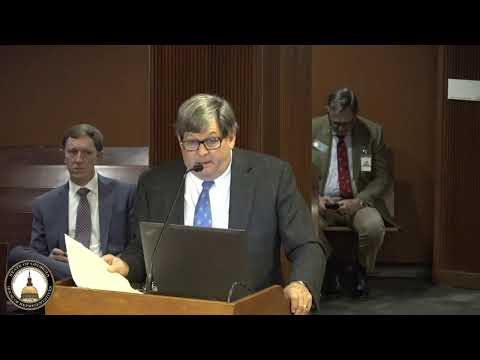
Tom Bond, director of utilities at the Georgia Public Service Commission, told the panel the commission is neutral on policy but warned that regulating water would require additional staff and resources. He estimated a unit similar in size to the commission's telecom unit (roughly six employees plus a unit director) would likely be needed to process water rate cases and carry out hearings.
Representatives of private water companies described substantial recent investments and urged careful design. Adam Schafer, president and CEO of Piedmont Water Company, said, “We have invested over $40,000,000 in the last 5 years” and described summer peak demands and recent construction of a surface-water treatment plant. He said added regulation would increase costs that ultimately pass to customers. Mark Smith of Water Utility Management described operating many small, rural systems and said the company consolidated multiple rates over time.
Members asked questions about tap fees and whether utilities require customers to buy pumps or grinders from the company; the sponsor said tap fees and accessory costs can drive the total hook-up cost to $25,000–$35,000 in some places when ancillary equipment is included, while at least one private operator said its stated tap fees are $5,000 for water and $6,000 for sewer with an additional pump cost around $8,000.
The hearing was for information only; no committee vote was taken. The committee adjoined with plans to take further testimony and draft language in a future session.