Get Full Government Meeting Transcripts, Videos, & Alerts Forever!
Get email alerts on the Short Term Rentals topic
No spam. Unsubscribe anytime.
Miami code board fines multiple Brickell-on-the-River units for unlawful short-term rentals
Summary
The City of Miami Code Enforcement Board found dozens of short-term rental listings at 41 SE 5th St. in violation of Miami zoning and code, imposing fines and immediate compliance orders across multiple condominium units.
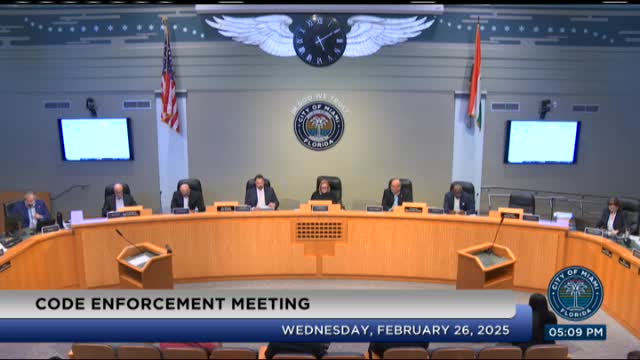
The City of Miami Code Enforcement Board on the evening of the meeting heard a long docket of cases related to short‑term and nightly rentals at Brickell on the River (41 Southeast Fifth Street) and issued multiple adjudications, including fines, per‑day penalties and immediate compliance orders.
The board adjudicated dozens of individual unit cases after city inspectors presented online listings, booking screenshots, guest reviews and copies of leases that the city said showed repeated early terminations of purported “30‑day” leases and active nightly listings. Inspector Eric Espinosa told the board he was able to make short stays on multiple listings while assembling cases for the city.
Why this matters: Board members said the pattern of frequent turnover harmed longtime residents’ quality of life and security and that the building’s Certificate of Use allows only residential occupancy—not transient lodging—unless the building secures a different certificate and certificate of occupancy. Neighbors testified the influx of different, short‑term guests produced noise, frequent hallway traffic and security concerns.
The board followed the evidence with formal votes. Several cases resulted in immediate compliance orders, per‑day penalties if the listing or conduct continued, and one or more large one‑time “irreparable harm” fees. Residents and the association repeatedly told the board that they had earlier warned unit owners and circulated a June 3, 2024 notice telling owners not to run rentals under 30 days. The city’s position — echoed by inspectors and several neighbors who testified — was that numerous units were operating as unlawful lodging because more than a handful of units were being used transiently, a legal status that would require a nontransient lodging certificate of use and appropriate occupancy approvals.
Inspector Eric Espinosa described the city’s evidence in multiple cases as a consistent pattern: online nightly listings tied to photos matching the condominium units, multiple separate short leases or “mutual terminations” that left stays of just days, and guest reviews or bookings that aligned with the short‑stay activity. Resident witnesses said they had repeatedly called the front desk and code compliance and that police had been dispatched on some incidents.
Resident Francesca Lucia, who testified as a neighbor and as counsel for other residents in some hearings, said, “This is not by happenstance. This is purposeful and willful violations of the law.” Jorge Castillo, another resident witness, told the board he had observed frequent luggage and changing people at units and said, “They are Airbnb guests and they’re there just for a few days.” Those firsthand accounts helped inform the board’s judgments on harm and penalties.
Votes at a glance (cases heard at 41 Southeast Fifth Street) - Case 113908 — Unit 1615: Board voted 5–2 to find the property guilty; ordered immediate compliance; imposed a $2,500 one‑time irreparable‑harm fee and a $1,000 per‑day penalty if noncompliance continued. (motion and roll call recorded in transcript) - Case 113922 — Unit 2210: Board found the property guilty; ordered immediate compliance and imposed a $10,000 irreparable‑harm fee plus a $1,000 per‑day penalty. (motion seconded and approved) - Constantine (owner) — Units 1102 and 2312 (cases in docket): Board found the properties guilty and ordered immediate compliance; the board imposed $10,000 irreparable‑harm fees and $1,000 per‑day penalties for the cases presented on those units. (motions recorded in transcript) - Unit 1717: Board found the property guilty, ordered immediate compliance, imposed a $15,000 irreparable‑harm fee and $1,000 per‑day penalty. (resident testimony and board motion recorded) - Unit 1008: Board found the property guilty; ordered immediate compliance and imposed a $15,000 irreparable‑harm fee and $1,000 per‑day penalty. (motion and second recorded) - Unit 1407: Board found the property guilty; ordered immediate compliance and imposed a one‑time fee of $50,000 (described in the transcript as an “approval fee”) plus a $1,000 per‑day penalty. (motion and roll call recorded)
The board heard and adjudicated other similar units during the same session; for many the city sought irreparable‑harm fees and per‑day penalties and the board issued immediate compliance orders. The transcript shows the board explicitly handled at least 15 cases tied to the same building in the hearing.
What the board said it could and could not order: City staff and the board attorney repeatedly told owners that the board could issue compliance orders and fines and could recommend removal of advertisements and other remedies, but the board does not itself change building certificates or issue occupancy permits; those are actions that require permitting and change of certificate of use/occupancy through city departments and — in some instances — building‑wide approval.
Next steps: The board’s written orders will be issued to the individual respondents and include deadlines for compliance. City inspectors said they will follow up to confirm that online listings are removed and that tenant or guest activity ends. Several residents and the association representatives told the board they plan to continue coordination with city staff and, if necessary, to pursue other legal remedies.
Ending: The meeting ran long and included dozens of public witnesses and property owners; board members emphasized case‑by‑case adjudication and cautioned against prejudging subsequent hearings. Several residents told the board they intend to press for follow‑up enforcement if the violations continue despite the orders.