
Board of Appeals upholds Entertainment Commission limits on Habibi Lounge’s late‑night entertainment
Get AI-powered insights, summaries, and transcripts
Sign Up Free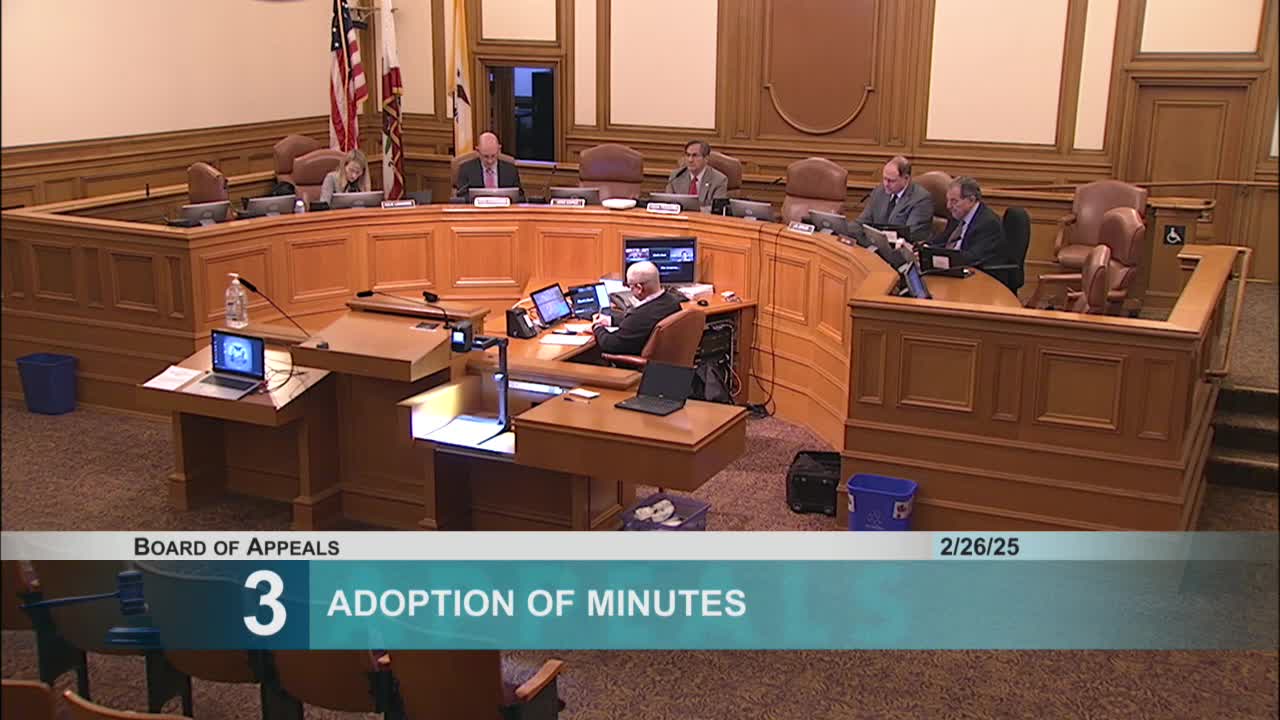
Summary
The San Francisco Board of Appeals denied an appeal by Habibi Lounge seeking later indoor entertainment hours, upholding the Entertainment Commission’s conditional permit that sets a 2 a.m. end time after a record of repeated permit violations.
SAN FRANCISCO — The San Francisco Board of Appeals on Feb. 26, 2025 denied an appeal from Habibi Lounge of the Entertainment Commission’s conditional approval of a place-of-entertainment (POE) and extended-hours premises (EHP) permit, leaving in place a 2 a.m. end time for indoor entertainment.
The decision preserves permit conditions the Entertainment Commission imposed after inspectors recorded multiple instances of unpermitted entertainment and outdoor amplified sound at Habibi Lounge, a restaurant at 26 Sixth Street. The Entertainment Commission cited repeated violations, multiple notices of violation and escalating fines as the justification for limiting late‑night entertainment, and the Board of Appeals concluded the commission’s determination stands as a matter of law.
Appellant Joe Benveniste, a California-licensed architect representing Habibi Lounge and owner Ali, said the business has sought later hours to serve late‑night customers and that neighborhood stakeholders, including the Tenderloin Housing Clinic and managers of the Seneca and Windsor hotels, had agreed to a later 3:30 a.m. closing time. Benveniste told the board he disputed some factual claims in the commission’s brief about health and assembly permits and said the business received a health permit on Aug. 8, 2024. “This is my first time doing it so give it my best shot,” Benveniste said during his presentation.
Caitlin Azevedo, deputy director of the San Francisco Entertainment Commission, defended the commission’s decision and detailed its enforcement history with the venue. “The time‑based permit condition is necessary and justified due to Habibi Lounge’s repeated noncompliance with the city laws, failure to adhere to permit requirements, and disregard for regulatory enforcement despite multiple educational efforts and citations,” Azevedo said. She described a sequence of inspector visits starting with a 3‑1‑1 sound complaint on Aug. 25, 2024, followed by notices of violation and citations on Sept. 8, Sept. 14, Oct. (two citations), Nov. (including a $500 citation), and Jan. 1, 2025.
Board members debated the scope of the commission’s discretion. Board President Trevino said he had “very real concerns about the commission’s use of its discretion,” noting the applicant had reached negotiated agreements with nearby residential stakeholders. Vice President J.R. Epler and Commissioner Rick Swig emphasized the commission’s authority under Police Code Article 15.1 to impose reasonable time, place and manner conditions and pointed to the venue’s compliance history. The board heard that the Entertainment Commission oversees roughly 800 active permits citywide and that extended-hour entertainment is limited and regulated.
A motion was offered to deny the appeal and uphold the commission’s conditional approval of the permits; that motion did not receive the votes needed to pass. With no additional motion offered, the board stated that “the underlying determination is upheld as a matter of law, which is the equivalent of a denial,” and the appeal was denied. A written decision will be issued to the parties the following day.
The commission’s permit conditions for Habibi Lounge include the 2 a.m. indoor entertainment end time (rather than the later hours the applicant requested), limits on outdoor amplified sound times for the rooftop terrace, a security‑guard requirement on busy nights, a requirement that patron queuing be directed up Sixth Street and away from Stevenson Alley, posted no‑loitering/no‑smoking signage and an internal sound abatement limit specified in the commission’s permit documentation. The commission noted the business paid the fines tied to citations and did not appeal those fines.
The board and the commission both said the business may seek a future modification of permit conditions after demonstrating a sustained record of compliance. Azevedo told the board that applicants may request to reappear before the Entertainment Commission to seek an amendment, and the commission will consider demonstrated compliance when weighing such requests.
The board’s decision preserves the Entertainment Commission’s conditional permit as written; it does not prevent the business from seeking future action under the commission’s established procedures if the venue corrects its compliance issues.