Get Full Government Meeting Transcripts, Videos, & Alerts Forever!
Get email alerts on the Immigration Policy topic
No spam. Unsubscribe anytime.
Senate committee advances bill to prohibit sanctuary policies; members trim penalties and defer some funding language
Summary
House Bill 133, which would ban sanctuary policies by local governments and require cooperation with federal immigration authorities, moved from the Agriculture committee with amendments that lower criminal penalties and leave disputed funding‑redistribution language for later action; public testimony included both support and opposition.
The Senate Agriculture, State & Public Lands & Water Resources Committee voted to advance House Bill 133, a measure that would prohibit sanctuary policies at state and local levels and require cooperation with federal immigration authorities.
Sponsor Joel Guggenmoss, representing House District 55, told the committee the bill “ensures uniform enforcement of federal immigration laws across Wyoming by prohibiting sanctuary policies at the state and local levels.” He described the bill as promoting cooperation between local governments, state employees and federal authorities and said it includes penalties for noncompliance and an immediate effective date.
Guggenmoss walked committee members through the bill sections as printed in the draft: definitions, prohibitions on local governing bodies (cities, towns, counties), penalties for noncompliance, protections for state employees from being hindered when they communicate with federal authorities, a prohibition on an executive order declaring Wyoming a sanctuary state, and statutory cross‑references. He said the measures have “nothing to do with race” and that they aim to keep immigration enforcement orderly.
During public comment, speakers ranged across the issue. Antonio Serrano, advocacy director for the ACLU of Wyoming, said, “The ACLU of Wyoming opposes house bill 133,” and warned the bill would push immigrant and mixed‑status families into the shadows and reduce trust in local law enforcement. Bob McClaren of the Wyoming Association of Municipalities said his organization represents the state’s cities and towns and stated they opposed the bill as unnecessary: “We represent the state's 99 cities and towns, and, we're standing in opposition to this bill… we don't believe this is necessary. There are no… sanctuary cities in Wyoming.”
Jeremiah Grama, representing the County Commissioners Association, urged revisions to ensure parity between local and state employees and questioned provisions that would withhold and redistribute certain funds: he told the committee federal formulas for funds such as PILT and Secure Rural Schools may prevent the state from redistributing those federal moneys in the manner the bill initially proposed. He said the bill’s original draft “does not say what happens if the state does any of those things,” and urged the committee either to apply penalties at the state level as well or remove the redistributive language.
Supporters included Brett Moline of the Wyoming Farm Bureau, who said his members backed the bill as a state‑level response while recognizing federal immigration policy requires congressional action.
Committee members debated penalties and other text changes. The sponsor accepted committee edits including: clarifying removal of an extra conjunction in a definitions line (the Olson amendment) and agreeing to language that would make penalties applicable to “any state, or local official or employee.” The committee also reduced the original proposed felony range from five‑to‑ten years and up to $20,000 in fines to a suggested penalty of two‑to‑five years and a maximum fine of $10,000. Committee counsel and members also recommended removing the clause that would redistribute certain funds (page 5, lines 10–18) and agreed to address state/federal funding questions before floor action.
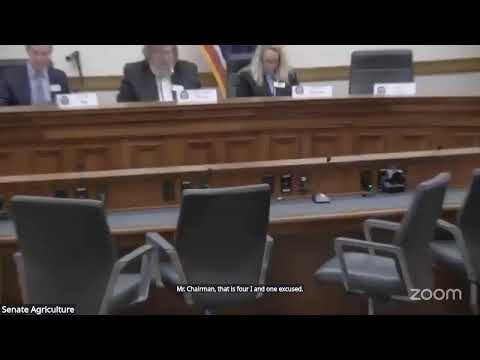
After working the amendments, the committee moved the amended bill out. The transcript records a roll call on House Bill 133 as amended: Senator Eyde (aye), Senator McEwen (aye, via absentee form), Senator Pearson (aye), Chairman French (aye); Senator Crago was recorded excused. The clerk reported “House Bill number 133 has passed, as amended … 4 in favor, 1 excused.”
The bill now proceeds to the full Senate for committee of the whole and possible floor amendments. Committee discussion recorded in the transcript shows members and stakeholders focused on penalty severity, whether state employees should be treated the same as local employees under the bill, and legal limits on withholding or redistributing federally allocated funds.