Get Full Government Meeting Transcripts, Videos, & Alerts Forever!
Get email alerts on the Wildfire Restoration Grants topic
No spam. Unsubscribe anytime.
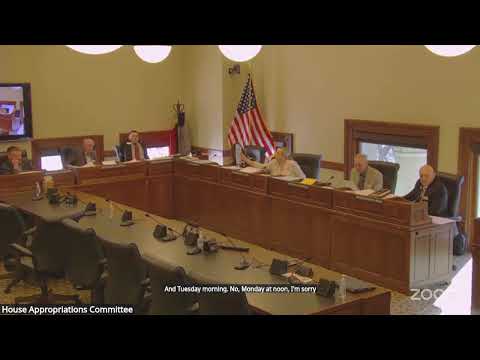
Committee passes wildfire restoration grant measure with amendments, 4-3
Summary
The House Appropriations Committee voted to pass Senate File 148 as amended, approving a smaller, grant-focused package to help communities recover from the state's recent wildfire season.
The House Appropriations Committee voted to pass Senate File 148 as amended, approving a smaller, grant-focused package to help communities recover from the state's recent wildfire season.
Senator Barry Crago, sponsor of the bill, told the committee the measure was intended to address landscape and watershed restoration after the summer's fires and to limit the state contribution to projects that provide a clear public benefit. "The conditions will be...the weeds will love it if we're not there to take care of it," Crago said, summarizing the need to treat invasive grasses and restore vegetation after fire.
What the bill does (as discussed) Crago said his original filing reflected a broader supplemental request; the version before the committee narrowed the scope to pay primarily for restoration of grass and vegetation destroyed by wildfires, invasive-species treatment and watershed-health projects. He described line items that replenish contingency and suppression accounts, restore money borrowed from LISRA, and provide grants to address watershed and vegetation needs. Director Greg Budd (presenting the implementing agency's approach) explained how grants would be prioritized and administered: counties would submit proposals through local weed-and-pest districts, conservation districts, game and fish or fire districts; projects would be vetted for permitting, matching funds and capacity. "This is probably all we could do in the coming year," Budd said of the state's capacity to treat post-fire acres.
Public testimony Ara Arano, representing Rocky Mountain Farmers Union, told the committee the union supports the bill, noting members' concern about invasive annual grasses. Monica Leininger of The Nature Conservancy described post-fire conditions that favor invasive annual grasses and urged the committee to fund post-fire invasive-species control efforts. Both organizations urged support for the restoration focus in the bill.
Amendments and committee action During markup members offered and adopted several amendments that reduced funding levels and adjusted language. Representative Carlson proposed striking the $100 million figure and replacing it with $40 million; that change was adopted as part of further amendment activity. Representative Harrelson moved language changes to reallocate a $10 million item (restoring lost public infrastructure) and to refine project language; Representative Hilsen subsequently amended the borrowing authority line to reduce $40 million to $30 million; Representative Angelos submitted conforming adjustments to headline totals. After amendment the committee recorded a roll-call vote on the amended bill: Angelos, Harrelson, Pendergraft and Sherwood voted aye; Aleman, Smith and Chairman Bair voted no. The committee reported the bill as passed 4-3.
Sponsor and administration notes Crago said the bill as amended narrowed the governor's original request and focused the larger appropriation on treating invasive species and restoring watershed function. He and Director Budd emphasized the grant process would prioritize projects by fire perimeter and readiness, seek matching funds and follow existing permitting and contracting practices. Budd noted that the appropriation cannot be used to make direct payments to private landowners; grants would operate at landscape scale and be administered through local and state partners.
Next steps The committee passed the measure with the amended appropriation levels and forwarded it for floor management. Sponsors and agency staff said they expect further adjustments and follow-up once on-the-ground needs are better understood and that additional funding requests could follow in subsequent sessions.