Get Full Government Meeting Transcripts, Videos, & Alerts Forever!
Get email alerts on the Performing Arts Center Master Plan topic
No spam. Unsubscribe anytime.
Tulsa Performing Arts Center unveils multi‑phase master plan; $79.7M renovation funded, larger expansion seeks private dollars
Summary
Mark Fry, chief executive officer of the Tulsa Performing Arts Center, presented a multi‑phase facility master plan that uses $79.7 million in IoT 3 funds for core renovation and proposes privately funded expansions including a West Side extension and a new 1,400‑seat theater.
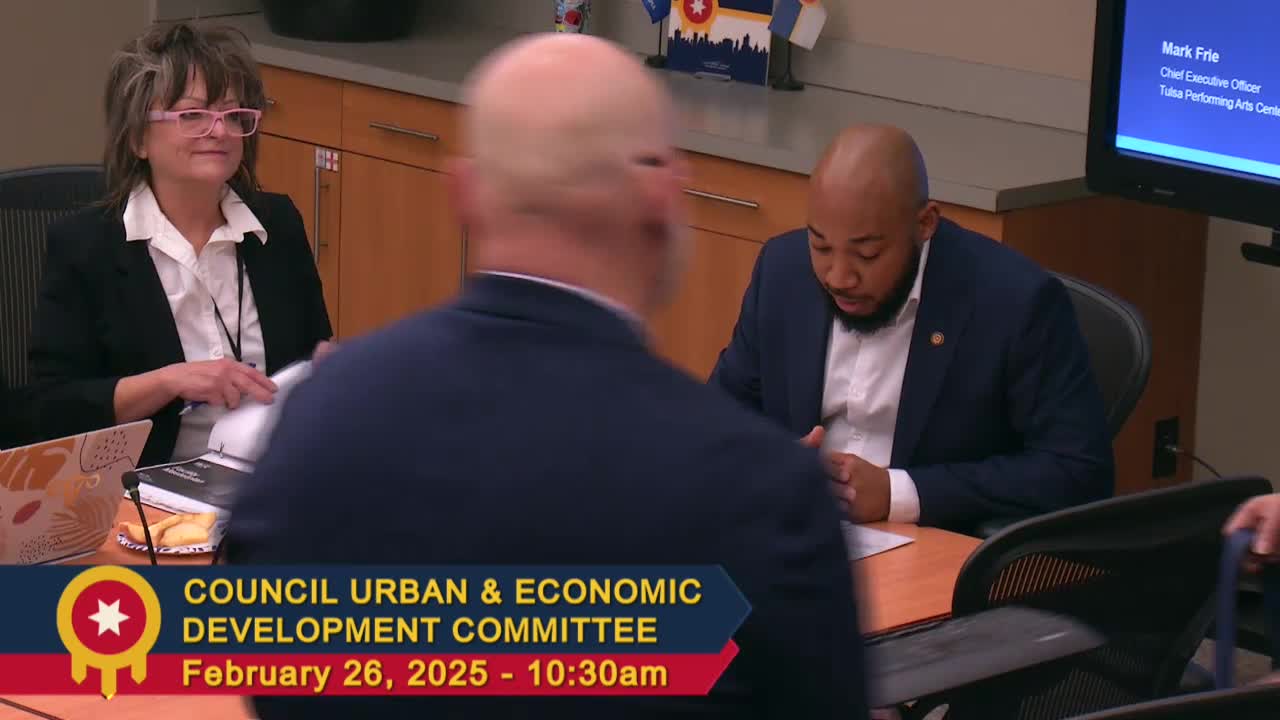
Mark Fry, chief executive officer of the Tulsa Performing Arts Center (PAC), told the City of Tulsa’s Urban and Economic Development Committee that the PAC has a multi‑phase facility master plan that uses $79,700,000 in IoT 3 funds for an initial renovation and relies on private fundraising for a West Side expansion and a new 1,400‑seat theater.
The plan calls for an extensive renovation to address deferred maintenance — including a covered east loading dock, new backstage dressing rooms and a passenger elevator, upgraded HVAC and mechanical systems, and regraded seating in Chapman Music Hall to add two central aisles for safety and accessibility. Fry said those items are the work IoT 3 will fund and that work is expected to require 30 to 36 months of closure to complete.
“I really believe that this is the right plan, for us to have a transformational world class performing arts center,” Fry said. He told committee members the PAC board expects the IoT 3‑funded renovation work to begin in earnest in early 2028 and estimated the initial phase would be substantially complete by late 2030, with final touches into 2031.
Nut graf: The renovation would modernize an almost 50‑year‑old facility and rectify longstanding safety and mechanical deficits, but the duration of the work raises financial and programming challenges for resident arts groups and downtown businesses. The PAC proposes to raise private funds for a 60,000‑square‑foot West Side expansion (estimated $46.6 million) with restaurant, bars, retail and roughly 50 additional restroom stalls, and to pursue a larger new theater on an adjacent surface lot (estimated about $110 million) that would add regional capacity.
Fry described the tradeoffs and risks for the performing arts ecosystem if the PAC shutters for renovations. He said the board is considering two approaches to maintain operations during a long shutdown: (1) complete West Side expansion fundraising and build that work concurrently with the IoT 3 renovation so the PAC can preserve greater program continuity; or (2) operate a large temporary structure — a highly engineered “theater tent” or “palladium” — while renovations proceed. Fry said rental of such a temporary theater would be about $3 per seat per day (roughly $2.5 million per year for a 1,400‑seat structure) and that a three‑year rental program could cost about $7.5 million.
Fry and trustees highlighted projected economic impacts: the PAC currently hosts about 900 events and 300,000 annual attendees, producing an estimated $60 million in annual economic activity; with the proposed expansions they estimate annual impact could rise to roughly $180 million. The PAC team also presented plans for a 250‑foot sky bridge linking new components and for reconstructed below‑grade parking to preserve City Hall parking if the surface lot is redeveloped.
Committee members asked for more detailed economic scenarios, funding‑mechanism analysis and program sequencing. Councilors raised options to support fundraising, including a council resolution of support, exploring hotel‑motel/tourism taxes or other tourism funding mechanisms, and confirming whether existing TIFs could be leveraged. Fry asked for an early council resolution to show potential private funders city support for the project.
Wendy Garrett, chairwoman of the PAC Trust, said the trustees have run feasibility work and community engagement, and that the board plans a capital campaign and advisory cabinet. Fry said the trust will hold a combined advisory council and trustees retreat in April to craft a capital campaign cabinet and detailed fundraising plan.
Ending: Fry told the committee that while the renovation is largely funded by IoT 3, the transformational elements depend on private gifts and coordination with city leaders. The PAC asked the council to signal support as trustees finalize fundraising and phasing analyses.