Get Full Government Meeting Transcripts, Videos, & Alerts Forever!
Get email alerts on the Economic Development topic
No spam. Unsubscribe anytime.
Empire State Development outlines budget bids for downtown Albany, Power Up electric infrastructure and semiconductor, AI investments
Summary
At a joint fiscal hearing, Empire State Development President and CEO Hope Knight described the governor's economic development priorities — expanded small‑business supports, a $400 million Downtown Albany initiative, a proposed $300 million Power Up program to address utility access, additional Fast New York funding, and new AI and semiconductor
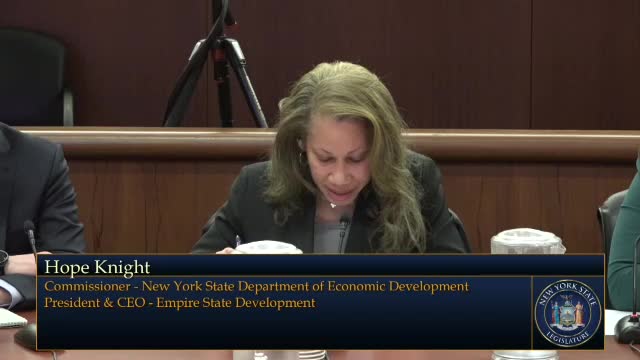
Hope Knight, President and CEO of Empire State Development and Commissioner of the New York State Department of Economic Development, testified to the Senate Finance and Assembly Ways and Means committees about the governor's economic development proposals, highlighting investments aimed at small businesses, reshoring manufacturing and building capacity for semiconductors and artificial intelligence.
At the hearing Knight described the budget proposals as focused on "supporting small businesses and entrepreneurs, building vibrant communities, growing the innovation economy, reshoring advanced manufacturing, and attracting investment in emerging and legacy sectors." She noted that the governor's executive budget would expand several longstanding programs and create new initiatives, including a $400,000,000 Downtown Albany program, a proposed $300,000,000 "Power Up" program to improve utility access at industrial sites, and an additional $100,000,000 for site-preparation through FAST New York.
Knight also outlined proposals intended to boost small-business financing and talent attraction. The governor would raise the cap on the Low Interest Capital Loan Program (LINC) to $1,000,000,000 to lower borrowing costs for small and midsize firms, and propose Catalyst New York, a tax credit that would go directly to workers at early-stage firms, intended to make New York more competitive for talent.
On technology and manufacturing, Knight said New York is "leading America's semiconductor resurgence," asserting the state has attracted more than $121,000,000,000 in new investments. The budget would create a new Excelsior Jobs Program tier for semiconductor supply-chain firms and would include workforce development and R&D initiatives. Knight described existing efforts — including the GoSemi office and site development work — and said proposed changes to incentives would aim to anchor semiconductor supply chains in New York.
Knight discussed film and media programs and called for first-in-the-nation initiatives including an Empire State Independent Production Program and a Production Plus program to support repeat production activity. She also reported that ESD is seeking $90,000,000 to expand Empire AI (and a related Harmony AI initiative) and that the state has committed funds connected to advanced tools and facilities, including preparing to house an extreme ultraviolet lithography tool at Newark Creates, with a projected delivery next year contingent on construction progress.
Lawmakers pressed Knight on a range of issues during Q&A: how much of the New York Rush appropriation had been committed (Knight said projects are in the pipeline but funding had not yet been allocated), whether $100,000,000 is enough for FAST New York site readiness (Knight said Power Up would be paired with FAST funding to address utility hookups), and when Empire AI and related facilities would move from planning to construction (Knight said consortium members have progressed and $90,000,000 was requested to expand capacity).
Several legislators raised concerns about MWBE utilization and the state's disparity study. Knight defended the legal sufficiency of the disparity study, saying it shows continued utilization gaps and that the administration would not re-do the study because it is constitutionally sound; she said the administration is pursuing programs to increase MWBE use and utilization. Other lawmakers urged additional outreach and support for minority-, women- and veteran-owned firms.
On workforce and site readiness, Knight described Power Up as intended to address a major barrier to attracting manufacturers — access to adequate utility and power infrastructure — and called Fast New York and site-preparation funding essential for keeping sites shovel ready. She said ESD continues to partner with localities on site development and to prioritize affordable housing and infrastructure when possible.
What was not decided: The hearing did not produce formal votes; lawmakers flagged several items for follow-up, including requests for additional detail on the Rush pipeline, FAST New York site counts, Empire AI expenditure plans and MWBE denial appeals. Knight and her staff promised to provide follow-up material to members' offices.
Ending: Knight said ESD will continue to work with the Legislature on specific program rules, site lists and project prioritization as the budget moves toward final negotiations.