Get Full Government Meeting Transcripts, Videos, & Alerts Forever!
Get email alerts on the Cannabis Regulation topic
No spam. Unsubscribe anytime.
Acting OCM director says licensing and staffing improved, launches Trade Practice Bureau as illegal market enforcement continues
Summary
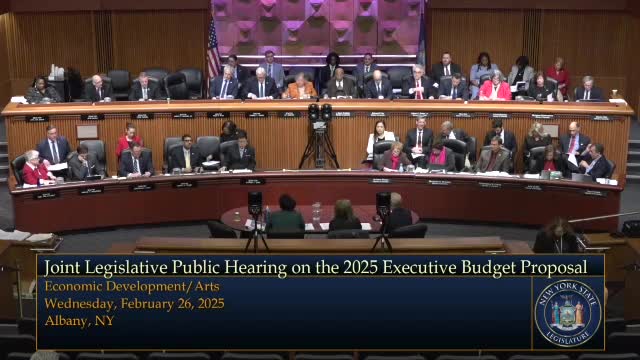
Acting Executive Director Felicia A. Reid of the New York State Office of Cannabis Management told the joint Senate Finance and Assembly Ways and Means budget hearing that the agency has increased licensing staff and moved hundreds of applications forward while continuing enforcement against unlicensed operators.
Acting Executive Director Felicia A. Reid of the New York State Office of Cannabis Management told the joint Senate Finance and Assembly Ways and Means budget hearing that the agency has increased licensing staff and moved hundreds of applications forward while continuing enforcement against unlicensed operators.
Reid, who testified during the fiscal committees' review of the governor's executive budget, said OCM hired nearly 50 staff since she started and that the agency now has roughly 215 employees across Albany, New York City and Buffalo. "Doubling OCM's licensing team has made navigating the application process more transparent," Reid said. She told lawmakers OCM has implemented a single-point-of-contact system so each applicant has an assigned case manager.
The testimony came as Reid asked the Legislature to approve a proposed $5,000,000 in the governor's budget to support additional hiring, licensing, compliance, enforcement and legal work and to increase OCM's staffing cap from 245 to 274.
Why this matters: New York's legal cannabis market reached about $1 billion in adult-use sales by the end of 2024, and legislators pressed OCM about whether the regulated market is growing fast enough and whether enforcement is reducing the illicit market. Reid said the agency and related state efforts "padlocked over 300 unlawful stores, saw more than 200 additional unlicensed operators close on their own, and seized nearly 7,500 pounds of illicit cannabis," describing those numbers as part of an enforcement push that runs alongside licensing and market-growth work.
Lawmakers pressed Reid on staffing, licensing throughput, enforcement and equity. Assemblymember Crystal Peoples-Stokes, chair of the cannabis oversight committee, asked how many licensing staff OCM had added; Reid replied that licensing staff grew from 21 when she arrived to about 47. Reid told the committee that since June 2024 OCM "has moved almost 193 more licenses through to the Cannabis Control Board for approval," and that overall hiring across the agency totaled "around 50-plus" in recent months.
Reid described other internal changes. She said OCM installed an Office of Internal Control and Audit, created a customer service team, reduced the agency's Freedom of Information backlog by about 25 percent, and launched a Trade Practice Bureau inside the Office of General Counsel "to go after operators who violate the two-tier market, undermine the development of local business, and who disregard New York's cannabis equity priorities." She said the new unit will investigate matters such as diversion, license stacking and other business malpractice.
On equity and statutory roles, several legislators raised the chief equity officer position created by the Marijuana Regulation and Taxation Act. Reid said she referenced the statute when drafting the job description and that the agency aims to preserve the statutory functions while also building internal DEIA capacity. Assemblymember Peoples-Stokes and others expressed concerns that a recent posting did not include the full statutory responsibilities and asked whether the role would have staff to fulfill its oversight duties.
Lawmakers also questioned OCM about market stability and supply chain issues. Reid said the agency remains "sanguine" about market stability but warned about oversaturation risks seen in other states. She noted recent cultivation approvals but observed that cultivation is often outdoor and that plants "aren't in the ground yet," so yields for the coming season remain to be seen.
Regarding enforcement, Reid said the agency's enforcement and compliance teams have conducted hundreds of inspections and issued corrective action plans; she told the committee compliance teams performed more than 210 inspections in the prior year and issued more than 1,018 findings. When asked whether any licensed operator had permanently lost a license for out-of-compliance behavior, Reid said that to date no license had been revoked and that most operators corrected deficiencies under agency oversight.
Several lawmakers asked about coordination with local law enforcement, training and technical assistance. Reid said OCM provides training and information-sharing to municipal and county partners, including Operation PADLOCK training for New York City, and that OCM works with the Department of Taxation and Finance on investigations that can cross into criminal matters. She said the agency is mindful of building cases carefully for hearings and possible legal review.
What was not decided: The hearing produced no formal votes or agency directives; legislators signaled they will continue oversight and may follow up on staffing, the chief equity officer role, proximity protections, and enforcement against illicit operators.
Looking ahead: Reid said OCM will continue its licensing reforms, increase enforcement capacity, and pursue the Trade Practice Bureau's investigations. She asked for funding and the staffing cap increase included in the governor's budget request so the agency can keep hiring and reduce application backlogs.