Get Full Government Meeting Transcripts, Videos, & Alerts Forever!
Get email alerts on the Affordable Housing topic
No spam. Unsubscribe anytime.
Developer asks Plantation CRA for $700,000 local match to build ~75 affordable units, seeks 30-year affordability
Summary
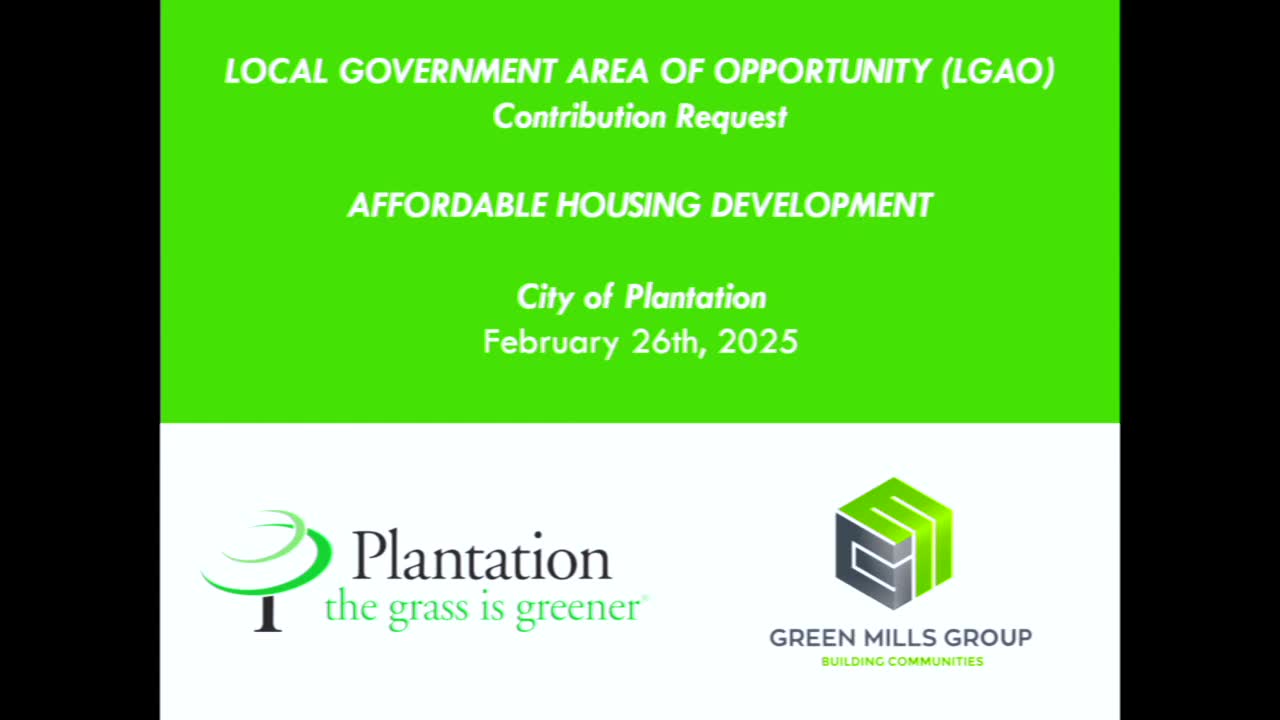
Green Hills Group asked the City of Plantation CRA on Feb. 26 to commit $700,000 as a local government match for a proposed roughly 75‑unit affordable housing project in the CRA district. The board approved the request 6-0; no site was identified and terms require later site-specific approvals.
Mitch Rosenstein, principal and cofounder of Green Hills Group, asked the City of Plantation Community Redevelopment Agency on Feb. 26 to commit $700,000 as a local government match to support development of at least 75 affordable housing units in the CRA district.
Rosenstein told the CRA the developer would cap most units at 80% of area median income (AMI), allow up to 20% of units at up to 120% AMI for flexibility, and commit to a minimum 30‑year affordability covenant (and said he would accept a 50‑year covenant if required by the state agency). He said the request is for a 0% interest, 30‑year loan with potential forgiveness at the end of the affordability period if covenants are honored.
The commitment, Rosenstein said, is intended to serve as the “local government area of opportunity” (LGA) match when applying to the Florida Housing Finance Corporation for low‑income housing tax credit and other state subsidies. He said the city would hold a first lien on the property once it is zoned for multifamily development and, at financial closing with larger construction and conventional debt, the municipal contribution would customarily move to a subordinate lien tied to recorded affordability covenants.
Why it matters: the CRA’s $700,000 commitment is intended to leverage a larger financing package and tax credit equity that Rosenstein said would support a roughly $30 million project. CRA funds used as a local match can increase an application’s score with the Florida Housing Finance Corporation, making state tax credit awards more likely.
Rosenstein described Green Hills Group’s operating model—on‑site management, amenity packages, background and credit screening, 12‑month leases and long‑term ownership—and said the firm historically keeps properties in its portfolio rather than selling. He said the company serves seniors, families and supportive housing populations and that many of its properties are fully occupied with waiting lists.
Several commissioners asked clarifying questions. Commissioner Fadgen noted no specific parcel had been identified and confirmed the CRA would return to review and approve any loan tied to an identified property and that Gateway taxes would be considered in the property tax picture at that later stage. He asked the CRA to include conditions that would return funds to the city if a sale occurred within a set period; Rosenstein said he was comfortable with such protections.
Commissioner Anderson asked how many units would be held at 80% AMI versus higher tiers; Rosenstein said about 80% of the units would typically be capped at 80% AMI with up to 20% potentially at higher AMIs, and said the developer would accept a fixed split if the CRA desired. Anderson also asked about parking and trip generation; Rosenstein said senior developments typically require fewer parking spaces (he cited typical parking ratios between 0.5 and 0.75 spaces per unit for senior properties) and warned that high parking requirements can drive up development costs.
City staff and Rosenstein said the developer was pursuing site control on multiple parcels (one parcel under contract and another described as a warm lead, both in the 441 CRA corridor), but no final site or site plan was before the CRA. Rosenstein said the city would not be asked to disburse funds until site acquisition and financial closing, and that the CRA could obligate funds in future fiscal years if it preferred.
Public comment included resident Dennis Conklin, who asked whether applicants with no credit score could qualify and whether the CRA commitment would cover both standard CRA mills and Gateway levies. Rosenstein answered that a literal 0 credit score would be challenging and "would probably disqualify" an applicant, and reiterated that the city’s financing documents and recorded covenants would specify eligibility and protections.
The CRA moved and seconded a motion to approve the commitment on the terms described and voted by roll call: Commissioner Anderson — yes; Commissioner Andreo — yes; Commissioner Fagin — yes; Commissioner Horland — yes; Commissioner Weinstein — yes; Commissioner Sordle — yes. The motion passed 6‑0. The CRA recorded no site and directed staff to return with site‑specific documents, loan agreements and recorded affordability covenants when a parcel is identified.
Rosenstein and CRA members repeatedly framed the proposal as contingent on later site approvals and on compliance with tax credit and fair‑housing rules; the city’s legal review and staff gateway process were noted as required next steps. Ending note: the CRA’s approval authorizes the agency to provide the LGA commitment to Green Hills Group to support the developer’s state subsidy application; any actual transfer of funds or lien placement will follow the identification of a specific parcel and completion of closing conditions.