Houston leaders unveil 'Metro Now' plan to boost safety, reliability and ridership
Loading...
Summary
Metro board chair Elizabeth Gonzalez Brock and Mayor John Whitmire announced 'Metro Now,' a package of safety, cleanliness, fleet and microtransit measures and multi-agency investments intended to increase ridership and improve transit reliability in Houston.
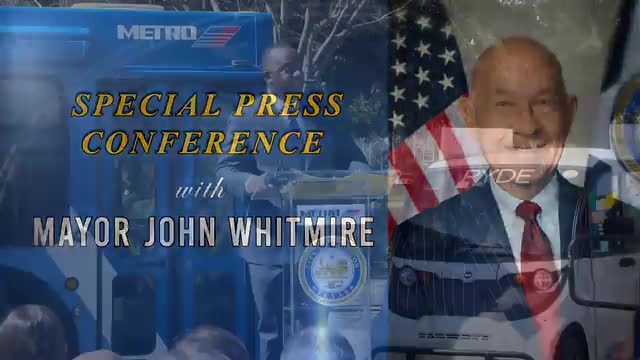
Elizabeth Gonzalez Brock, chair of Metro's board, and Mayor John Whitmire on the same day unveiled “Metro Now,” a package of initiatives to address safety, cleanliness, reliability and ridership across Houston’s public transit network.
The announcement, presented at a city press event with Metro board members and city officials, lays out a mix of operational changes, equipment purchases and partnerships aimed at restoring rider confidence and expanding first- and last-mile connections. "We are calling this set of initiatives, Metro Now," Brock said, adding that the program prioritizes increasing ridership and improving customer experience.
The plan includes new public-safety measures and staffing changes, an immediate commitment of funds to homeless services tied to transit sites, investments in major road corridors and traffic relief, and a range of service- and technology-focused steps. Brock said Metro will "appoint a new police chief" and coordinate deployments with the Houston Police Department, the Harris County Sheriff’s Office and constables. She told the press, "We will take back our buses, and our shelters, and our transit system from the homeless, and get back to our intended mission."
Brock outlined several specific investments announced as part of Metro Now: a $10,000,000 dedication to the mayor’s homeless initiative tied to transit cleanliness and safety; a planned $100,000,000 investment in heavily traveled routes in coordination with county and city partners; participation in a $200,000,000 traffic-relief plan for the Inner Katy Freeway with TxDOT; and a $300,000,000 partnership with city and county leadership to revitalize the Gulfton area, which Metro described as transit-dependent. Brock also said Metro will "replace 350 buses in our fleet, [and] a hundred Metro Lift vehicles," and will "right size" routes by moving large, underused accordion buses to areas where they are needed most.
Service changes announced include expanded microtransit and on-demand vehicle options. Brock described a free, app-based microtransit pilot operating in the Second Ward, Third Ward and downtown that is intended to help riders reach bus and rail lines. "Micro Transit is currently a free service ... and this is quickly becoming one of our more popular services," she said. Metro also plans to open new facilities such as a Missouri City Park-and-Ride that Metro said will connect more riders to the Texas Medical Center, and to prioritize direct routes between the airport and downtown and the George R. Brown Convention Center.
The initiative includes customer-facing technology changes: Metro said it will implement an "easy pay" fare system that accepts mobile payments such as Venmo and Google Pay, expand multilingual communications, and increase ADA accessibility work. Brock stated Metro has grown ADA accessibility "in over 5,600 shelters, sidewalks, and crosswalks," and said the agency will pursue additional accessibility and reliability gains.
Mayor Whitmire, speaking after Brock, framed the rollout as part of broader city momentum and tied it to major upcoming events. "It's a great day to be the mayor of the city of Houston," he said. He noted concerns from riders who say they do not feel safe using rail and bus services and said the administration would not wait until the World Cup or other events to improve transit for residents.
Brock said Metro will conduct an operational assessment aligned with a mayoral review, pursue data and AI tools "to improve routes and customer satisfaction," and identify efficiencies and best practices. Several items announced will require coordination and funding commitments from city, county and state partners, and Brock noted Metro had "repurposed" funds from existing projects to start some elements of the plan.
The announcements were presented as policy and operational commitments rather than final legislative actions; no council vote or board resolution was recorded at the event. Metro and city officials said they would provide additional details and timelines as work continues and as partners finalize funding and project scopes. A press availability for further questions was scheduled after the event.