Get Full Government Meeting Transcripts, Videos, & Alerts Forever!
Get email alerts on the South Corridor Busway topic
No spam. Unsubscribe anytime.
CITT hears South Corridor BRT and supporting infrastructure updates; busway service set to begin this summer
Summary
Alex Barrios, interim deputy director for the Department of Transportation and Public Works, said the South Corridor’s limited-stop busway service is programmed to begin on July 21, 2025, while related parking garages, station upgrades, a long shared-use trail and a new electric-bus operations center proceed through design and construction.
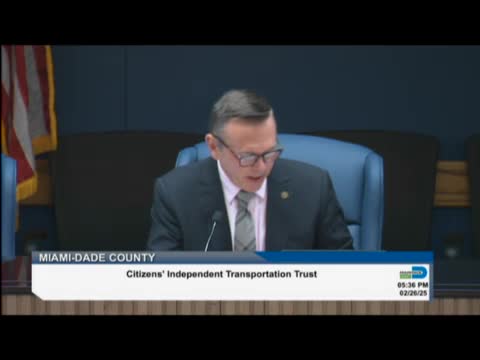
Officials with the Department of Transportation and Public Works told the Citizens Independent Transportation Trust on Feb. 26 that the South Corridor Transitway — a bus rapid transit (BRT) project — is on track to begin service this summer while a slate of supporting parking, station and operations projects move through design and construction phases.
Alex Barrios, interim deputy director for DTPW, said the limited-stop busway service is “programmed for the busway to begin service July 21” and that stations and related facilities are being delivered through a mixture of PTP (People’s Transportation Plan) dollars and federal and state grants. He told the trust that the 160th Street station platforms are on schedule even where associated parking garages are delayed by code and fire-suppression changes tied to electric-vehicle infrastructure.
The trust was given project-level briefings on multiple South Corridor elements: a roughly 644-space parking garage at 168th Street (budgeted at about $58 million, including a $9.5 million FTA grant and the remainder from PTP), a new park-and-ride at 260th Street (planning budget about $2.5 million, PTP and FDOT grants expected), upgrades at Dadeland South Intermodal station (PTP-funded work to extend canopies, replace escalators/elevators, add charger infrastructure and retrofit passenger amenities), and a Quail Roost transit parking element embedded in a larger transit-oriented development (PTD) that will include both county-owned transit spaces and developer-funded resident parking.
Javier Bustamante of DTPW described the 168th Street garage as nearing mechanical and electrical finish work and said the project’s remaining delay stems from the location and fire-suppression design for EV chargers; the team is targeting substantial completion in June and opening in August. He said the garage budget includes roughly $48 million in PTP funds and the $9.5 million federal grant.
On the corridor itself, DTPW officials described several system features and timing: the BRT will run a limited-stop “express” service that uses signal preemption and, uniquely, gate arms at intersections to protect higher-speed bus movements. Irene Hegeros, chief of Transportation Enhancements and Special Projects, said the gate-arm concept is being trialed on the corridor and the county has a conditional approval from the Federal Highway Administration; DTPW must complete a six-month operational study and return data to FHWA for final approval.
Planned passenger amenities include new public restrooms at three terminus locations, expanded covered walkways, enhanced bicycle storage (a mix of covered and uncovered), surveillance cameras at parking facilities and the addition of en-route chargers to support an electric bus fleet. DTPW reported that 17 electric buses have already been accepted and more vehicles are due so the South Corridor can be operated with electric buses when the BRT launches; the full procurement calls for a 100-bus electric fleet to be delivered through the year.
The trust also heard a briefing on the South Bay (South Dade) Trail, a proposed shared-use path roughly 20–22 miles long running near the transitway from Dadeland South to Florida City. Irene Hegeros said the project is in 30% design with community outreach upcoming; the project team plans lighting, drainage work, wayfinding, hydration stations and tree canopy improvements where possible. She noted that because right-of-way widths vary, full separated bicycle/pedestrian sections are not possible everywhere; the design therefore emphasizes clear roadway crossings, relocated pedestrian push buttons at 26 intersections and improved ramps at 11 intersections.
Cost estimates for the trail are substantially larger than the current design funds. DTPW said the county has roughly $14.6 million (about half PTP, half state) to complete design work, while the full project estimate is in the hundreds of millions (DTPW presented figures in the range of $140–$184 million depending on scope). DTPW staff said the trail will be segmented for funding and grant applications, and that federal funding would require committing to larger portions of the project.
Separately, the South Dade Transit Operations Center — a charging and operations complex supporting the electric fleet — is under construction. Barrios told the trust that the project’s scope expanded from an initial estimate of about $56 million (when it was planned as a conventional bus facility) to roughly $308 million as the county added electric bus charging infrastructure, administrative buildings and an emergency operations capability. He said the expansion reflects a change in program scope identified after initial planning.
Members of the trust asked detailed questions about parking counts, developer contributions at Quail Roost, the location and number of covered bike racks, and timing for escalator/elevator work at Dadeland South. DTPW officials said some station and garage schedules vary by project: the busway service start is targeted for July 21, 2025; the 168th Street garage substantial completion is targeted for June with a formal opening in August; other park-and-ride and garage projects will follow a design-to-construction cadence that, in some cases, extends into 2027–2030 depending on scope and funding.
Why this matters: the South Corridor BRT is the centerpiece of a broader package of PTP-funded investments intended to expand rapid transit and shift bus routes to higher-capacity, zero-emission service. The Corridor’s opening will reconfigure transfers at major intermodal nodes and is expected to change rider flows at Dadeland South and other terminus stations.
Next steps and follow-up: DTPW will continue design and construction, finalize the gating and preemption trials with FHWA, and provide the trust with follow-up details on parking counts, exact charger locations and final construction schedules as permit and procurement milestones are reached.