
Department of Consumer Protection seeks broad updates to licensing and enforcement powers; lawmakers probe potential impacts
Get AI-powered insights, summaries, and transcripts
Sign Up Free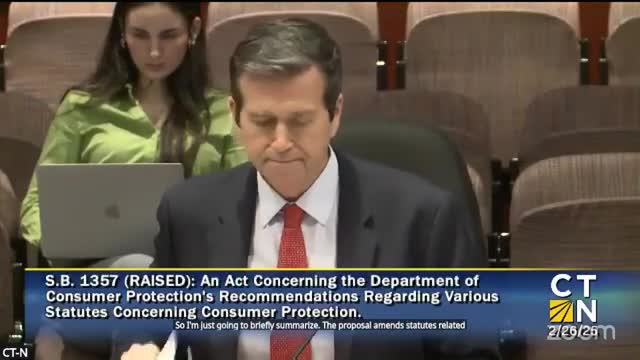
Summary
The Department of Consumer Protection presented a large, multi-part agency bill proposing licensing reforms, new stop-work authority, expanded restitution tools and clearer disclosure rules for dealers and retailers. Committee members pressed for clarifications on specific provisions and potential impacts on regulated professions including CPAs,
The Department of Consumer Protection outlined an expansive agency bill — Senate Bill 13 57 — that would modernize licensing processes, add enforcement tools, and revise multiple consumer protections across sectors from auto dealerships to home-construction guarantee funds.
Commissioner Brian Caffarelli told the committee the package "modernizes and streamlines processes for licensees," and highlighted changes including a site-specific stop-work order for unlicensed activity, alignment of food-safety enforcement with general enforcement powers, and expanded restitution pathways for consumers affected by construction and home-improvement defaults.
Committee members asked for specifics on high-interest sections. Representative Risigliano pressed the department on vehicle fee disclosures and optional versus mandatory dealer fees; the commissioner said the bill would require dealers to list fees and indicate which are optional. Representative Turco asked about newly proposed consumer protections for health-club contracts; Commissioner Caffarelli explained the bill would prevent automatic transfers of memberships to a new facility without written consumer consent and allow consumers to void contracts if an essential amenity — for example, a pool — is no longer offered.
Several professional groups filed testimony requesting technical fixes. The Connecticut Society of CPAs asked the committee to defer two sections (sections 1 and 2) tied to peer-review reporting and continuing education while the State Board of Accountancy prepares detailed amendments; the board expects to vote on a proposal in mid-March and the department agreed to coordinate.
The bill also contains changes to guarantee funds used to reimburse homeowners for bad home-contractor conduct, raising certain caps and clarifying recovery processes. Commissioner Caffarelli said the agency believes those funds are solvent and that the department routinely recovers funds from bad actors after reimbursement.
What happens next: Committee members said they will schedule follow-ups with DCP staff and affected professional boards (e.g., the State Board of Accountancy) to refine technical language, review fiscal impacts on guarantee funds and draft implementation details.
Why it matters: The DCP's package touches numerous everyday transactions — auto purchases, home repairs, new-home construction and health-club memberships — that directly affect Connecticut residents. The committee emphasized working with sector experts to avoid unintended consequences while improving consumer protections.