Get Full Government Meeting Transcripts, Videos, & Alerts Forever!
Get email alerts on the Poultry Disease Board Funding topic
No spam. Unsubscribe anytime.
Minn. turkey industry and Board of Animal Health press for funding as avian viruses spread; HF979 sent to Ways and Means
Summary
Turkey growers described heavy losses from highly pathogenic avian influenza and avian metapneumovirus and urged continued state support for the Minnesota Board of Animal Health. The committee moved House File 979 to the Ways and Means Committee; an amendment to increase emergency funding failed on a 6–7 roll call.
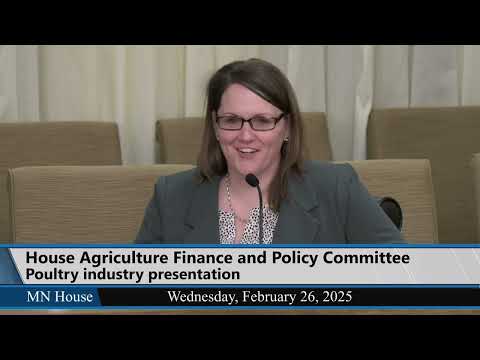
Chair Anderson, chair of the Minnesota House Agriculture Finance and Policy Committee, heard testimony on poultry disease risks and agency funding during the committee’s hearing that included presentations from the Minnesota Turkey Growers Association and the Minnesota Board of Animal Health.
Minnesota Turkey Growers Association Executive Director Ashley Coles told the committee Minnesota leads U.S. turkey production, raising roughly 40,000,000 turkeys annually on about 600 farms and supporting thousands of jobs. She and turkey grower Erica Sawatzki described recent disease impacts and urged continued investment in animal-health response capacity. “A silent barn is not only sad, but it’s truly very eerie,” Sawatzki said, describing arriving at a barn that later tested positive for highly pathogenic avian influenza and the subsequent depopulation and composting of the flock.
The presentation drew into sharper focus testimony from Dr. Brian Hayes, the state veterinarian and executive director of the Minnesota Board of Animal Health. Hayes said the state is facing multiple, evolving threats: highly pathogenic avian influenza (H5N1), cases in dairy cattle during 2024, and a more recently circulating poultry strain (D1.1) linked to migratory waterfowl. “We can no longer refer to this as a foreign animal disease. This virus is endemic,” Hayes told members, adding that the agency faces ongoing workload and staffing pressure as it manages multi-year response efforts.
Why it matters: committee members and speakers stressed that the Board of Animal Health and the Minnesota Department of Agriculture (MDA) are central to detecting and responding to poultry and livestock disease outbreaks. Witnesses said federal indemnity payments for bird losses remain federal funds administered through USDA programs, but state-level staff, testing, and emergency supports are necessary to sustain a long-running response.
Key details from testimony and department slides: - The turkey sector’s statewide size and economic metrics were highlighted: roughly 40 million birds on about 600 farms and multi‑billion-dollar economic contribution to Minnesota (figures cited by industry witnesses). - The board reported roughly a dozen highly pathogenic avian influenza detections in poultry since November (a mix of backyard and commercial flocks) and more widespread reporting of avian metapneumovirus since April of 2024; the latter is not indemnified under federal foreign-animal-disease funding. - USDA has begun a pilot milk‑surveillance program that requires PCR testing of milk for H5N1 in states including Minnesota and South Dakota; that testing program is being rolled out with preliminary federal reimbursement, and MDA said it began sample collection. - The Board of Animal Health receives a portion of its funding from USDA cooperative-agreement funds (the board described roughly 20% of its funding coming from federal cooperative agreements) and said those funds are subject to federal freezes and uncertainty. - The board described a small share of the state budget (described as under 0.1%–0.02% in testimony) allocated to the agency and said prolonged response obligations are straining staff morale and resources.
Committee action and bills: - Representative Jerry Anderson (chair) moved House File 979 to be re‑referred to the Committee on Ways and Means; the motion carried and HF 979 will go to Ways and Means. Representative Hansen’s A1 amendment to HF 979 — which would have inserted specific funding amounts and increased the agriculture emergency account — failed on a roll call, 6 ayes to 7 nays (see “Votes at a glance” below). Chair Anderson said the bill was intended as a vehicle and that final appropriation figures would be set later. - House File 1101, a related measure to fund the agriculture emergency account, was discussed; Representative Anderson moved the bill and it was laid over for possible inclusion in the omnibus bill. Representative Hansen offered an A1 amendment to HF 1101 that also failed on a 6–7 roll call.
What witnesses asked for: industry and farm groups (Minnesota Farm Bureau, Minnesota Farmers Union) urged larger, more predictable funding for the Board of Animal Health and the agriculture emergency account so response work (testing, PPE, indemnity administration, and rapid field response) is not delayed if federal funds are constrained.
Context and constraints: federal indemnity for birds is administered by USDA and remained part of the response conversation, witnesses said. The board and MDA emphasized that some programs — notably avian metapneumovirus response — are not nationally indemnified, so state funding is the primary avenue for supporting growers who suffer non‑HPAI losses.
Ending: Committee members signaled continued attention; Chair Anderson said the committee will continue work on funding levels through the Ways and Means process and that other bills tied to agency budgets will follow. The Board of Animal Health and MDA emphasized they will continue surveillance and response operations as spring migration and production cycles continue.