Get Full Government Meeting Transcripts, Videos, & Alerts Forever!
Get email alerts on the School Safety Shield Act topic
No spam. Unsubscribe anytime.
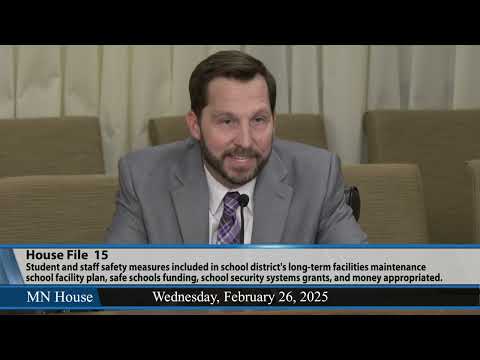
Committee approves referral of HF15, shield act funding for school security; A1 amendment adopted
Summary
The Education Policy Committee adopted an author amendment to House File 15 and voted to re‑refer the bill, which would create grant funding for multi‑layer physical security and communications systems in Minnesota schools, to the Committee on Public Safety, Finance and Policy after extensive testimony for and against the measure.
The Minnesota House Education Policy Committee on Feb. 26 adopted an A1 amendment to House File 15 and voted to re‑refer the bill as amended to the Committee on Public Safety, Finance and Policy.
HF15, described by author Representative Engin as the SHIELD Act, would create a grant program to allow school districts and certain schools to install layered physical security measures and related communications tools. Representative Engin said the bill focuses on providing “cover, concealment and communication” for students and staff and is not about gun policy or replacing mental‑health prevention work.
The nut graf: Supporters, including school administrators, school resource officers and safety consultants, said HF15 funds practical retrofits such as controlled entry points, magnetic locks, ballistic panels, duress alarms, mass notification and classroom reinforcements tailored to each building. Opponents warned the committee that over‑reliance on hardware risks diverting attention and funds from prevention, mental‑health services and threat assessment work.
Several current and former school leaders described how layered security worked in practice. Jason Polinski, a former school resource officer with more than 29 years in law enforcement, said he had investigated “over 55 threats of violence to public schools” since 2002 and called HF15 a “game changer” for response. Lakeville district witnesses — including administrators Joel Koski, Brett Domstrand and Superintendent Michael Baumann — described a multi‑layer system their district installed after a referendum and said the upgrades let staff secure more than 700 students in under a minute during drills. A district witness said the Lakeville system cost about $15 million for 15 schools (about $1 million per school) in the referenced installation.
Opposition testimony came from Rick Kaufman, executive director of community relations and emergency management for Bloomington Public Schools, who testified remotely. Kaufman said physical security hardware alone does not stop targeted attacks and cautioned against “security theater” that emphasizes industry‑sold products over prevention and intervention strategies.
Committee members asked about charter school eligibility, vendor requirements, whether grant money should prioritize Minnesota vendors and whether districts should follow an order of operations (for example prioritizing secured vestibules before other upgrades). Representative Engin said she had consulted charter schools and expected the committee to consider targeted amendments: to clarify vendor eligibility and require Minnesota vendor preference, and to allow district‑specific assessments that prioritize retrofit work based on need.
The committee adopted the A1 author’s amendment and agreed to re‑refer HF15 as amended to Public Safety, Finance and Policy. The committee chair made the motion, members voiced their support with “aye,” and the motion prevailed; no roll‑call tally was provided in the transcript.
The measure will be considered next by the Public Safety, Finance and Policy Committee, where Representative Engin said she will offer further technical amendments on vendor eligibility and scope.
Votes at a glance: The transcript records adoption of the A1 amendment and the committee motion to re‑refer HF15 as amended; both motions were approved by voice vote.