Get Full Government Meeting Transcripts, Videos, & Alerts Forever!
Get email alerts on the Pfas topic
No spam. Unsubscribe anytime.
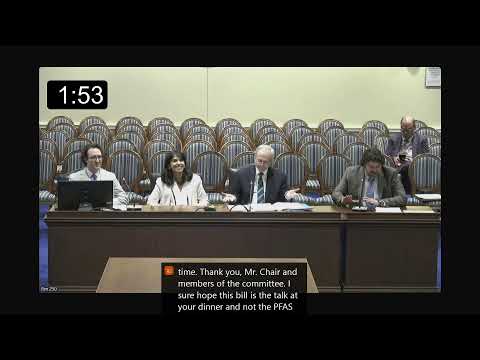
PFAS in sewage sludge draws sharp testimony as Maryland considers limits on land application
Summary
House Bill 909 would require testing and set limits for PFAS in biosolids prior to land application; environmental and community groups urged strict caps and rapid action, while wastewater utilities and counties warned of high costs and operational limits and asked for staged implementation and source-control provisions.
House Bill 909 would require testing of biosolids for PFAS and set concentration limits on PFAS in biosolids before those materials could be land-applied as fertilizer. Testimony on Feb. 26 drew starkly different perspectives from environmental advocates, local residents, farmers, compost/biogas technology vendors and wastewater utilities.
Advocates and residents argued land application spreads “forever” PFAS chemicals into soils, food and groundwater. Brent Wallace of Upper Potomac Riverkeeper said farmers and communities are now asking whether sludge applications have contaminated soils and wells. Environmental lawyers and groups urged limits aligned with EPA caution and said the state should adopt conservative biosolids limits to avoid the multi-million-dollar cleanups seen elsewhere.
Farmers’ representatives and county farm groups supported the bill’s intent but warned it must be tailored to avoid immediate collapse of beneficial reuse programs. They emphasized the importance of clear timelines on source control (identifying and reducing industrial PFAS discharges to sewers) and compensation options for producers and farmers if biosolids management is restricted.
Wastewater utilities and county associations urged caution. WSSC (Washington Suburban Sanitary Commission) and DC Water told the committee that utilities primarily receive passively-sourced PFAS from household and commercial products rather than producing it themselves. Utilities said analytical capacity and source-tracing to industrial contributors takes time and that immediate, very low numeric limits in statute would force municipalities to landfill or incinerate biosolids at very high cost. WSSC projected large capital requirements to build alternative treatment systems and noted the draft EPA risk assessment is not yet final.
Technical vendors representing non-incineration PFAS-destructive technologies (thermal gasification, pyrolysis, waste-gasification with high-temperature units and biochar production) testified that some technologies can yield PFAS-free biochar and energy recovery, but advocates countered those systems are unproven at scale and may produce emissions requiring careful regulatory oversight.
The hearing highlighted a policy tradeoff: immediate strict limits enacted in statute could protect farms and groundwater but create urgent and expensive solids-management problems for utilities; a phased regulatory approach tied to source-control and monitoring would shift responsibility to industrial dischargers and require resources to test and trace PFAS sources.
No committee action was recorded. Sponsors and MDE staff said they would continue dialogue on tiered limits and timelines to reconcile protection goals with operational realities for wastewater utilities.
(Reporting note: testimony summarized from committee transcript; numeric concentration examples reflect witnesses’ references in testimony.)