Get Full Government Meeting Transcripts, Videos, & Alerts Forever!
Get email alerts on the Reentry Workforce Development topic
No spam. Unsubscribe anytime.
Harrisburg discusses contracting with reentry employer CEO for cleanup and job pathways; union and funding questions remain
Summary
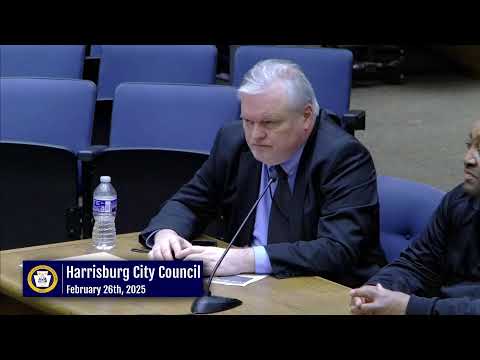
HARRISBURG — City officials and service providers discussed a possible partnership with the Center for Employment Opportunities (CEO) to supply transitional work crews for litter cleanup, other public-works tasks and job pathways for people returning from incarceration during a Harrisburg City Council policy work session led by Councilman Rodriguez.
HARRISBURG — City officials and service providers discussed a possible partnership with the Center for Employment Opportunities (CEO) to supply transitional work crews for litter cleanup, other public-works tasks and job pathways for people returning from incarceration during a Harrisburg City Council policy work session led by Councilman Rodriguez.
CEO site director Kia Hansard told council members CEO provides a short paid orientation called P2E followed by immediate transitional employment, daily pay on prepaid debit cards and a year of retention services. "CEO helps men and women returning from state correctional institutions establish a life not defined by their convictions," Hansard said, and noted CEO has operated in Dauphin County since 2017. Hansard said the program has served 764 participants since it opened there and that 152 people participated last year.
Why it matters: Council members framed the discussion as an opportunity to address persistent illegal dumping and other neighborhood maintenance needs while creating training and employment pathways for people reentering the community. Labor representatives and the city solicitor said the source of funding and contract design would determine whether a formal agreement is feasible under the city's collective-bargaining obligations.
CEO's model and local results
Hansard described CEO's two-day paid orientation, P2E, and transitional crews that work four days in the field with a vocational day for resume and barrier support. Participants can earn up to $500 in retention incentives during a one-year follow-up period after full-time placement. "We provide our participants prepaid debit cards. So they are paid daily," Hansard said.
Alonzo Piper, CEO's social enterprise manager who supervises transitional crews, and Kelly McDonough, director of the Dauphin County Department of Solid Waste Management and Recycling, outlined the existing county partnership. McDonough said the county began working with CEO on July 10, 2023, initially with one crew of eight participants and is now running two crews (16 participants per day). "Since our relationship began in July of 2023, they have collected 45.8 tons," McDonough said, and the county has an agreement with Lancaster County Solid Waste Authority for free disposal and a Keep Dauphin County Beautiful affiliation for supplies.
Labor and legal considerations
Tom Rivera, Pennsylvania Eastern regional field coordinator for AFSCME Council 13, said the union represents the city's nonuniformed employees and flagged the risk that contracted crews could duplicate work covered by the bargaining unit. "The only obstacle that's in front of me is making sure that anything that were to transpire from any kind of agreement... there's no duplication of our work," Rivera said.
City Solicitor Veil Grover told council the funding source is decisive: if the city used real-estate tax dollars to hire labor that the bargaining agreement covers, that could violate the contract. "If we take real estate tax dollars and hire people to do this labor, we are now violating the union contract," Grover said. He said arrangements funded by third-party grants would be a different legal scenario and that the city could negotiate terms or an MOU with the union as part of any design.
Public-works perspective and workforce pipelines
Director West of the city's public works department described existing models where some maintenance is contracted and other work is kept in-house. He said the department already partners with external groups for mowing, snow removal and other seasonal work and has hired formerly incarcerated people into permanent city sanitation jobs. West emphasized insurance, training and logistics as key operational issues and noted Capital Region Water's role in street cleaning equipment and coordination.
Next steps and council direction
Council members and presenters identified follow-up items rather than taking action at the session. Councilman Rodriguez said CEO had previously supplied a sample contract and said he would reissue it to council. He also agreed to provide a cost analysis. City staff said the administration would discuss program design in senior management meetings and with the mayor's office; Grover said any third-party agreement would likely come to council for approval. No formal motion or vote occurred during the work session.
The record
Speakers asked about whether CEO accepts referrals from county jails and work-release programs (Hansard confirmed yes), the scope of permissible tasks, grant funding sources (Hansard and McDonough identified PCCD violence-intervention prevention funds as supporting crews), and union impact. City staff and union representatives indicated they are willing to negotiate designs that avoid displacing bargaining-unit employees while allowing supplemental crews where lawful.
There was no public comment during the session and no decision; council members asked staff to pursue design options, consult AFSCME, and present contract language and cost estimates to the mayor and council for later consideration.