Get Full Government Meeting Transcripts, Videos, & Alerts Forever!
Get email alerts on the Behavioral Health Funding topic
No spam. Unsubscribe anytime.
Bert Nash warns Douglas County of growing budget shortfall as Medicaid enrollments fall
Summary
At a Feb. 26 Douglas County Commission work session, leaders of the Bert Nash Community Mental Health Center warned that rising service demand, a surge in uninsured patients following state Medicaid disenrollments, and fewer Medicaid payment-triggering visits have produced a projected shortfall in the center’s 2025 operating budget unless local, state and payer partners act.
At a Douglas County Commission work session on Feb. 26, Patrick Schmitz, president and CEO of the Bert Nash Community Mental Health Center, told commissioners the center faces a budget shortfall driven by rising service demand, a larger uninsured caseload after recent Medicaid disenrollments, and lower-than-expected Medicaid prospective payment system (PPS) triggers.
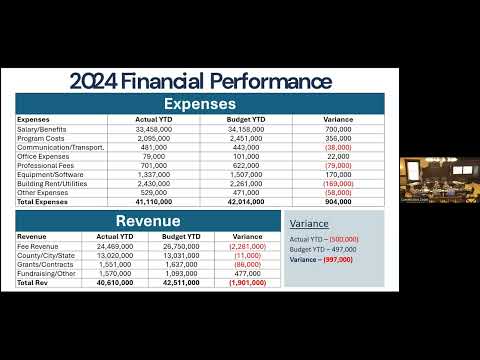
Schmitz told commissioners the organization has grown substantially since 2018 — from about $13 million in annual operations to roughly $41 million in 2024 — and that its 2025 budget assumptions show expenses near $43.7 million, about $1.7 million higher than 2024. He said fee revenue is projected to cover about 59% of revenue, county funding about 17% and state funding roughly 13%, and that a mix shift away from Medicaid PPS-eligible visits toward uninsured and commercially insured visits has reduced the PPS revenue the clinic can claim.
Why it matters: Bert Nash is the region’s designated community mental health center and a Certified Community Behavioral Health Clinic (CCBHC). Commissioners were shown that the center’s cost of care outpaced what commercial insurers and Medicare reimburse, and that the Medicaid PPS rate remains the only payer source that approximates actual cost. Schmitz said the Medicaid “unwinding” — the end of continuous enrollment rules — led to state-level disenrollments (the center cited a statewide figure of about 114,000 Kansans losing Medicaid, or roughly 21% of enrollees) and a measurable rise in uninsured patients at the center.
Key takeaways from the presentation: - Service levels: The center reported substantial growth in services since 2018 and a marked increase in uninsured patients in 2023–24. Schmitz said the center provided more visits and services in 2024 than budgeted and that fewer PPS-triggering Medicaid visits than expected reduced PPS revenue by about $1.6 million relative to expectations. - Financials: For 2024 the center showed roughly $42.2 million in total cost of care. Non-Medicaid fee revenue (commercial and Medicare) did not cover the cost of care for those payer groups; commercial and Medicare reimbursements combined were far below the cost of serving those patients. The center reported an actual operating shortfall in 2024 of about $500,000 (the difference between budgeted and actual results after expenses and revenue), and earlier in the materials a $1.9 million gap between budgeted and actual revenue was highlighted. - 2025 budget assumptions and responses: The draft 2025 plan assumes limited new growth, pauses hiring on many open positions, delays some training and raises, and considers selling or repurposing lightly used transitional housing (referred to in the session as "Bridal/Bridal house"). The center is negotiating commercial contracts and reviewing sliding-fee policies, county support, fundraising and state/legislative requests (including a request tied to the state mental-health reform pool and a separate youth recovery grant).
Quotes and attribution "We are a safety net provider," Patrick Schmitz said, describing the center’s obligation to serve uninsured and underinsured people in its catchment area. He told commissioners: "We exist because of you," addressing the county’s role as a major partner and funder.
Steven O’Neil, chief operations and strategy officer at Bert Nash, described negotiations with commercial payers bluntly: "Their job is to return a profit to their shareholder, period." O’Neil and Schmitz said those dynamics make it difficult to secure higher commercial rates and that outside negotiators have had limited success persuading insurers to materially raise payments for the center’s services.
Dr. Kirsten Watkins, the center’s clinical director, described how clinical teams make placement decisions: "We always are thoughtfully making decisions about care and, trying to match people with the services that they need. Those are always clinical decisions..."
County questions and clarifications Commissioners pressed for detail about where county funds are allocated and how much of the center’s operating shortfall is covered by reserve funds. Commissioner Kelly asked about fund balance and the 2024 deficit; center staff said the organization’s total reserves (including an endowment) are roughly $3–4 million, but most of that is an endowment with limited flexibility and cash on hand at the end of 2024 was about $200,000–$300,000. Schmitz said the center took a $1.5 million endowment withdrawal to stand up the CCBHC model and that the endowment is not a source to “easily pull” to cover operating shortfalls.
Programs and pressures Schmitz and staff highlighted several expensive services that drive costs: the Treatment and Recovery Center (TRC), the mobile response team, assertive community treatment, and transitional housing and recovery campus planning (the "Rockledge" project and a proposed youth recovery campus were discussed as capital/expansion projects not expected to appear in the 2025 operating budget). The TRC, they said, has a low Medicaid penetration and a high proportion of uninsured patients; the center also pays annual rent to Douglas County for space used by the TRC (presenters and commissioners discussed a rent figure described as "over $800,000" annually).
Steps under consideration Center leaders outlined a set of potential steps to close the funding gap: renegotiating commercial contracts, increasing billed prices to the maximum allowable, adjusting sliding-fee scales, tightening service access or focusing on priority populations, pausing new hires and delays in raises/training, reducing leased space and pursuing targeted fundraising and state legislative dollars (including potential increases to the state mental-health reform pool). Schmitz emphasized the need to include payers, employers and state partners in discussions about financing and care delivery.
What the county should know next Schmitz asked the commission to treat the presentation as an early warning and to continue close collaboration: the center will finalize its 2025 budget after further negotiations and expects to present more detailed, line-item operating information to county staff in the coming weeks.
Ending note Schmitz closed by noting the center serves roughly 420 staff and stressed the public-health and community impacts of its services, saying he preferred an “uncomfortable” budget conversation now rather than deferring and risking service disruptions later.