Proviso 209 staff outline FY26 budget timeline, contract renewals and proposed student fees
Loading...
Summary
Proviso Township High School District 209 finance committee received updates on a FY25 budget amendment scheduled for March 11 and an FY26 planning calendar that includes revenue projections in March-April and tentative board approval in June.
Proviso Township High School District 209 finance committee received updates on a FY25 budget amendment and planning for the FY26 budget, plus previews of contract renewals and proposed student fees.
Dr. Hill (recorded in the transcript as the presenter) said the district will present a single-line FY25 amendment to the full board on March 11 to ensure compliance with the district's administrative cap. Dr. Hill then summarized the FY26 calendar: stakeholder input and department budget development through March; revenue projections with the township treasurer in March and April; salary and benefits and special-request reviews with human resources and the business office; a draft budget expected by April or May; a tentative board review and approval in June; a 30-day public display; and a public hearing with final budget adoption expected between August and September.
Dr. Hill told the committee that about 30 to 40 percent of district revenue typically comes from state and federal sources and that the district currently holds roughly six months of reserves. He said that while some federal and state funding "is uncertain," required programs such as Title I and IDEA are expected to continue. Dr. Hill recommended caution on major new projects until reserves are rebuilt as the district completes major construction work with Gilbane.
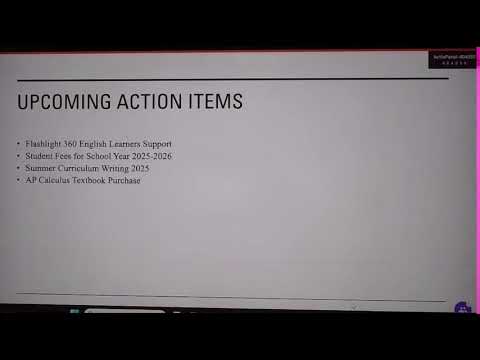
Technology, curriculum and contract renewals were next on the agenda. Staff previewed several contracts that expire in June and will return as action items to the board in March. Items identified in the meeting include: - Renaissance Star: the universal screener for grades 9'12. Renaissance recently acquired Nearpod; staff noted Nearpod's record-book and grouping features that can integrate with Renaissance data. The presenter said the district had used a free version of Nearpod and will consider the integrated offering. No pricing or contract length was provided in the transcript. - Nearpod: discussed as part of the Renaissance acquisition and as instructional content that can be used to support differentiated instruction. - Newsela: an existing reading platform the district has used for several years; staff said usage and teacher support training have produced positive feedback. - Flashlight 360 and Summit K'12: tools referenced for English learner (EL) supports and formative assessment; staff said these are funded through federal grants (Title I funds were mentioned as the funding source for EL supports).
Staff also previewed textbook adoptions (chemistry and physics pilots), an AP Calculus textbook action item, and a summer curriculum-writing initiative estimated at about $64,000 to update or create curricula not substantially revised since 2015.
On student fees, staff said the district is exploring several modest fees to generate additional revenue post-COVID: a registration/enrollment late fee structure, a summer school fee, and a technology fee. The technology proposal referenced in the meeting included a $25 annual baseline technology fee and a $100 laptop replacement fee; staff discussed fee waivers for families who qualify for free or reduced-price lunch and other safeguards to avoid denying access to students who cannot afford fees. The committee discussed widespread charger loss and replacement costs and the district's practice of collecting senior laptops each year to recycle as replacements.
Staff said the district orders about 1,300 devices for incoming students and that an estimated one student per day at both campus sites requires a replacement device; staff described warranty arrangements and a process for repair and replacement. No final decision on fees was recorded; staff said proposed fees and contract renewals will return as formal action items to the board in March.
Committee members asked about the effect of federal/state funding uncertainty; Dr. Hill reiterated that reserves (about six months) provide a buffer and that required federal programs such as Title I and IDEA remain priorities. No formal votes were recorded in the transcript.