Get Full Government Meeting Transcripts, Videos, & Alerts Forever!
Get email alerts on the Department Finance topic
No spam. Unsubscribe anytime.
Parks Department reports roughly $10 million in grants and donations since 2017; seeks funding for wildfire resiliency and park projects
Summary
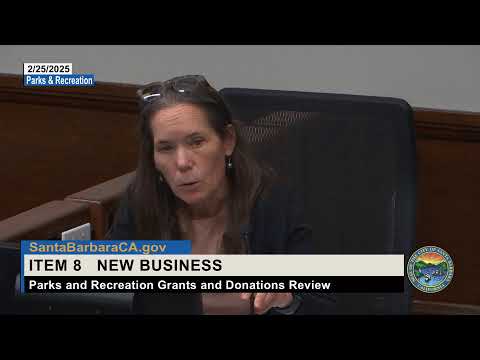
Parks and Recreation staff summarized grants, donations and volunteer support from 2017–2024, reporting about $10 million total (roughly $4.1 million from state sources) and outlining pending grant seeks for wildfire resiliency, the Ambassador Park Chumash Cultural Project and Ortega Park.
Parks and Recreation staff presented a summary of grants, donations and volunteer contributions covering roughly February 2017–2024 and told the commission the department has received about $10 million in outside funding and donated services over that period.
Jeremy Gill and Director Joe Zachary said roughly $4.1 million of that total came from state agencies (including Cal Fire and the State Coastal Conservancy) for capital and resilience projects. Staff highlighted major projects and funding sources: Cal Fire support for the Wildfire Resiliency Project, State Coastal Conservancy grants for coastal and open-space projects, Community Development Block Grant (CDBG) funds used historically for playgrounds and neighborhood parks, and trust/endowment funds for parcels like the Douglas Family Preserve and Parma Park.
Staff described several pending grant efforts: an augmentation of the Cal Fire wildfire-resiliency award toward nearly $1 million (subject to final work plans and Conservancy approval) and a $240,000 preliminary-design grant for the Chumash Cultural Project at Ambassador Park that the Coastal Conservancy board would consider in April. Staff also said Ortega Park would be the likely project to pursue under the Outdoor Recreation Legacy grant opportunity because it fits program eligibility.
Staff explained how donations and in-kind support have been used. Examples include private foundations underwriting free swim lessons and summer programs (a recurring foundation grant of approximately $37,000 per year was cited for the department’s summer drop-in program), Park Foundation management of tax-deductible gifts, and private or corporate in-kind contributions such as donated paint or trees purchased by nonprofit partners (for instance, Santa Barbara Beautiful purchases some trees used in plantings).
Commissioners asked about trends and capacity. Director Zachary noted that competition for state and federal funds has increased, with fewer per-capita allocations and more competitive grant pools in recent years; she described the overall grant environment as more challenging than in earlier decades when larger state bond programs provided more predictable per-capita funding. Commissioners also discussed volunteer labor: staff noted that donated labor is difficult to accept for capital projects when prevailing-wage rules apply, although donated materials and other in-kind contributions remain useful.
Staff said grant funds are held in a miscellaneous grants fund to protect donor intent and that Park Foundation partnerships and endowments (for example, the Parma Park Trust and Douglas Family Preserve endowment) are important mechanisms for longer-term maintenance funding. Volunteer hours and program-specific donations were also tallied and discussed as part of the department’s broader funding mix.
Staff asked commissioners to help raise awareness about the Park Foundation and community funding opportunities; they said foundation and donor connections can improve competitive grant leverage and show community support when applying for larger grants.