Get Full Government Meeting Transcripts, Videos, & Alerts Forever!
Get email alerts on the Synthetic Turf Regulation topic
No spam. Unsubscribe anytime.
Pompano Beach planning board tables synthetic‑turf text amendment after wide-ranging debate on drainage, trees and neighbor impacts
Summary
The board voted Feb. 26 to table a staff‑initiated text amendment on synthetic turf to the next meeting (March 26), asking staff to return with revisions addressing seawall setbacks, tree drip‑line protections, perimeter edging/barriers, drainage/permeability standards and enforcement/amortization considerations.
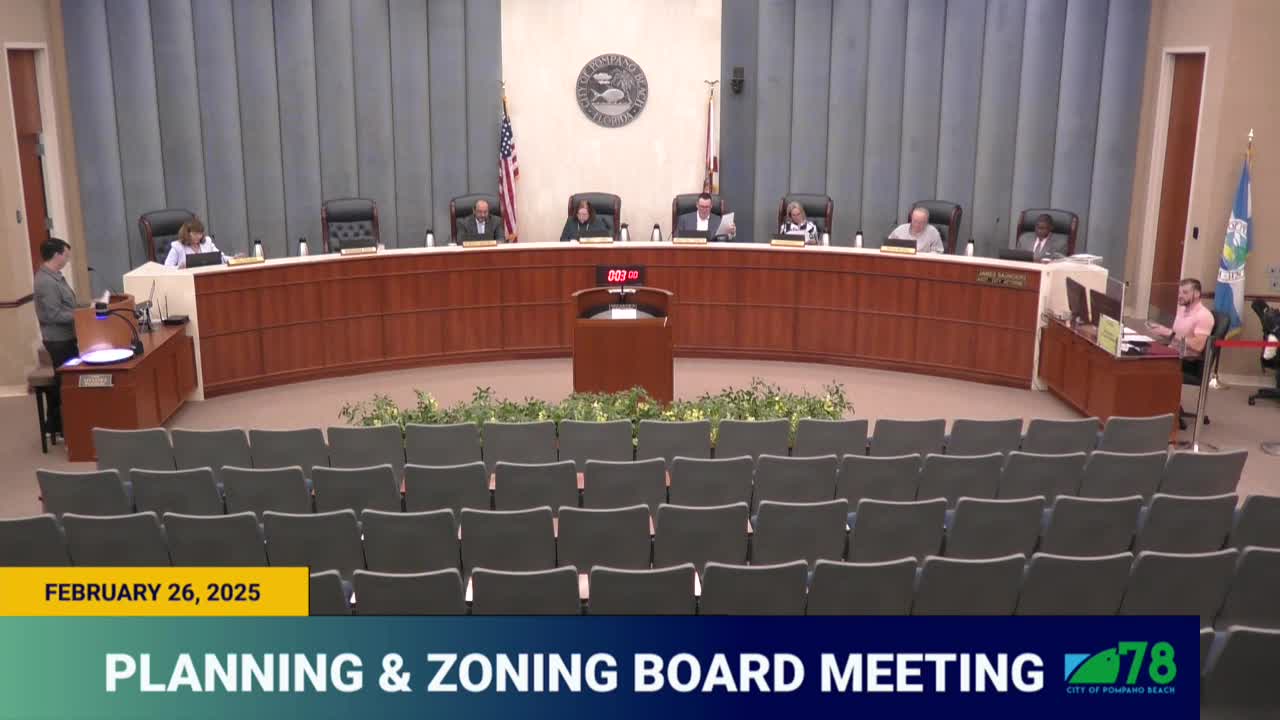
The Pompano Beach Planning and Zoning Board on Feb. 26 voted to table a staff‑initiated text amendment that would regulate synthetic turf in single‑family and two‑family lots, asking staff to return next month with revisions addressing drainage, tree protection, seawall setbacks and neighbor‑interface issues.
Max Weems, principal planner in Development Services, presented the draft language and said the city's existing code does not explicitly regulate synthetic turf; the proposal would allow synthetic turf for single‑family and two‑family properties only if the installation meets specified design, permeability and maintenance standards and if the property provides a stormwater management plan for single‑family/two‑family installations.
"Living material cleans the air, cleans the water, allows direct recharge into our water supply," Weems said, explaining why the city currently ties pervious‑area requirements to living plant material and why staff proposed standards for synthetic turf that include a minimum pile height, a minimum face weight, polyethylene material and a minimum permeability rate. Weems said staff also proposed installation standards (compacted subgrade with a porous base, anchored seams, silica‑sand infill or engineer‑approved substitute) and that any synthetic turf installation would require a building permit.
Board members raised multiple concerns during a robust discussion: drainage and how a compacted subbase for turf would affect stormwater runoff; erosion and the proximity of synthetic turf to seawalls; protection of tree drip lines and health of mature trees; neighbor conflicts where synthetic turf abuts natural lawns and risks from landscapers and mowing equipment; heat concerns on synthetic surfaces; enforcement challenges for stormwater maintenance; and whether an amortization period should be provided for existing noncompliant installations.
Carrie Ann Worley asked whether sod installation requires a permit; Weems said sod does not typically require a building permit, and added that the proposed rules would require a permit for synthetic turf. Several board members urged a physical barrier or edging between synthetic turf and neighboring lawns to avoid damage and migration of infill; Weems said staff would draft perimeter edging standards and clarify drip‑line language.
Robert Hartzell moved to table the text amendment to the board's next meeting on March 26, 2025, to allow staff time to revise the draft to reflect the board's comments. The motion was seconded and passed in a roll call vote with all members present voting yes.
Staff said it will return with revised draft language that may add: a required physical edging between synthetic turf and adjacent lots, explicit prohibition of turf within tree drip lines, a defined setback from seawalls or waterways, clearer language tying turf allowance to stormwater engineering that meets a specified permeability standard, and consideration of whether an amortization period is appropriate for existing noncompliant installations.
The board did not take a final position on whether synthetic turf should be treated as pervious or impervious in all instances; staff's draft ties the allowance to an engineered stormwater plan and to manufacturing/installation standards.
Notes: item was introduced as agenda item LN687 (text amendment).