Get Full Government Meeting Transcripts, Videos, & Alerts Forever!
Get email alerts on the Traffic Calming topic
No spam. Unsubscribe anytime.
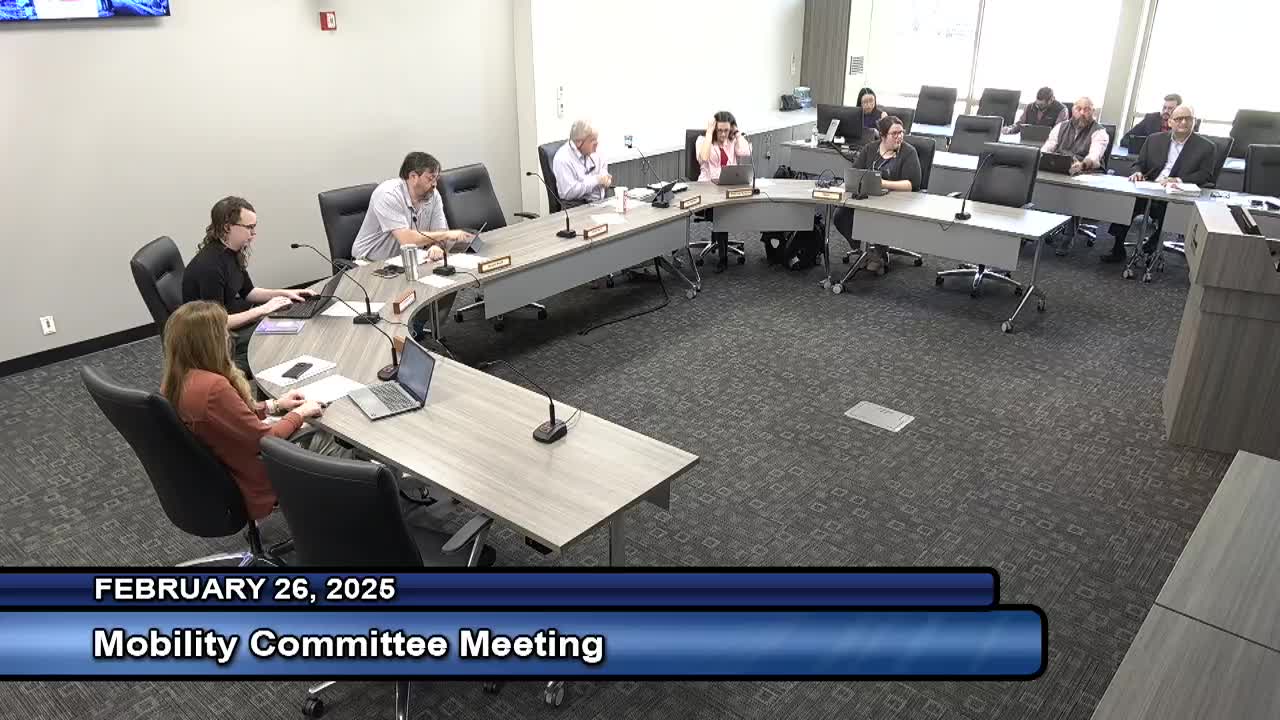
Mobility committee weighs traffic calming, staff to return with implementable recommendations
Summary
City staff presented traffic-calming principles and evidence showing lower speeds reduce crash severity; committee members asked staff to pursue policy changes, design standards updates and include economic-development effects in prioritization.
Greg Scott, City of Denton Transportation Services Division bike, ped and ADA coordinator, told the Mobility Committee that traffic-calming — which he defined broadly to include speed management and design that intentionally engages drivers — reduces speeds and the severity of crashes and works best as a coordinated package of treatments.
Scott said the city has moved toward prioritizing human life over travel speed and comfort and that calming “uses design to communicate proper behavior.” He warned the conventional approach of widening and prioritizing vehicle speed sends the wrong message and is linked to higher pedestrian risk: “you can't prioritize both speed and safety,” he said.
The presentation summarized evidence the committee was given, including crash-modification factors that estimate how specific calming treatments change injury-crash rates, and federal guidance encouraging calming approaches. Scott described how relatively small changes — for example, speed pillows or curb geometry — can compress the range of vehicle speeds and reduce stopping distance and crash severity. He also noted tradeoffs and community trust challenges, saying drivers may be upset because calming “adds some really relatively minor risk” in the right of way to reduce far greater risks to people outside vehicles.
Committee members welcomed the shift from short-term enforcement toward longer-lasting engineering fixes. Councilor Holland and other members asked staff to examine how new street designs are creating conditions that invite speeding — citing recent collector segments such as Highland Park Road and Parvin — and whether the Transportation Criteria Manual and other planning standards should be revised to avoid creating future problems.
Farhan, deputy director of the Transportation Services Division, said staff has drafted initial updates to the Transportation Criteria Manual and expects the first round of significant updates to be presented within the next one to two months; a more in-depth standards review will follow and include other departments such as police and fire.
Members also asked staff to include economic-development considerations when prioritizing calming projects, citing downtown and corridor examples where slower, pedestrian-friendly streets support businesses. Scott and staff said they will return with implementable recommendations and an action plan at a future meeting; staff informed the committee that several smaller projects are already in the queue for implementation based on completed traffic studies.
Committee requests and next steps captured in the meeting record include: staff to provide an implementation plan of recommendations (timing and funding implications), an update on Transportation Criteria Manual revisions, inclusion of economic-development metrics in project prioritization, and examples of low-cost paint/striping treatments for near-term use.
The committee did not take a formal action on the presentation; Scott said staff will come back with recommended next steps.