Get Full Government Meeting Transcripts, Videos, & Alerts Forever!
Get email alerts on the Litter And Creeks topic
No spam. Unsubscribe anytime.
City outlines Clean Creeks program, reports years of litter removal and plans for digital coordination
Summary
Austin Resource Recovery and Watershed Protection briefed the committee on the Clean Creeks program, which includes litter crews, partnerships and plans for a digital cleanup-tracking platform; staff said operations remove creek debris and coordinate with encampment outreach.
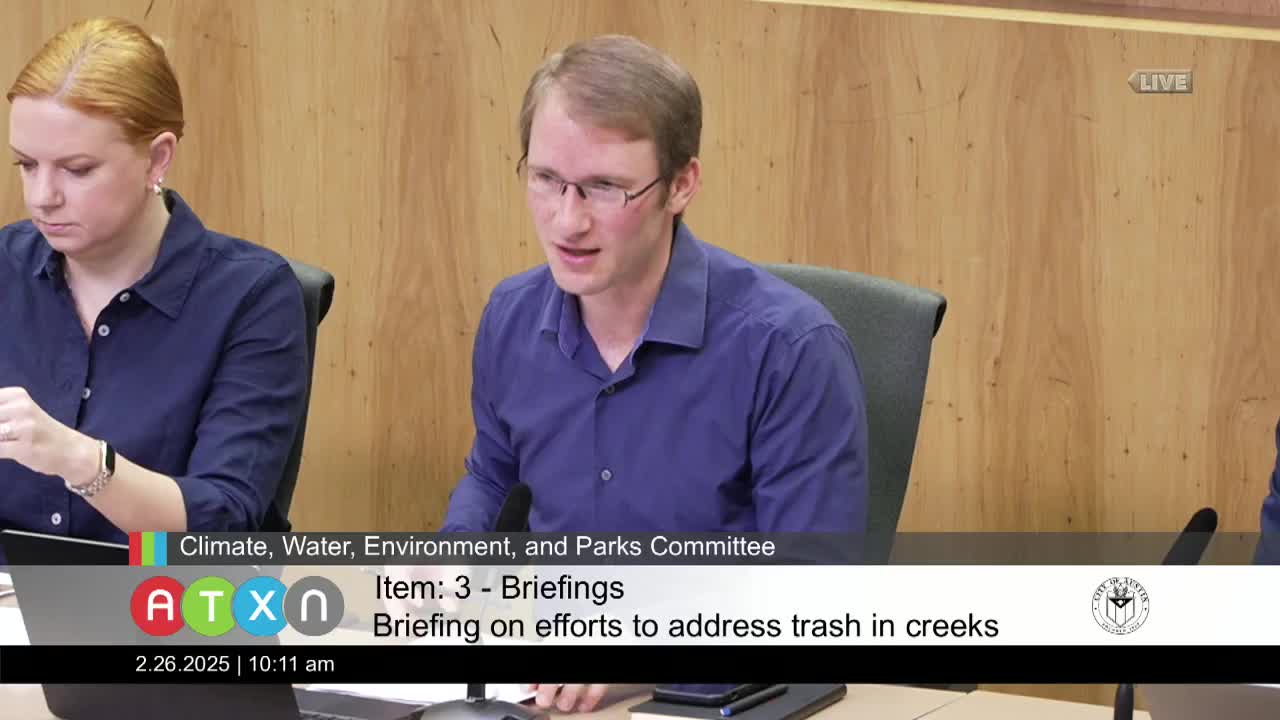
Austin Resource Recovery and Watershed Protection updated the Climate, Water, Environment and Parks Committee on municipal efforts to remove trash from creeks and reduce litter entering waterways.
Richard McHale, director of Austin Resource Recovery, and Amy Slagle, assistant director for litter abatement, described the Clean Creeks program developed after a 2020 council resolution. The program was operationalized in 2022 and currently includes six full-time staff dedicated to creek cleanup. Crews clean approximately 50 sites twice monthly; operational and partner teams also remove litter as part of encampment cleanups, street sweeping and special-event services.
McHale told the committee that crews and partner programs collected thousands of tons of litter citywide: combined litter-abatement teams removed more than 7,800 tons last year across streets, creeks and public areas. Slagle said tonnage spiked in 2023 due to several encampment removals that produced concentrated debris, and tonnage fell in the last fiscal year as regular maintenance reduced recurring accumulation.
Program details staff provided: - Operations: Six FTEs assigned to Clean Creeks; crews maintain about 50 sites two times per month and add sites based on Watershed referrals and complaint-driven discovery. - Partnerships: Work with Watershed Protection, Keep Austin Beautiful and volunteer groups; coordination with Parks, Transportation and TxDOT on areas within state right-of-way. - Services: On-demand bulk and brush collection expanded to three pickups per year for residents; city sweeps residential streets up to six times per year and downtown daily. - Prevention and diversion: Business incentives to reduce single-use styrofoam and noncompostable packaging; 2024 council action to limit single-use plastics in city facilities was cited by staff. - Tracking and metrics: Staff proposed a digital platform to spatially track cleanups and identify service gaps; planned metrics include tons removed and linear miles cleaned.
Council members and staff discussed notification and coordination with TxDOT, ways to add creeks to the program (one public speaker requested Country Club Creek East be added) and the role of volunteer organizations. Jason McCombs, division manager for strategic initiatives, said ARR awarded about $19,000 in grants last year to help businesses convert away from disposable containers and that outreach to restaurants, multifamily operators and business associations is ongoing.
ARR said its current staffing and contracts are meeting program needs but that it is continuing to evaluate resource needs as the program evolves and partnerships expand. Staff will convene a litter coordination group to align nonprofit, city and state cleanup efforts and will pursue a digital data system to improve planning and reporting.