Get Full Government Meeting Transcripts, Videos, & Alerts Forever!
Get email alerts on the Workforce Development Green Jobs topic
No spam. Unsubscribe anytime.
Presenters and community groups urge funding and staffing for Austin Civilian Conservation Corps pathway
Summary
Program partners and participants told the Joint Sustainability Committee that the Austin Civilian Conservation Corps (ACCC) and its partners provide work, training and conservation services but face budget shortfalls that threaten ongoing operations.
Speakers representing the Austin Civilian Conservation Corps (ACCC) and partner organizations told the Joint Sustainability Committee that the ACCC pathway supports workforce development and environmental stewardship but faces funding and staffing shortfalls.
Chase Wright, president and executive director of the Hungry Hill Foundation, described his group's workforce training and homelessness‑exit services and said Hungry Hill has partnered with ACCC for more than two years. "We initially started out in the pilot process until we received measurements of success," Wright said, adding that his organization had a city career‑development contract worth about $720,000 over five years and that annual funding for year two was roughly $144,000. He said the contract language included contingencies and that losing the partnership would affect many clients who depend on low‑barrier work opportunities.
Park Smith, chief executive officer of American Youth Works, described a long partnership with the city and said his program runs two 10‑person crews in ACCC and overall employs roughly 20 young people a season. Smith said the consolidated contract supporting conservation crews and ACCC crews totals "about $1,600,000" annually and that the program is facing an estimated shortfall "somewhere around 250,000, 2 hundred and 50 2 thousand, something like that." He said an AmeriCorps grant of about $400,000 had helped cover stipends this year.
Juan Espinosa, program manager for the Austin Civilian Conservation Corps, told the committee ACCC currently has two full‑time staff and three partner agreements (American Youth Works, Hungry Hill Foundation and Austin Youth River Watch). He said the program was moved into the Economic Development Department and that other competing pathways originally proposed for ACCC (environmental education, recreation, museums and zero‑waste pathways) are on hold because of funding constraints. "Some projects were put on hold. However, we still have myself and Kirsten here," Espinosa said. He described recent accomplishments including planting more than 400 seedlings and mapping hundreds of acres of invasive species in fiscal year 2024.
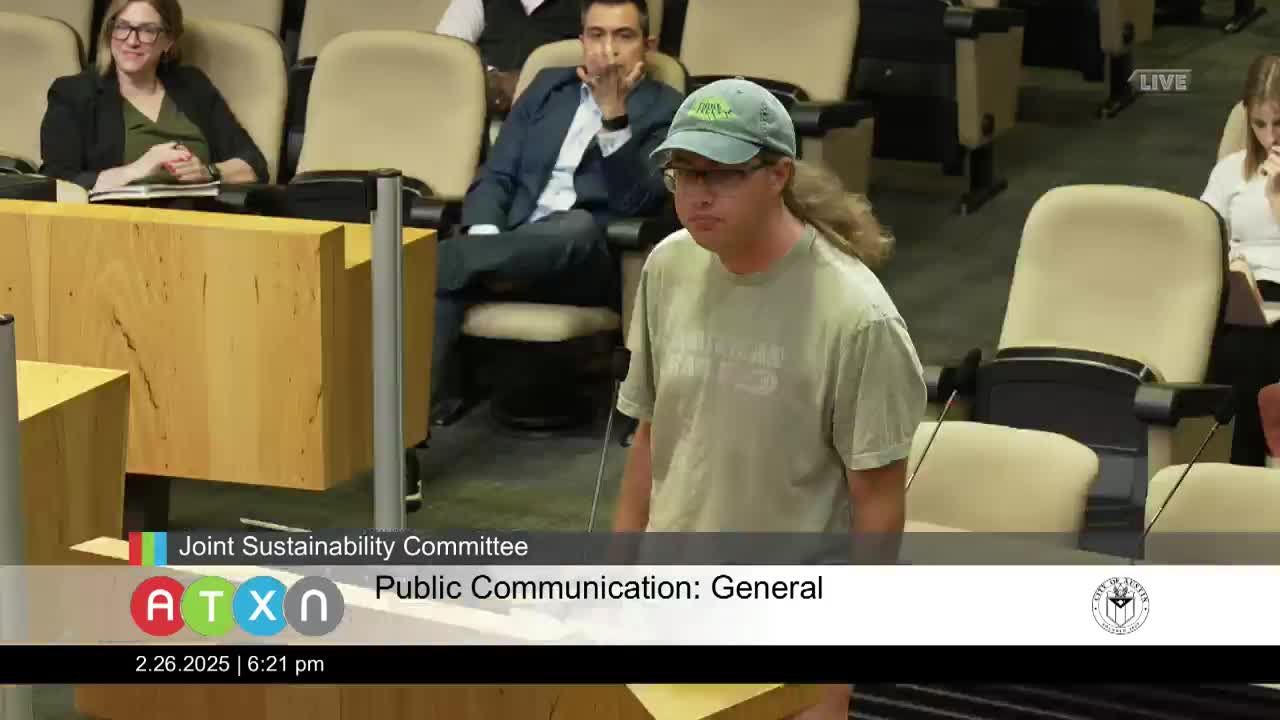
A public commenter and ACCC crew member, Zachary Leeper, described on‑the‑ground benefits of natural‑systems work: "One of the biggest benefits I've had out of this program is learning a lot more about natural systems, and how climate change is affecting them," Leeper said. Park Smith and others urged continued funding for ACCC pathways and for the city to identify new, recurring resources rather than one‑time funds.
Committee members asked about where ACCC could be housed and whether the program could gain recurring budget support; staff replied they were pursuing grants and inter‑departmental funding options but that long‑term, recurring funding had not been secured. Espinosa said the program had applied for grants including a congressional earmarked urban forestry proposal and had a NOAA grant pending.
No formal committee action was taken on the ACCC presentation during the meeting; members said the topic and budget needs would be considered as the committee develops budget recommendations.