Get Full Government Meeting Transcripts, Videos, & Alerts Forever!
Get email alerts on the Prison Safety topic
No spam. Unsubscribe anytime.
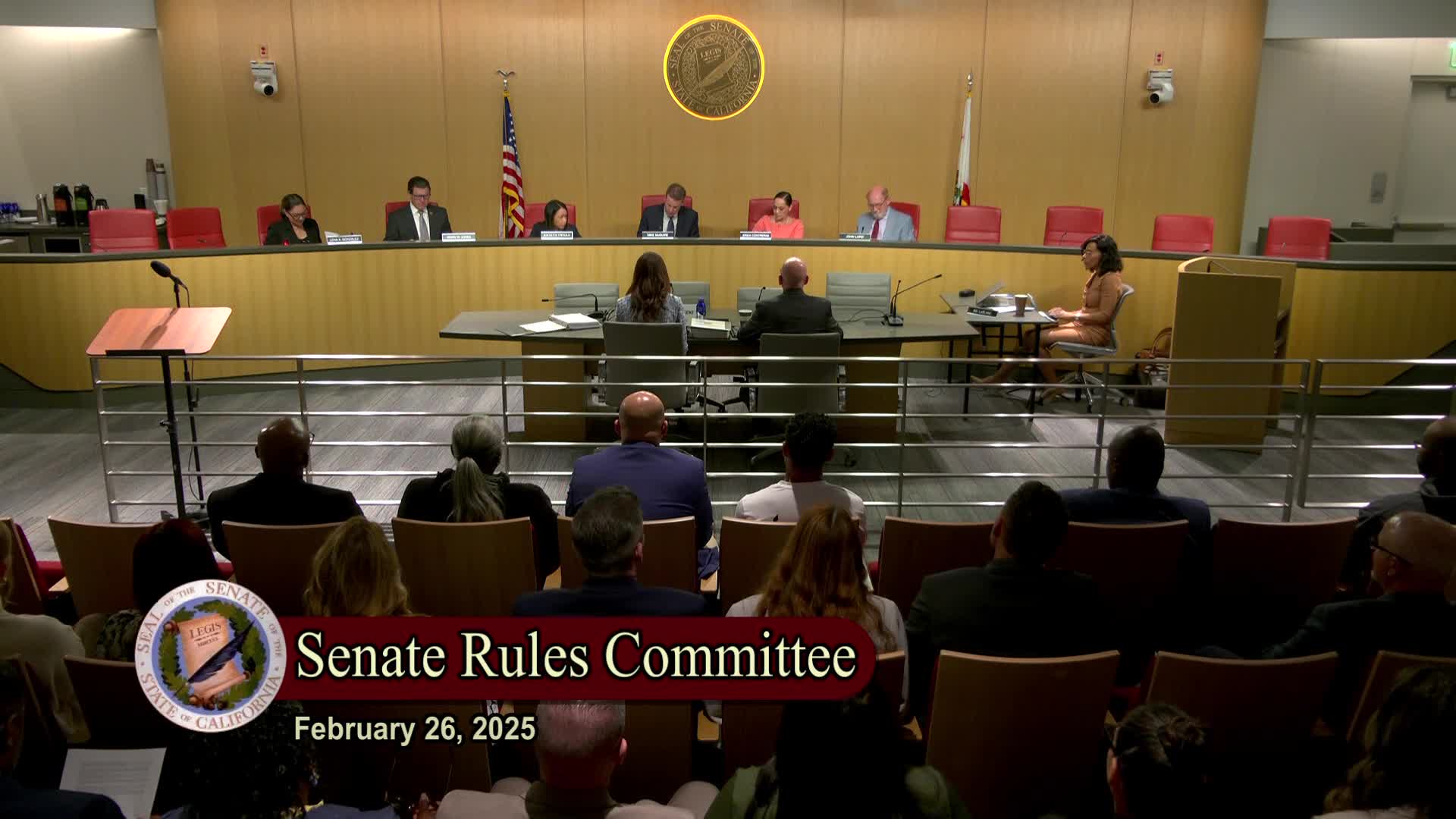
Senate Rules Committee advances two CDCR associate director nominees after questions on women’s prison safety
Summary
The California Senate Rules Committee voted 4-0 to advance Angela Kent and Patrick Eaton to the Senate floor for confirmation as associate directors at the California Department of Corrections and Rehabilitation after a hearing focused on safety in women’s facilities, PREA compliance and body-worn camera policies.
The California State Senate Rules Committee voted to advance two nominees for associate director positions at the California Department of Corrections and Rehabilitation (CDCR) after a hearing in which members pressed nominees on safety, reporting and oversight at the state’s women’s prisons.
Associate Director Angela Kent, nominated for the division of adult institutions in Region 2, and Associate Director Patrick Eaton, nominated for Region 1, each gave opening remarks and answered questions about how CDCR is addressing allegations of staff misconduct, the agency’s tracking of referrals for prosecution and recent reforms aimed at preventing sexual misconduct.
“The floor is yours,” Chair Powell told the nominees before Kent spoke. Kent said she was ‘‘thankful to be in front of you today seeking confirmation’’ and described her 26-year career in probation and parole, her work focused on programming for women and her commitment to ‘‘promoting staff wellness and fair and equitable treatment for those incarcerated, particularly our women.’’ Kent also named external partners she said the department works with on prevention and training, including Just Detention International and the Anti-Recidivism Coalition.
Committee members focused most of their questions on measures to prevent sexual misconduct and ensure accountability. Kent described ongoing efforts tied to the Prison Rape Elimination Act (PREA), including a PREA prevention working group, quarterly town halls, PREA peer education, and what she described as improved training for staff. She said CDCR began providing a course called “safety matters” totaling 22.5 hours of training for staff working with women, and that the department has designated PREA compliance lieutenants in the women’s prisons.
“We have been fully compliant,” Kent said, referring to documentation CDCR provided to the U.S. Department of Justice, and she said the department is “looking forward to what that investigation produces so we can continue our improvements.”
Committee members also asked about CDCR’s misconduct tracker and how internal complaints are handled. Chair Powell said he had data showing cases referred for prosecution from 2019 to 2024 and a separate internal tracking system that covers 2022 to the present; he asked CDCR to provide a cross‑comparison of those datasets and a year-by-year breakdown of misconduct categories. Kent said cases referred to the Office of Internal Affairs are entered into the tracker immediately and that referrals meeting the elements of a crime are sent to district attorneys for prosecution.
The nominees described the use of body-worn cameras in women’s facilities. Kent said policy changes will require the cameras to be used full time at the women’s prisons, implementing a recommendation from a prevention working group and that the department expects to put a uniform policy in place within about 60 days. She said officers are required to state why they deactivate or reactivate cameras when doing so; the committee asked that CDCR clarify the specific deactivation and reactivation procedures.
Public comment at the hearing was overwhelmingly supportive of the nominees. More than a dozen speakers representing or affiliated with the Anti-Recidivism Coalition, Amity Foundation and Impact Justice urged confirmation and praised the nominees’ commitment to reform and rehabilitation.
Votes at a glance: The committee recorded several unanimous procedural and substantive approvals during the session. Key recorded outcomes related to this hearing were: - Motion to advance Associate Director Angela Kent and Associate Director Patrick Eaton to the Senate floor for confirmation: motion moved by Senator Laird; roll call 4–0 (Senators Maguire, Gonzales, Jones and Laird voted aye; Senator Grove absent). Outcome: approved. - Routine administrative motions (governor’s appointees not required to appear; bill referrals; subcommittee ratification; item 5; floor acknowledgments items 6–13): all passed by recorded roll calls of 4–0 during the meeting. (Motions were generally moved by Senator Laird; specific seconds not recorded in the transcript.)
What the committee requested next: Committee staff (Lisa Chin was named as the Rules Committee contact) will follow up with CDCR to get the cross‑comparison and year‑by‑year breakdown of internal tracking versus prosecutions referred, clarify the definition and categorization used in the tracker, and document the timeline and procedures for body‑worn camera deactivation/reactivation.
Why it matters: The confirmations would place two experienced CDCR managers in senior regional roles responsible for adult institutions, including the state’s women’s prisons. Committee members framed their questions around public safety, staff accountability and whether recent reforms — training, PREA-focused staffing, a misconduct tracker and expanded camera use — are producing measurable improvements.
The committee closed the public portion of the hearing after taking public comment and recessed to executive session; the nominees were advanced to the full Senate for consideration.